Jack manages to just get over the line again – – –
I have spent the last few days, as everyone does at this time of year, failing to start my push lawnmower. It reminded me of something!
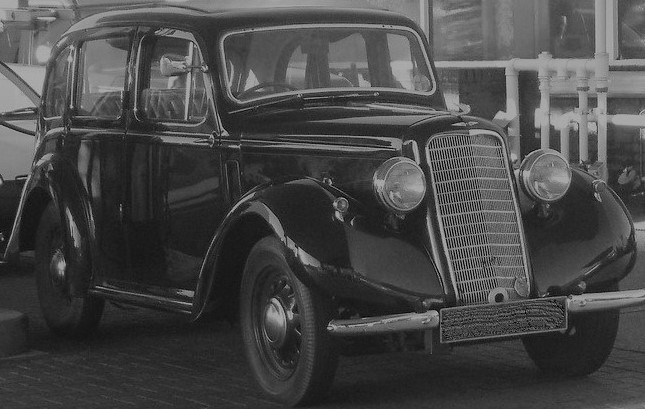
When I was just five or six years old my dad bought his first car – a 2nd (or maybe 3rd) hand 1936 Hillman Minx and on damp cold mornings it would often prove difficult to start. That’s when he had to ‘ca the haunle’ (use the starting handle). If you look carefully at the picture you can see an opening just above the front bumper, at the bottom of the grille. He would insert the handle through that and it engaged with the engine. If the battery was low, then that’s how folk started most cars back then!
I’m sure you can imagine how dispiriting that could be on a cold wet morning. If the engine was flooded with gas then it could backfire and could easily break your thumb if you weren’t holding the handle correctly!
But very few people we knew then in the late 1940s had cars so we were lucky. I remember many excursions to local beauty spots and beaches, although we often had stop along the way for Dad to tinker with the Minx – it was well named – –
He needed a vehicle for his work as a self-employed painter and decorator, and he moved on to more reliable transport over the succeeding years, but I have fond memories of that first one.
Guest review by Janelle Bailey, retired Literature teacher.
This book was recommended by a friend and former colleague when I shared via social media a photo of a short stack of “to reads” I’d collected aimed to help me learn more about not only Ukraine and its people and literature but also about the people and literature of the surrounding countries as well, while brushing up on my geography to do the initial research.
Westerlund’s book was then added to the stack and was the first that I pulled to read. Her book was published in 2019, so it was written prior to the current crisis in the Ukraine, but it provides some great background on and understanding of Ukrainian culture and life there, valuable to anyone wishing to understand better Ukraine and its people, which helps any of us to better empathize with the current crisis there.
I very much enjoyed the sincerity of this story and Westerlund’s honest conveyance of her cross-cultural experiences; she was born in 1973 and left Ukraine in 1995, and she highlights aspects of her life prior to 1995 and which became part of her Ukrainian self, as well as developments since 1995 and which have helped to develop her Ukrainian-American self. Additionally as she is first teaching, and then marries and raises her two American sons, she is often still feeling at times that she is straddling that cultural divide. And I suspect that this is all a new struggle as well, as far away as she now lives from “home” and much of her family yet, and as real their daily challenges currently.
The more I read, though, the more I felt that while Westerlund describes much of this as Ukrainian culture vs. American culture, there are so many things that are handled differently from family to family or region to region even right inside of the United States, such that it is possibly easier to confront and define and address them when the two parties are from different countries than it is when they are both American, say, but raised with different values, different traditions, etc. There is a certain respect for another’s actually different country and its culture and customs that is almost easier to learn about and from and ultimately respect than when it is just differing family practices, traditions, customs and all within the same country/state/community. I see these latter differences leading more often to conflict and arguments than the learning and understanding and acceptance of those differences that can come with the former.
Probably my favorite part of the book, personally, was when she discussed the difference between direct and indirect communication, her having to learn to value “small talk,” for instance, and also explaining that as a cultural difference. And I thought, whoa…this is a difference among individual Americans as well…and very much leads to the same kinds of conflict Westerlund describes, the misunderstandings and the confusion. I thought about how much more I value and honest and sincere conversation than someone asking “How was your weekend?” and not even expecting much as thoughtful return, much like asking, “How are you?” but not truly wanting to know. My recent reading of The Collaborative Way and its principle of “generous listening” has prompted me to evaluate conversations in a whole new way. Westerlund has done all of that work as well.
I also very much appreciate her humor, her inclusion of recipes and food traditions—I actually successfully made and served my first Ukrainian Easter paska last weekend using the recipe Westerlund shares in the book. It’s yummy and pretty! And I appreciate her vocabulary and storytelling voice…and her heart. Ruslana Westerlund is a smart, strong woman, and most will gain much from reading this. I am very pleased to have read it…and look forward to making some borsch as well and to reading Westerlund’s next book, whenever she finds time to write that now that she has become the voice of Ukrainian-Americans and organizer of numerous relief efforts, as well as a speaker-in-high-demand during this new crisis.


 Wendy Welch: Books, Yarn, Cats, Opioids