
The Monday Book: DELAWARE BEFORE THE RAILROADS by Dave Tabler

The Monday Book comes from guest author Dave Tabler this week, author of a new book about the state of Delaware.
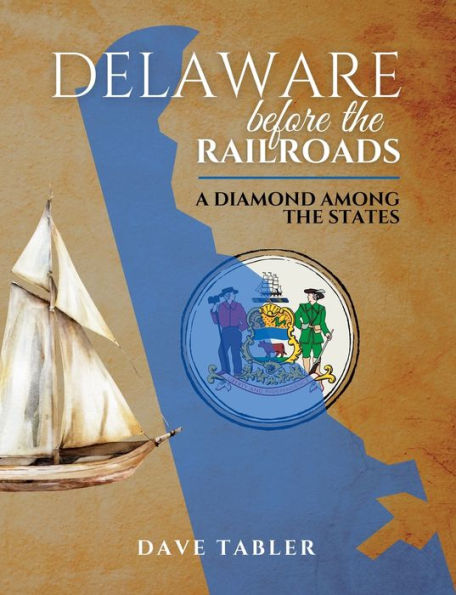
What are my three biggest influences as a writer of history? Ripley’s Believe it or Not, Paul Harvey’s “Rest of the Story” radio show, and my 8th grade geography teacher, Mr. Jarboe. Ripley’s, because Robert Ripley was able to boil down the essence of a historical item into one cartoon panel visual; Paul Harvey because of his ability to lead the listener right up to the cliffhanger, leave them gasping for air during the commercial break, and then resolve the rest of the story very neatly in a minute or two. And Mr. Jarboe, because he used the clever hat trick of telling the story of famous people through their teenage eyes. Which of course appeals endlessly to 8th graders! I wanted to create a history book that has the stunning glossiness of National Geographic photography, coupled with event driven narrative that gallops along in ‘you are there’ first person. I wanted to work in an overall style that seduces the reader with a sense of just how familiar the lives of those from long ago feel once you get past the funny speech and the strange clothing. I’m not a Delaware native, and I’ve only lived here for 12 years. But the advantage of seeing this place as an outsider is that I notice things locals take for granted. How fascinating that “the penman of the American Revolution,” a close friend of Thomas Jefferson and George Washington, hailed from Dover! That Delaware’s early history is in fact the nation’s early history in miniature! In “Delaware Before the Railroads,” I’ve avoided footnotes and a professorial tone. I want my reader to feel that history is not reserved for ivory towers and dusty bookshelves, that history is a living thing that informs who we are and how we got here, and told right, can help guide us toward how we might develop next as a culture

More Ice, Sir?

Jack gets over the line in time, for a change – –

My cousin Donald is the family historian and posted this today – So I had an ancestor who survived the sinking of the Titanic!

This post is for my Beck cousins in the main, and anyone who is interested in the sinking of the Titanic and the Battle of Jutland.

My great great grandfather was William Beck or Back, born in Musselburgh in 1843. He was one of eight, and was the second youngest with a younger brother Andrew who was born in 1845. The family appears to have changed the spelling to Beck in the 1860’s. Thus William was married in 1864 under the name of Back to Janet Sutherland but from the census of 1871 onwards he used Beck as his name.

William and Andrew appear to have been close as they both trained as House Painters in Edinburgh before converting to Ship’s Painters. They are resident together in Dumbarton in the 1871 census where I believe they worked in the Denny shipyard. They both took painting contracts in the Hampshire shipyards and one of William’s daughters married on the Isle of Wight, whilst I now know that both of Andrew’s daughters, Janet and Mary Beck, lived in Southhampton.

Janet Sutherland Beck (named in honour of her aunt) was born in Musselburgh in 1869 whilst Mary Beck was born in Dumbarton in 1871. Janet married Southampton man, Henry William Candy in Southhampton in 1887, and they had ten children before he died in 1915. She re-married Charles West in 1919 and died in Hampshire in 1929. Mary married Frederick Griffiths in 1891and had five children.

The eldest daughter of Henry Candy and Janet Sutherland Beck was Henrietta Janette Candy. She married Albert Charles Edward Self in May 1912, just a month or so after the sinking of the RMS Titanic. Albert Charles Edward Self was a stoker or ‘fireman’ on the Titanic.

Details of A C E Self are found here https://www.encyclopedia-titanica.org/…/edward-self.html

Who knew that each Titanic survivor has his or her own web-page!

The eldest son of Henry Candy and Janet Sutherland Beck was Andrew William Charles Candy. He joined the Royal Navy in 1911. from 1912 to 1918 he was a stoker on HMS King George V which was a super dreadnought and flag ship of the first battle squadron at the Battle of Jutland in 1916 (which was not heavily engaged in the battle it has to be said).

I’ve got photos of Janet Sutherland Beck and her second husband Charles West. I’ve also got a photo of Albert Self. I think I can see Charles and Janet, and other English relatives in a photograph of my great grandparents John and Georgina Beck, taken in Hampshire in the early 1920s. Always wondered who they were.

I believe I am named after John Beck of Hampshire although I’ve always been known as Jack.