
Revolutionary Thoughts – – –

Jack easily makes it in time again – –

I really don’t want to write anything about Covid 19 so last week I wrote about my wee parlor guitar. This week it’s about a different and equally beloved piece of musical equipment –

phono

Many years ago I had a hankering for a wind-up gramophone (phonograph over here). So Wendy announced before one Christmas that we were going on a trip. She had done some research and found a gentleman who collected and sold ‘old technology’. He lived in a big old mansion house south of Edinburgh and he welcomed us graciously when we arrived.

The basement area was a warren of passages and side rooms that were probably originally cold storage for food etc. Each room had a different kind of ‘stuff’ – radios, TVs (including mechanical Baird Televisors), Medical equipment, telephones, scientific instruments – and on and on!

Eventually we reached the room with gramophones. Everything from old cylinder machines to 1960s Dancettes.

I had already gathered a fair collection of old 78 rpm records, everything from old Scottish traditional performers to Glenn Miller. But I wanted the kind of machine they were intended to be played on.

We chose a lovely old HMV machine and agreed a price. The gentleman then insisted on giving us a free box of needles too (I still have most of them).

For any readers not familiar with these machines – the turntable is driven by a powerful spring which is wound tight by the handle on the side. The needle picks up the sound vibrations and a diaphragm makes them audible, then feeds the sound to a horn. In my gramophone the horn is built in and opens behind two doors on the front. The doors are, effectively, the volume control. There are two levers beside the turntable, one controls the speed of rotation and the other is a brake which turns the rotation off or on. There’s no electricity involved at all.

The great thing is that my old 78s sound exactly as they should.

I often wonder about the previous owners, what they played on it and whether it had pride of place in their houses – I like to think it did, just like here!
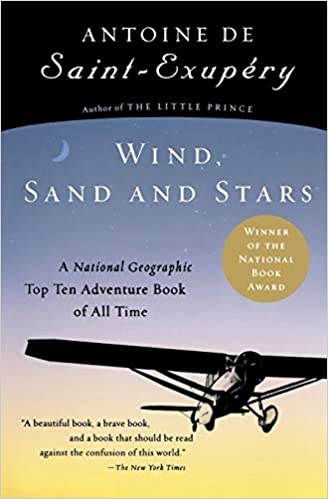
The Monday Book – Wind, Sand and Stars

Jack gets to write today’s book review –

Wind, Sand and Stars – Antoine de Saint-Exupery

wind

Some years ago Wendy and I watched a movie called ‘Wings of Courage’ at the IMax theatre in Chattanooga. It told the story of a pioneering mail flight across the Andes from Chile to Argentina that went badly wrong. The pilot was called Guillaumet and he crashed in the mountains and had to walk over many days through the snow to reach safety. What I didn’t know was that the story was based on a chapter in this book.

As an enthusiast for anything to do with early aviation, I was delighted when Wendy handed me the book from some (pre-quarantine) thrift store outing. She thought I’d find the book interesting and she wasn’t wrong. Saint-Exupery’s writing is wonderful and the translation by Lewis Galantiere does it full justice. The author describes his own experiences as one of the early aviators opening up mail routes around the world – particularly in North Arica and South America. His descriptions of the perils of flying at low altitude and before the days of navigational equipment are amazing and nail-biting.

As I finished the chapter about Guillaumet’s experience in the Andes we watched ‘Wings of Courage’ again on line and it proved very true to Saint-Exupery’s telling of the story. When I came to the final chapter, I was once again blown away as the author described crash landing in the Sahara. He was trying for a record flight between Paris and Saigon and got lost as he was heading for a stopover at the Nile. He plowed into a hill top destroying the plane, but miraculously escaping injury along with his engineer. They struggled for days finding a way to rescue with very little food or water, almost exactly replicating the earlier Andes story, but with sand instead of snow.

The book, however, isn’t all about flying. There’s a good deal of philosophizing about the meaning of life, the relationship between people and peoples, and the futility of war.

I think the only thing that might bother anyone reading the book might be the authors views on the effect of technology on humanity. He appears to view all technological advance as completely benign but I suppose we have to allow for when the book was written.

‘Wind, Sand and Stars’ finishes with the author visiting Spain during the civil war and ruminating on the way a community can be so easily and sadly divided.

Many people know Saint-Exupery best as the author of the children’s classic The Little Prince. He flew a reconnaissance mission over the Mediterranean in 1944 from which he never returned.