
The Monday Book – Forgive Me, Leonard Peacock by Matthew Quick

Guest review by Janelle Bailey, retired Literature teacher.

This title popped up on Libby recently, as I sought a new audiobook to read while walking (LOVE that I can be reading two books at once that way, one in print and one audio). I had not heard of it, yet I am SO pleased to have been handed it this way. Everyone should read this one.
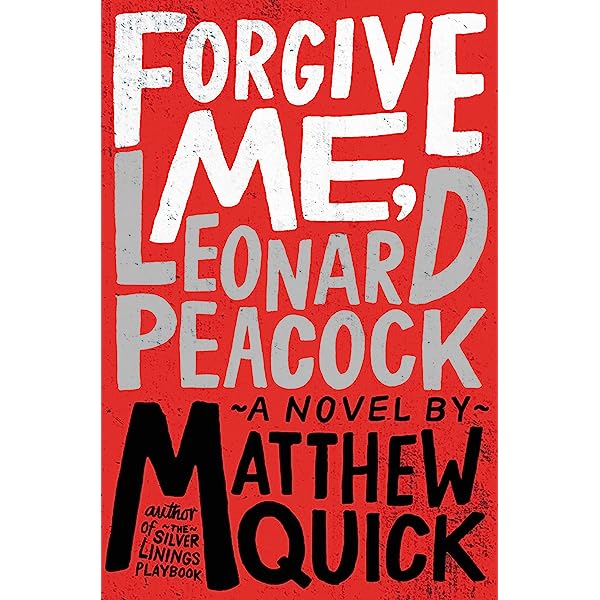
Leonard Peacock, high school senior, has very clearly been neglected and left to his own devices, left ON his own to take care of himself by two parents too full of themselves and too selfish to address their son’s daily care with the devotion demanded. Honestly, Leonard’s not asking for much–just his parents to, well, “parent.”

Thank goodness he has other caring people in his life, including an elderly neighbor Walt, a social studies teacher Herr Silverman, and his AP English teacher, his counselor, a couple of others. Nobody really has daily duties for supervising Leonard, but each of these adults are attentive to him and notice the changes in his behavior that are alarming.

And Leonard is an interesting young man himself. He’s bright, well read, and conducts interesting humanities experiments, occasionally skipping school to put on an old suit, ride the subway, and follow for a while some sad adult to see yet another life he does not wish to grow up and into himself.

Not all readers will love the initial setup for this story, but that should not deter a single one from reading it in its entirety. Quick is a smart writer, and Leonard’s story is an important one.

The Many Daughters of Afong Moy by Jamie Ford

Guest review by Janelle Bailey, retired Literature teacher.

Like many readers, I’ve waited for a long time for Jamie Ford’s next book, after enjoying very much his Hotel at the Corner of Bitter and Sweet.

I was not disappointed.

For me this was David Mitchell’s Cloud Atlas meets Matt Haig’s Midnight Library meets that idea (that I treasure and relish much more than my five daughters may currently) that we women were eggs in our grandmothers’ bodies as well when they carried our mothers into life.

Seven women, Afong and the six generations of daughters who descend from her, are the main characters in this book, which chronicles their intertwined lives from the 1800s well into a future decades from now.

Ford very richly brings Afong, thought to be the first Chinese woman in America—everyone gawking at her bound little feet, actually paying to see them and her, as she is shown, displayed for paying spectators, somewhat like a museum exhibit, but she’s not wax! This is wrong all along—to the US from China in 1836.

Then he weaves the stories of her daughter and her daughter and her daughter…you get it (and you know I’m no spoiler! You need to read it yourself)…through different eras and countries and lives…but each of them with Afong thread through them, to Annabel’s story in 2086. We see nearly every woman as both mother and daughter…carrying their pasts on through their futures and their legacies.

And there’s even a bit of sci-fi, but the very digestible and accessible, if also at times troubling kind. Am I the only one who’d call The Handmaid’s Tale science fiction when Margaret Atwood wrote it in 1986 (or so, I think…and for as long as I taught it having to explain to students that none of that technology was readily available back then, even though they could not conceive of that when reading it in 2000-2017; Atwood was((ney, IS!)) simply that smart), and now a horror novel/historical fiction?!—for anyone first reading it in 2022 (and no longer sci-fi at all)? Sorry for that rant, but that’s how I see Ford’s sci-fi here: accessible, believable, makes some improvements and adds numerous ethical questions for real people to figure out.

There are layers. If you know my reviews and me, you know this matters. There are ponderings of spirituality—Buddhism, even, the consideration of karma, contemporary as well as classic poetry, and much, much more. The stories are rich, each of them. Maybe the characters are more similar than uniquely themselves, but given that they’re all connected, genetically, that’s less a criticism than explainable. They each have their own row to hoe, but they are never completely alone to hoe it.

I say: read it. Then let me know, please, when you have so that we can chat about it. That’s always my favorite part of every book.