
The Monday Book – The Last of the Tinsmiths

The Last of the Tinsmiths – Sheila Douglas

Jack gets to do the Monday Book this week –
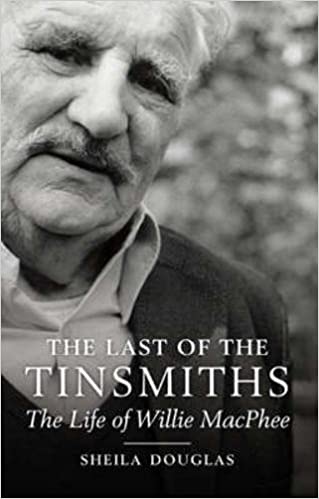
I should start by saying that I knew both the author and subject of her book. Sheila Douglas was an academic expert on the life of Scottish Travellers and their culture. Her house in Scone was a meeting place where Travellers were frequently brought together with visitors from all over the world.

Willie MacPhee was one of her favorite source singers and interviewees; I met him many times, sometimes at her house, often at traditional music festivals and also at his trailer outside Perth. When he passed away I attended his funeral at a small Church on the banks of Loch Lomond.

The book grew out of Douglas’s research for her PhD, but there’s nothing dry or academic about it. It’s very obviously a labor of love. Willie was a singer, a piper, a tinsmith and a storyteller and closely related to many other notable carriers of those traditions. The author pays due attention to them as well throughout.

Included are a number of his stories. Douglas has been careful to set them out exactly as he told them. She also describes his life in his own words and keeps her observations quite separate.

I first met Willie at the parking place on the road to Fort William where he entertained the tourists dressed in full highland costume and playing his pipes while his wife sold bunches of white heather. Every time I’ve been back, since his passing, I still see him in my mind’s eye.

I enjoyed this book and can recommend it without reservation.

The Monday Book: ALL THE LIGHT WE CANNOT SEE by Anthony Doerr

Perhaps I enjoyed this book so much because it broke one of the cardinal rules of fiction: continuity in a narrative arc. The book time jumps and it has chapters that are two pages long, tiny vignettes in larger lives. And it WORKS!

The topic is tried and true: World War II. The book follows two teenagers: a blind girl whose father is a museum employee in Paris tasked with protection of a rare gem; and an orphaned boy in Germany whose aptitude for all things electronic sends him to an elite school for boys destined to be leaders in the Reich.

Both kids are hampered by something significant, navigating one of the most dangerous and heartbreaking times in Europe. And both are trying to have actual lives, not recognizing that they are pawns to other people, seeing themselves as themselves–although Werner starts catching on toward the end of his years in the school, as Germany begins to lose the war. It’s interesting how human Werner is, absorbing terrible cruelty as part of his education but beginning to wonder what’s going on when the electricity is rationed. He’s still human, and humane, but he’s not challenging the order from his powerless position, because he knows what will happen if he does.

Marie-Laurie is 11 and a pampered child who doesn’t understand why they aren’t sleeping in a bed when her father leads her out of Paris. He makes models for her of the towns they live in, and as far as he can teaches her to be self-sufficient. The rumors of Germany disinterest in accommodating handicaps is a rumbling undercurrent in her confinement as the war roils around her. Mostly she is interested in the same thing Werner is: eating, learning, and whether her immediate family is all right.

After fleeing Paris to the seaside town of St. Malo, Marie-Laurie and her father (who is arrested and sent to Germany) at first settle in with an eccentric uncle and his very smart housekeeper. The housekeeper is organizing resistance activity, and the radio hidden in their attic becomes a key component of all the futures of characters in this novel.

Piecemeal and brilliant in the way the novel uses chaos to narrate chaos, All The Light We Cannot See is driven by characters, which is my favorite kind of novel. What they want and what they value drives their decisions: the housekeeper feels like a girl again as a 74-year-old resistance leader unsuspected because of her age. Werner wants to be able to look his little sister in the eye again after living as a Nazi. Marie-Laurie knows she can’t have what she wants, which is her father to return. And one of the Nazis wants the rare gem Marie-Laurie’s father took with him from Paris. Who gets what they want, and who doesn’t, makes for a rich read. Highly recommended.