
The Monday Book – Born Fighting – Jim Webb

Jack’s job is the Monday book this week again – so a day late of course – –

I may have reviewed this book some years ago, but there’s nothing wrong with revisiting a book!

When I first read the book I was impressed, first of all, with the description of early Scottish history and then with the history of the ‘Scotch Irish’ in Ireland.

On re-reading, though, I have some doubts. I read ‘Wales – A History’ recently and that sheds a rather different light on the early history of the Celts (or Brythons) and that paints a contrasting picture. The lowland Scots, who were Webb’s ancestors, were part of the Brythonic culture and spoke Welsh rather than Gaelic or Scots. He doesn’t really cover that period well.

Then his coverage of the lowland Scots in Ireland seems to me now to be written strongly from a Protestant point of view and is rather condescending about the majority Catholic population. There is only passing reference to the Potato Famine which was effectively a British ‘pogrom’ against the inhabitants of the country and hugely important.

The book isn’t just a general history, but a very personal history and it’s important to bear that in mind. Webb’s roots are in Appalachia and he really starts from there and weaves everything around that. There’s no doubt that he set out to place himself in that context and that’s fair enough.

Webb writes well and Born Fighting is an easy read, however I would strongly recommend reading other books about the history of the Celts and the Appalachians alongside this one.

Wales – A History – Gwynfor Evans

The Thistle and the Brier – Richard Blaustein
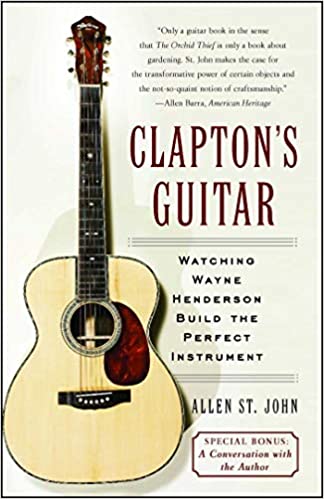
The Monday Book – Clapton’s Guitar

Clapton’s Guitar (Allen St. John)

Jack presents the Monday book today

As I’m a bit of a guitar freak, I looked forward to reading this and I wasn’t disappointed. However, I do have a few caveats –

First of all, despite the title, this isn’t a book about Eric Clapton – he makes no appearance. This book follows master guitar luthier Wayne Henderson as he builds two nearly identical guitars. One is being made speculatively for Clapton while the other is to auction off and raise money for Junior Appalachian Musicians (Jam). Jam was the brainchild of Henderson’s late partner Helen White and there are branches throughout Appalachia.

This brings me to my second issue with the book. There’s hardly a mention of White or JAM in the book, which strikes me as very strange. I have seen Wayne and Helen perform a good few times together and their individual activities were very much intertwined.  Perhaps she declined to be involved; I don’t know. I only know Henderson by reputation, whereas I had a friendly and mutually respecting connection with White through providing advice on tutor training for JAM. There’s no report in the book of how much went to JAM or whether any did.

I’m also not impressed with the way the author describes the various characters who hang out regularly at Henderson’s workshop. There was more than a hint of Appalachian stereotyping and condescension. For example, eating cold fast-food and the famous tail out of the box trick.

Aside from these issues, the book does describe wonderfully how Henderson puts these guitars together, where he gets his wood, the tools he uses and the sheer craftsmanship involved. This I found truly fascinating. I won’t give you a spoiler on whether Clapton bought the guitar.

The author is also a guitar freak, and he references many other excellent and well known luthiers, such as T. J. Thompson (I’m surprised he didn’t include Dana Bourgoise in Maine or Chris Bozung in Nashville.)

If your interest is in how a top notch luthier puts together a hand crafted guitar, then I can thoroughly recommend this book. Just ignore the ‘local color’ and wait for another volume that should be written about the life achievements of Helen White.