
The Monday Book – Americans in Paris

Jack gets to do the Monday book review this week –

paris

Americans in Paris – Charles Glass

Some years ago I met up with a fellow Scot and close friend who was in the middle of a French adventure. We met in Vichy on Bastille Day and helped the locals celebrate into the wee small hours. The following day we took a train down through the Massif Central to Bordeaux, sharing our compartment with an elderly couple. As we passed through various small towns they pointed out walls where ‘resistantes’ had been shot, but also where immediately after the war ‘collaborateures’ had also been shot. Vichy, of course, was the Capital of the collaborating French government under Marshal Petain.

So Glass’s book which chronicles the experiences of a wide range of US citizens in the lead up to, and during world war two and who lived in Paris during that time was a fascinating read.

There are a number of intertwining stories throughout – The American Hospital, Shakespeare and Company bookstore and the political machinations of the Vichy government are the main ones. The hospital and the bookstore somehow managed to continue, even after the US declared war on Germany. They become important waystations for escaping British and American soldiers and airmen, and their directors took enormous risks.

The writing is engaging and based on well documented research.

I knew very little of the tensions within the Vichy regime or between it and the German government, far less the attitude of the US towards Petain and Laval and their rivalries. Glass’s book, therefor, filled in many gaps in my knowledge.

Although I found the many personal stories of individuals intriguing, I think it was reading them within the broader political and wartime context that really caught my attention.

I thoroughly recommend this to anyone with an interest in France, Paris or the politics of the period.
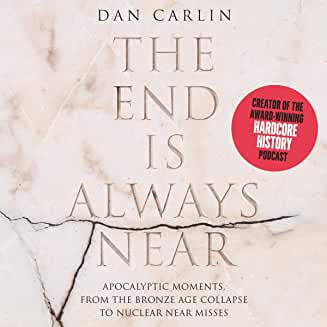
The Monday Book: THE END IS ALWAYS NEAR by Dan Carlin

The endThis week’s Monday book comes courtesy of Paul Garrett, who has a wicked sense of humor….

While the headlines of the day may have us fighting over toilet paper at the big box store and thinking of mortgaging the house for a bottle of hand sanitizer, it’s easy to assume we are facing a unique threat. The fact is throughout human history we have always been walking a knife edge between chaos and order.

Dan Carlin, famous for his long-winded (up to six hour) Hardcore History podcasts has written a relatively short-winded book about the history of the world from the perspective of disaster. Running just over 200 pages, The End is Always Near (Harper Collins, 2019) makes the point that though we may live in self-assured tranquility (up until about a month ago) from an historical perspective mankind is never far from disaster.

Much of the book’s narrative is spent on three topics: The first is the so-called Bronze Age Collapse, when civilization, after centuries of advancement suddenly and without explanation imploded and fell into a dark age. Another topic, which could have been written yesterday, covers the frequent scourge of pandemics: from the Black death to smallpox to the so-called Spanish Flu. That pandemic alone killed between fifty and one hundred million people world-wide in a period of about 24 weeks in 1918-19.

In a chapter entitled The Road to Hell he discusses the nuclear age and the deadly math of the war planners who believe the way to shorten war is to kill as many people as quickly as possible. The calculation is that many more lives will be saved by bringing the conflict to a quick end. He asserts that the threat of nuclear annihilation may have prevented many deaths as the nuclear powers have been loath to engage in large scale so-called kinetic action for fear of driving their enemies to the nuclear button. Instead we have opted for proxy wars where we encouraged various client states to do the fighting for us.

He gives barely a nod to Climate change, stating that whatever destruction it reaps will take place over decades or centuries while this book is about things that can wipe us out in weeks or milliseconds. We have only to notice how the Chinese Corona Virus has swept climate change off the front page to see his point.

The book has footnotes on almost every page, some with more text than the narrative, as if it were written by someone who forgot to take their Adderall. It is a warning to people whose most dire concern up until a month ago may have been who would “Like” their latest Facebook post. It serves as a reminder (as if the morning’s headlines weren’t enough) that no matter how secure we feel in our Mc Mansions with all the modern conveniences, there are dragons lurking out in the darkness.