
Jack creeps in late again – his Wednesday guest post – – –
Little pot stove.
We have been using our recently installed small woodstove the last few days and it’s working beautifully. Our friend and neighbor Nate did a great job of getting it and the chimney in place, all according to best practice fire safety and local ordinances. (One should not necessarily be confused with the other….)
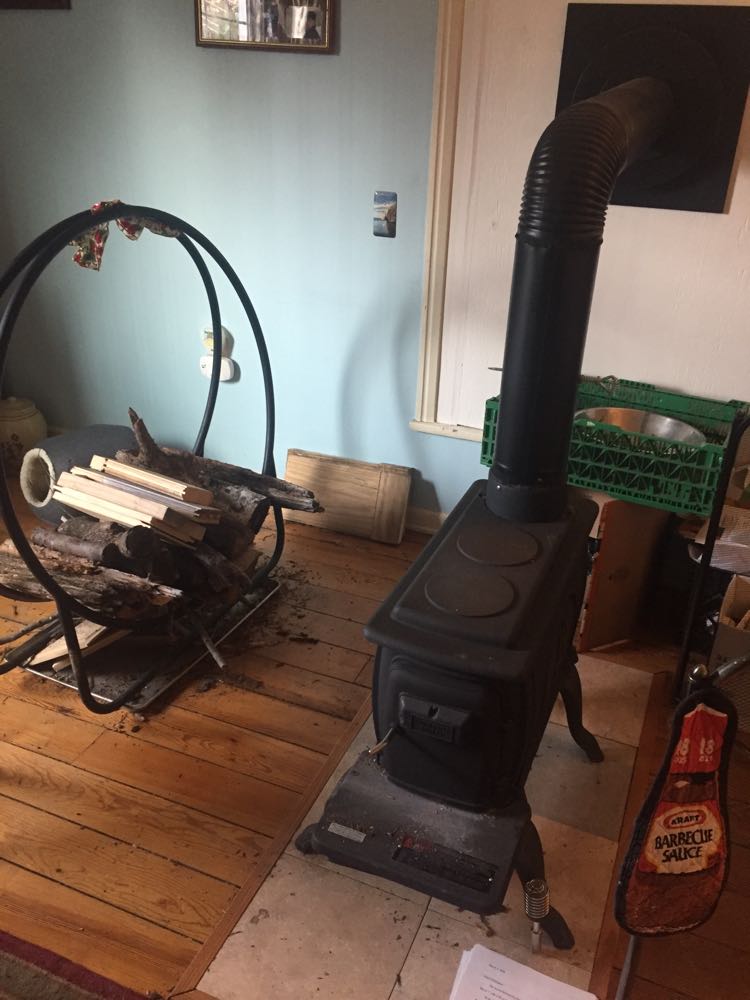
The only thing that still puzzles me is that the lighting procedure is upside down – you put the paper and kindling on top of the logs. Counter intuitive.
Using the wee stove reminds us of one of our favorite singers and one of his songs – Nic Jones and ‘The Little Pot Stove’ on his final album ‘Penguin Eggs’ (a quote from that song).
“In that little dark engine room where the cold seeps in your soul, how we huddled round that little pot stove, that burned oily rags and coal” The song is oddly pragmatic in its wording, and has reduced many an audience to tears with its sense of community. Beneath the simple survival techniques of these people in the biting winter isolation, is the sense that sitting together is part of what warms them. It’s a surprisingly beautiful song, one of Wendy’s all-time favorites. (She says it reminds her of camaraderie in the graduate student lounge at Memorial University in Newfoundland, where she did her PhD and summer was August 8-12.)
The song was written by Harry Robertson, a Scot who had emigrated to Australia and worked at the whaling station on South Georgia. The song mentions ‘Leith Harbour’, which is in Stromness Bay in S. Georgia. Wendy and I are very familiar with both Leith near Edinburgh and Stromness in Orkney.
Harry worked as an engineer on the engines of the whaling ships when they came into the harbor, and would take a small stove with him because the cold was so severe.
Nic changed ‘wee pot stove’ to ‘little pot stove’ but everything else is as Harry wrote it. The original LP by Nic didn’t credit Harry, but we’re pleased that that was corrected when it was released as a CD.
After Harry recorded his song, it was covered by another Scots emigre to Australia, Eric Bogle. I’m pretty sure that must be how it came to Nic and then – everywhere. It really is a catchy tune, and for those who have lived in places where huddling around a stove was part of the daily grind, well, it is quite meaningful.
Harry Robertson’s recording – http://www.harryrobertson.net/sound/WCM_Wee_Pot_Stove.mp3
Nic Jones’ recording – https://youtu.be/1FUzTQe72FU
PS – Nic was very seriously injured in a car crash shortly after a tour of Scottish folksong clubs and festivals. I spoke to him a number of times about his particular guitar tunings and playing style on these occasions and he was very willing to explain them to me. Although he can longer play guitar he sometimes sings with his son backing him.
Nic with son – https://youtu.be/saYFs2yRyBQ
 Wendy Welch: Books, Yarn, Cats, Opioids