
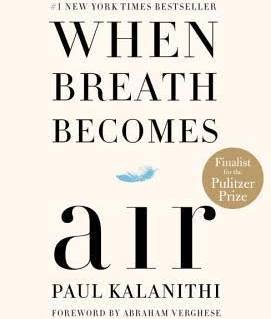
The Monday Book: WHEN BREATH BECOMES AIR by Paul Kalanithi

breathA surgeon used to the negotiation between buying people time and curing them suddenly finds himself in the same position. And sums up the advice he’s been giving, the thoughts he had on this moments, from both sides.

One of the central themes of the book is “when you know you’re going to die, what do you spend your last year or two doing?” In that framework, Kalanithi’s writing moves between poetic and lyrical, and surgically precise.

He struggles with returning to work, and someone says this to him:

“That message is simple: When you come to one of the many moments in life when you must give an account of yourself, provide a ledger of what you have been, and done, and meant to the world, do not, I pray, discount that you filled a dying man’s days with a sated joy, a joy unknown to me in all my prior years, a joy that does not hunger for more and more, but rests, satisfied. In this time, right now, that is an enormous thing.”

That one’s lyrical. Then he and his wife (who were having marital problems coping with their dual schedules as medical residents, drifting apart in exhausted frustration) have this exchange, after they decide to go ahead with trying for a baby once they know he’s sick:

“Will having a newborn distract from the time we have together?” she asked. “Don’t you think saying goodbye to your child will make your death more painful?”

“Wouldn’t it be great if it did?” I said. Lucy and I both felt that life wasn’t about avoiding suffering.”

Surgically precise.

The book was Kalanithi’s dying wish, and that is actually recorded in the book when his wife Lucy takes over, and recorded in the afterword as well. The afterword makes clear that, had there been more time, more editing might have occurred, and that the book as it reads is a singular walk less than a full narrative. Paul was concentrating on Paul, which makes sense.

Even then, there are several magic helpers in the book, although they appear but briefly. Most notable are Lucy and their oncologist (and the subtle between-the-lines understanding of what the couple are dealing with when colleague and friend becomes doctor).

Although this book is about dying, the “both sides of the desk” nature of it, reminiscent of Jill Bolte Taylor’s My Stroke of Insight, is a rare peep into a world none of us are too keen to explore: what happens when death happens to you? When you know the diagnosis but not the timeline, and when you have advised hundreds of people in the same position? What do words mean, actions mean, family mean, when you are the one making the singular journey?

Highly recommended.

THE MONDAY BOOK: Alas Babylon by Pat Frank

Thanks for the week off, everyone. We really enjoyed spending time with friends in a remote location. And now, back to business as usual. We appreciate Paul Garrett sending a review for this week’s Monday book.

Alas, Babylon

Alas, BabylonYoung Greta Thunberg was catapulted onto the world stage a few weeks ago when she addressed the United Nations General Assembly about the “existential threat” of climate change. Those of us who lived through the fifties, sixties, seventies and eighties remember another “existential threat,” that seemed at the time to be more ominous and unquestionable.

Pat Frank’s novel Alas, Babylon (Harpers, 1959) was one of the first of many books, like Walter Miller’s A Canticle for Liebowitz and The Fate of the Earth, by Johnathon Schell that attempted to come to grips with the looming threat of nuclear war.

A writer friend mentioned this book to me a few months back when a particularly prickly situation with Iran was playing out in the Persian Gulf, a place with which I became intimately familiar back in 1988. Apparently, the book was required reading in some high schools back in the day, while I was forced to read A Separate Peace and The Red Badge of Courage, two other anti-war novels, which begs the question; were all English Teachers pacifists back then?

Written in the heat of the cold war (pardon the pun) a few years before the Cuban missile crisis, the premise is that an errant missile fired by an American pilot devastates a Soviet base in Iran, launching the world into an atomic conflagration. Virtually all the major American cities are devastated, leaving a small backwater town in North Central Florida relatively unscathed. As the novel unfolds, the residents are forced to deal with the after-effects of the calamity, when they are cut off from what is left of the world.

Frank’s novel was written in an era when people were expected to be relatively well-behaved. Most of the looting in the book takes place off the page and the lone set of thugs who threaten our heroes are dealt with swiftly, despite some collateral damage. This was before things like hurricane Katrina, the Mad Max franchise, and Cormac McCarthy’s desolate novel The Road demonstrated what the end of civilization could really mean.

There are some quaint passages, as when a woman’s abortion is referred to as “a mistake she will never make again.”

Alas, Babylon avoids the preachiness of other anti-nuclear books of the age, perhaps because in the 1950’s, when school children regularly practiced hiding under their desks, home fallout shelters dotted the landscape, and Civil Defense air raid drills were carried out on a monthly basis, nuclear war was a foregone conclusion.

Pat Frank died in 1964, a good twenty-five years before the Soviet Union collapsed after rotting from the inside, and the threat of nuclear war was put on the back burner. One can’t help but wonder what he would have thought.

Nowadays worries over the horror of nuclear war are all but forgotten along with many other bugaboos and jeremiads about things that could really happen and are just around the corner and threaten life as we know it. It seems the end is always near. Nor is chronophobia a recent phenomenon, as pointed out in what is reported to be an old Scottish prayer: “From ghoulies and ghosties and long leggedy beasties and things that go bump in the night, Good Lord, deliver us.”

While we know that over 250,000 people were incinerated or left to die a slow excruciating death at Hiroshima and Nagasaki, there is little direct evidence so far that anyone has been killed by climate change.

It seems that whether it is nuclear war, acid rain, the ozone hole, the coming ice age, global warming, creeping socialism, or the threat of a second term for Donald Trump, powerful people are always trying to scare us into doing their bidding.

As it turned out, it wasn’t nuclear annihilation that threatened to bring us to our knees but a sneak attack from an unexpected quarter, or as Toby Keith famously sang; “A mighty sucker punch came flying in from somewhere in the back,” on September 11th, 2001. So, while it may be true as the aphorism says, “Ninety percent of the things you worry about never happen,” we might add, “…but beware of those things you never see coming.”