
The Monday Book – Nazi Gold

Reviewer is Jack Beck

Today’s book is Nazi Gold by Tom Bower (Harper Collins 2001)
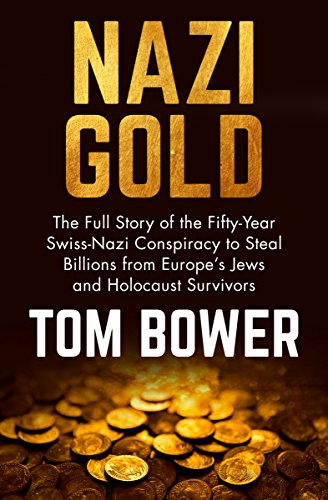
This is a very disturbing story of how Swiss bankers spent over fifty years trying to cover up their stealing of gold, jewelry and property belonging to invaded countries and holocaust victim’s descendants.

But it also tells another tale – of how anti-Semitic were Switzerland’s politicians, bankers and much of the general public, in parallel with other European countries before WW2, during it and for a long time after. The only country to emerge from this with any integrity was the US, where a couple of diplomats stood up to the prevailing ethos of not doing anything.

Bower explains very well what a strange country Switzerland is – a confederation that in some ways is very democratic yet is completely controlled by its banking system. For a very long time the bank’s secrecy and numbered accounts have been a haven for shady money from around the world.

The story includes refugees being forcibly turned back at the border by Swiss police into the arms of the gestapo, French police sending Jews to the death camps, British politicians refusing to help the survivors and descendants reclaim property, and bankers continually coming up with new ways of avoiding their responsibilities.

But immediately after the end of the war those same bankers were able to easily send money to Spain, Portugal and then to Argentina, as well as helping escaping Nazis with flights to Argentina. All part of the “we don’t talk about anti-Semitism” boys’ brigade.

During WW2 Switzerland was officially neutral, exporting important stuff to both sides and importing much needed goods from both sides, while surrounded by Germany, Italy and occupied countries. So it made sense for them to play the neutral card, which they had done for centuries. But the book details how stealing from the Holocaust victims eventually came to light and was such an embarrassment that they were forced to make amends.

This book is very well researched, with a copious section of references. If I have a reservation it would be the way that Bower has added what must be imagined facial expressions and tones of voice to what are simply printed transcripts.

If you are interested in Switzerland’s role in the Second World War then I can recommend this.

PS – As of 2020 rich individuals and their families have as much as $32 trillion of hidden financial assets in offshore tax havens, representing up to $280 billion in lost income tax revenues, according to research. Plus ça change, plus c’est la même chose.
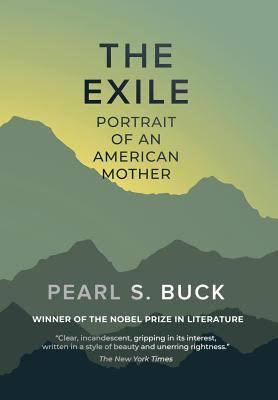
The Monday Book: THE EXILE by Pearl Buck

I picked up a set of Buck novels at a yard sale some time before the pandemic. And there they sat, until last month when I took The Exile to a conference with me.

The Exile is what I would call a character study. It is about Carie, a missionary in China who was a child during the American Civil War, and lives through both the Boxer Rebellion and the Chinese famine of the early 1900s. The story is told from someone observing Carie, occasionally slipping into first person and saying “I remember,” but usually a distant third person kind of narration. Not much dialogue appears in the book.

In fact, some 30 pages in I was tempted to set it aside, but something about the well-drawn Carie, mother to many babies only half of whom survive, a practical Christian less interested in prayer than feeding people, married to a man whose passion is for Christ—but then there are all those babies….

The story is told so subtly, how she winds up in predicament after predicament, some intense, some silly, a couple potentially lethal. As the young narrator describes how Carie faces down some threats, and flees from others, she continually builds up the practical wisdom and the sense of helplessness a woman of limited means and large heart would feel as she watched those around her starve.

Carie’s life with her husband Andrew is often glossed over, except that Andrew is the praying partner, and Carie feels a sense of ineptitude in her own relationship with God, when she sees the surety of Andrew’s. That said, it’s not a small part of Buck’s narrator’s voice that Carie is an amazing example of real compassion. At first I thought this was a story that told us about Carie rather than showed her character through dialogue and situations. But the more I read, the more I realized the subtle power of how Buck gets inside a female mind, displaying the power and prudence found there in understated ways.

The title is also a subtle pun, referring both to Carie’s life outside her beloved America, and her disquiet with traditional ways of expressing Christian devotion. She is an exile in many ways.

I’m not sure this novel would make a hit parade in modern times, but in 1936 it won the Nobel Prize. Modern readers will find flinch-worthy moments in relationships and assumptions between cultures.

In her day Buck was one of West Virginia’s most celebrated writers, and what is perhaps her best known work This Good Earth continues to be read in Classics classes. The Exile is quieter, more subtle, and yet somehow even more compelling. I never could resist a novel where character drives plot, and Carie is one of the most finely drawn, pencil-and-charcoal, light-and-shade characters Buck ever created. Highly recommended.