
The Monday Book: SULA by Toni Morrison

Sula is a tragi-comic book. Toni Morrison comes out with the best lines, told in this even pacing with no drama about the most dramatic subjects.

Age turns men’s lust to kindness about little girls in town. Two of them, Nel and Sula, are the ying to each other’s yang. While the book is named for one of them, it’s really a composite collection of characters: Shadrack, damaged by war and way too wise to be such a loose cannon; Eva, the misunderstood matriarch; Helene, “who won all social battles with presence and a conviction of the legitimacy of her own authority.” And Sula’s mother Hannah, who taught her daughter that “sex was pleasant and frequent, but otherwise unremarkable.”

The town of Medallion is divided into black and white residents, given the book’s timeline primarily between the world wars.

Overhanging the whole book is a miasma of “it doesn’t matter,” a kind of low-grade gloom summed up in the ways the characters expect or don’t expect things to happen. Morrison wrote it best: “They did not believe death was accidental—life might be, but death was deliberate…. The purpose of evil was to survive it and they determined (without ever knowing they had made up their minds to do it) to survive floods, white people, tuberculosis, famine and ignorance.”

The book is rife with sly humor. Sula makes the women in town mad, because, “She came to their church suppers without underwear, bought their steaming platters of food and merely picked at it—relishing nothing, exclaiming over no one’s ribs or cobbler. They believed she was laughing at their God.”

I laughed out loud at this book several times, which was frightening to the person seated next to me on the plane. Enthusiastic recommendation for reading Sula.

In closing, this is my favorite quote about Sula: And like any artist with no art form, she became dangerous.
Hello Neighbor

Kevin lived across the street from us. We saw him from time to time headed for his jeep, the same make as ours. We waved, he waved. Sometimes a black lab stayed with him and they played Frisbee in his backyard.

Dust and prisms

At night in our upstairs bedroom, we lowered the shade because light from Kevin’s desk lamp across the street fell exactly into our eyes as we lay in the big four-poster of our room. Kevin’s silhouette hunched over the computer; he didn’t have a shade. When one of us did an early dawn bathroom trip, Kevin was still there. We didn’t wave at night; that would have felt creepy.

At Christmases, we put a basket of baked goods on his porch. He put a nice card – the kind you buy special from Hallmark – on the windscreen of our Prius.

Kevin put up the Biden sign first, then we put up ours. They stood like pillars across the street from one another, flanking cars. We counted nods versus single-finger salutes.

And then one day I watched Kevin pull his car into the wide driveway of his home across from ours—and miss. Ours is a busy street. He backed up to try again as some driver whose time was more important than anyone else’s hit the horn to signal inconvenience.

Kevin took three tries to get into his drive. Days passed – almost a week exactly—before three cop cars parked alongside our house, another in his drive; no sirens blared. They weren’t in a hurry.

A few minutes later, Jack asked the policeman walking back to his car at the end of our driveway, “Is Kevin dead?”

The officer nodded. Jack didn’t want details and the police didn’t offer any.

The house went up for sale, listed cheap as “an excellent investment.” Every time we looked, hordes wandered about inspecting windows, tut tutting over the front lawn’s misshapen bushes, pointing at gutters dangling like accusations from the house. The realtor parked at 7 am and drove away at 7 pm; when it became evident the front door stuck, the savvy realtor left it open all day.

We wondered which ones would be our new neighbors.

The sign came down. Work vehicles arrived. The bushes were trimmed, front door replaced. Stuff began to appear on the front lawn, with a sign that said “FREE PLEASE TAKE.”

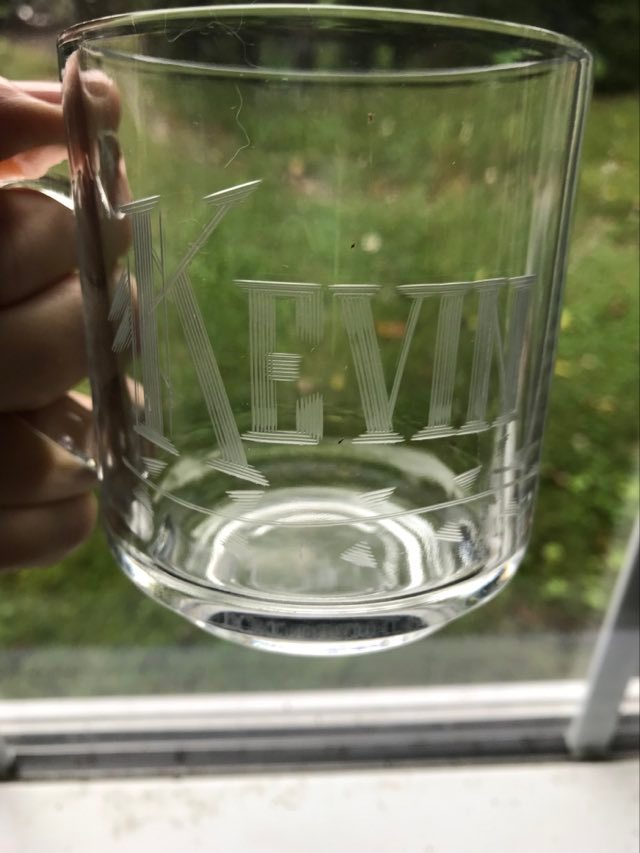
Jack and I watched people stop by and dwindle the pile. As dusk fell we walked over and looked at the remainder atop a ripped-out cabinet. And took home a small glass mug engraved KEVIN.

Kevin, we hope you enjoyed your life. Your mug on a shelf in our living room gathers dust and throws prisms. Life is like that, isn’t it? We will reach out to the new neighbors once they move in, because your mug reminds us to make friends while we can in this short dust-and-prism-filled life.