
A Real Lady

We’ve been very lax this week because of our 2nd vaccine shots – onwards and upwards – –

I was thinking about memorable folk I’ve met in my life and happened to look up at something on our kitchen wall. It’s a cushion cover, but no ordinary one! Hand made by a remarkable woman who had trained at the Slade School of Art in London.
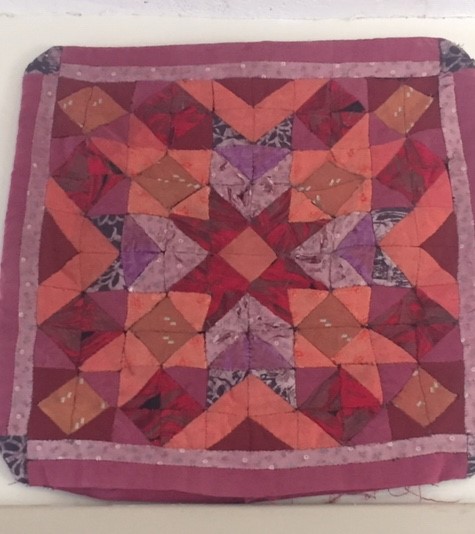
Nora Porteous came into our life via her son Lindsay who is also remarkable through his musical expertise. He and I wound up in the same traditional Scottish folk group and that’s how I got to know Nora.

She, her husband and children lived in the ‘hill-foots’ in central Scotland until tragedy struck and Nora was left a widow and almost penniless. She and the kids re-located to the beautiful and very historic village of Culross (pronounced Cooross) in Fife, which is owned by the National Trust for Scotland. Almost every Scottish movie or TV series you’ve ever seen set in the 1600s has scenes filmed in Culross.

Nora rented the ‘Tron House’ and rebuilt a derelict wash-house nearby for a studio and gift shop. She painted pictures, made things like our cushion cover, designed postcards and souvenirs for tourists. Right next door was the Palace with lovely original faded designs that she used as the basis for much of her work.

Tron houses in Scotland were set in the market squares and were where weights and measures were checked and agreed, so they were very important places. But Culross changed over the centuries and the streets and alleys gradually rose until the Tron House kitchen door’s stone lintel became lower. It was about a four foot space the time Wendy knocked herself out on it. When Outlander was filmed there we were amused to see the main players ducking as they came out the door. Some of them were big men, and we remembered how many times we’d seen stars as we forgot to duck!

Nora was intelligent, clever and savvy so she worked at using her academic and life training to survive and taught these skills to her kids as well.

We admired her for her ability to get up every time she was knocked down and her sense of place in the world. Whenever we visited for tea she produced her best china and silverware and observed every required rule – knives, forks and spoons carefully placed.

She was a lady for sure, and an important artist, but a survivor too!

The cushion cover was her wedding present to us – – –

The Monday Book: WHEN GOD HAD A WIFE

The Monday book comes from Paul Garrett this week.

Throughout history, deities have been both male and female; whether the Sumerian gods of Enki and Nammu, the Egyptian Isis and Osiris, or the pantheon of the Greeks and Romans. It seems Judeo-Christianity is one of the few religions with a singular male deity.

Or not.

 In When God Had A Wife, The Fall and Rise of the Sacred Feminine in the Judeo-Christian Tradition, Lynn (Bear and Company, 2019) Picknett and Clive Prince put forth the theory that this was not always so, even after the time of Jesus. Picknett and Prince relate the history of Judaism from the Egyptian enslavement through the 4th century BCE. Using the Bible and over 100 other sources, they attempt to prove that the so-called “sacred feminine” has been a major part of religious practice throughout the history of both sects.

Worship of a female goddess took many forms, until about 400 BCE when Nehemiah “discovered” the book of Deuteronomy. (Quotation marks by the authors; they posit that he actually wrote it.) Up until that time the Jews worshiped a goddess named Asherah, among others who is the female counterpart to Baal.  Asherah was a goddess of fertility and nurture. Hundreds of small Asherah statues litter ancient Jewish sites, including Jerusalem. There is some evidence that they once adorned the courtyards of the Jewish Temples. Asherah statues usually have large breasts and a prominent pubic triangle. This is not meant to be erotic. The breasts represent nurture and the pubic area creation.

The Old Testament mentions Asherah more than half a dozen times, mostly in Judges and Kings. One of the most interesting is from Judges 6:25-30 wherein the townspeople demanded the life of Gideon’s son after they found Gideon had cut down the Asherah statue.

Even though repressed by the religious elites, female worship did not go away, but took the form of Wisdom. According to the authors, the word wisdom (Sophia) in biblical writing echoes the sacred feminine, even when uttered by Christ.

In the New testament it gets more controversial. According to the authors, Jesus also had a female counterpart, Mary Magdalene, who took on the role of goddess. The Church falsely accused her of being a prostitute as a means of discrediting her. The Magdalene controversy is interesting, with some so-called Gnostic gospels, even indicating Mary was Jesus’ wife. The Church labeled the Gnostic texts heretical in the first Millennium, BCE.

The authors theorize that with Mary Magdalene out of the picture, it became clear that there was a void that needed to be filled, hence Mary, Mother of Jesus (the Madonna) was recruited to take her place, resulting in various Madonna cults arising throughout Christendom.

This is obviously a controversial topic among modern Christians. It occurs to me that only a few hundred years ago these authors might have been burned at the stake. But all nature is binary: up/ down, left/ right, dark/light good/evil, male/female, yin/yang. Why should the same balance not occur in the deity?

Was the sacred feminine suppressed by the chauvinistic church, or is it yet another of the myriad cults and fads in Judeo-Christianity that have come and gone through the centuries? After thousands of years, I doubt that the controversy will be laid to rest any time soon.