The Monday Book will return next week.
I’ve watched it multiple times, the video of 12:53 Wednesday Jan. 6, when a group trying to get into the capitol heaved broken security fencing at five officers trying to keep them out.
You can find it everywhere online. Since FOX, CNN, Politico, and NY Post all have it, one can safely believe it actually happened.
Watch the right-hand corner. As the people trying to get in shake the fence to break it, and as enough of them get their hands on it to be able to literally pick it up and hurl it at the officers, one officer falls down. And he stays down. The only word that accurately describes his body language is “cowers.” (No judgement here.) He curls on the steps, covering his face. His shoulders are heaving. Based on body language, the officer on the stairs seems to be a young man. Can’t tell for sure.
The bulk of the guys trying to get in continue toward the other four officers, and their efforts seem to divide into two parts. Some want to crush the officers under the fence, push them against the steps with the metal until they… what? Leave it there. Others are done with the fencing and the police the instant they can get through; they rush up the stairs into the building.
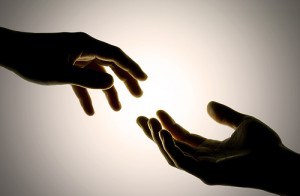
But in the right-hand corner, as the camera (iPhone?) swings left to see the violence, a guy in a red ball cap (one assumes it is a MAGA hat) reaches his hand toward the cowering officer. It is a “here let me help you up” hand.
Everybody was making decisions in that moment. None of us can know what MAGA said to Officer as he extended that hand, but his offer of help signals one thing: for that guy, not all his decency was lost yet, because he recognized the moment when “protester” turned into “terrorist.” In that moment, he was not so caught up that he could not see through anger to reality. He had participated in trying to hurt people, and now he chose not to.
Where did integrity enter his decisions? Did he know ahead of time, and think that violence was merited because it was for a good cause, then back out when he saw the actual person curled against the concrete? Did he believe that he and his fellow patriots could never devolve to a level of violence reserved for inferior countries (put quotes around several of those words, please)? Did he not think about it too hard; he had time off work, bus tickets were cheap, his friends were going and yeah, he had some vague unease about the sanctity of the election? Was it supposed to be the trip of a lifetime, a steam valve for anger, or a coup?
We’re all making decisions. They will get harder to parse in the coming months. And believe me, they are coming from both sides. That hand will be characterized by his friends as “aiding the enemy.” It will be characterized by the left as “too little, too late. You shouldn’t have been there in the first place.”
We are all making individual decisions. They add up to our collective future.


