1000 words

Next week I’ll tell you more about the ship and the people on our Alaskan adventure, and we still have the amazing story of the Aleuts in Juneau and the Russian Orthodox church there, but for this week, please enjoy vicariously the photos we snapped. If a picture is worth a thousand words, this is value for time. :]

Every time I woke up, I’d sneak out onto the balcony, and the views were always amazing. This is the first night, when the supermoon had just started waning.

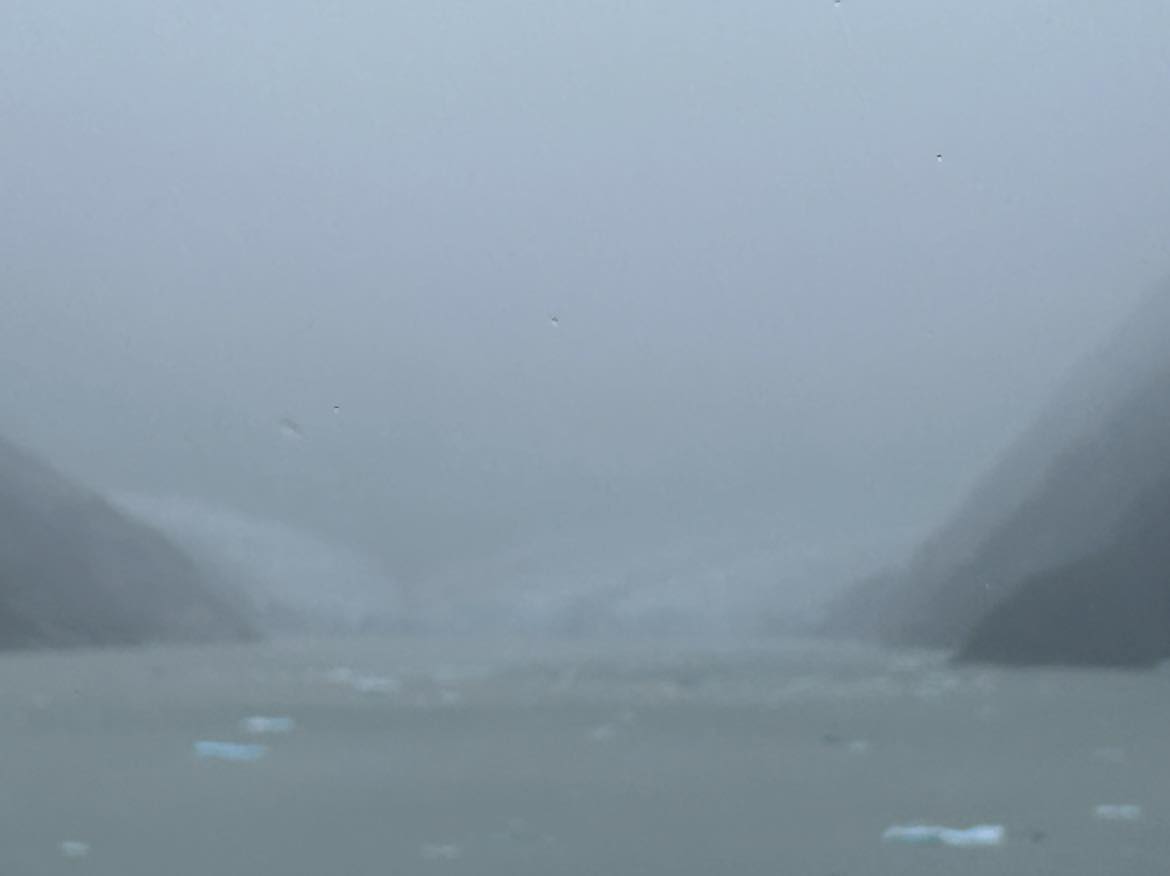
Dawes Glacier was a huge chunk of ice, with pieces breaking off and refreezing over time. It is named for Henry Dawes, a laywer and politician from Massachusetts who apparently knew the right paperwork to file, because it had been named in 1890 by John Muir as Young Glacier after his companion The Rev. Hall Young, but Dawes renamed it in 1891 and the name stuck. The fog started coming in just as we were leaving the glacier; the whiter parts are the ice.
There were so many waterfalls, the disembodied voice that came on the ship’s com and began telling us things said, because there had been significant rainfall the week before. Normally the mountains don’t have so many waterfalls.

Pack ice was all over the place as we went north, always close to shore though. Sometimes they looked like dragons or other mythical creatures and you began to understand why mariners thought they’d seen monsters.

I

The day the entire boat sat silent, taking in the grandeur of the glacier and fjords, we were also freezing on our balconies. Beth and Brandon waved from next door just before securing us all the day’s cocktail: Mallibu hot chocolate (rum added). We never found out how cold it was, but it reminded me of my days in grad school in Newfoundland, when the pack ice would come in and breathing near the ocean felt like ice razors were sliding down your throat.

More next week, including some of the fun fun people and silly things we did. But here’s one final shot of Jack enjoying the views. He said later that the balcony room had paid for itself – and that cruising was his ideal vacation: You sit with a drink in your hand watching the scenery walk past you.

Norah Porteous — Wonderful Artist and Devoted Mother

This is Jack’s promised post about Lindsay’s mum – –

I promised a post about Norah and her life. When she was relatively young her husband died suddenly and tragically, and she was left to look after three children – Nigel, Fiona and Lindsay. She wasn’t left particularly well off financially.

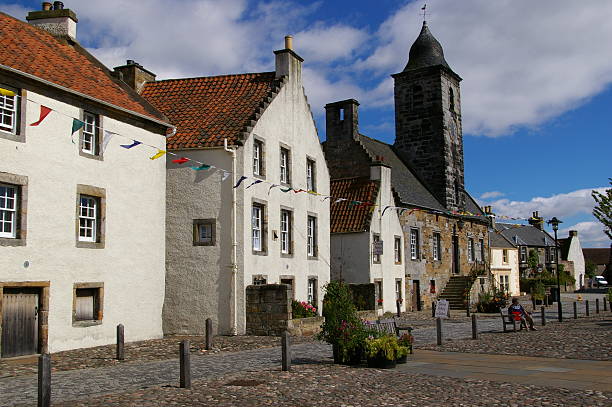
But she was resourceful and talented and made a plan. She had trained at the famed Slade School of Art in London, specializing in fiber art and water color painting. So she and the kids moved to a rented house in the small town of Culross (pronounced koorus) in Fife; the town is under protection by the Scottish Government and preserved in its original architecture and cobbled streets. Their house was called the Tron House – the most prestigious one and pretty close to the oldest; its lintel stone over the door says 1610.

Just at the top of the alley beside it was a dilapidated medieval stone wash-house which Norah bought and converted into a lovely gift shop focusing on her art work and other up-market offerings.

Nigel and Fiona moved on and made lives for themselves, but that left her and Lindsay. Knowing he would likely outlive her, she made it her work to make him self-sufficient and independent. She encouraged his involvement in folk music, believing it would give him a life of his own, which it did.

Wendy and I always enjoyed visiting them, and we were often invited for lunch or dinner, when Norah would set the table with her best china and silver. That’s when Lindsay would ‘code shift’ – speaking very posh in front of his mum, but reverting to a broad Fife accent and language when she left the room.

Her health eventually deteriorated, and their roles were reversed. Lindsay became the care-giver, and her training of him proved important in the end. He kept her from blowing money on psychics, trying to contact her dead husband, as her mind began to wander. In the end, it was Lindsay who looked after Norah.

Probably our favorite story about Norah would be easy to misconstrue: it celebrates her survival instinct and perfect manners coming to terms in a cunning move. We visited her and Lindsay around midnight on Hogmanay one year, when it’s traditional to take a bottle of whisky, a piece of food, and a lump of coal (lang may yir lum reek). This is called first-footing, and you tend to make up to a dozen such house calls on Jan. 1.

Usually you will exchange sips of Scotch from one bottle you bring with you and your host’s, and then carry on to another house with the coal sack, one piece missing from your cake, and a few drams less of the whisky. Norah took her sip from our rather expensive ¼-empty bottle, put it on the mantelpiece behind her (out of my reach), and then said “how generous; thank you.” We smiled weakly and headed for the door, planning to stop and buy another bottle to continue our first-footing.

What a woman!!