
When Amelia asked me did I want to go to Japan with her, I knew I was getting a guided tour from someone who understood the country and spoke the language. And had been there multiple times. So after day two, when we finally played polite chipmunks with each other (“No no, after you, what do YOU want to do” etc.) I asked her point blank what did she want to see that she hadn’t yet.
The giant buddha of Kamakura, she said without hesitation.
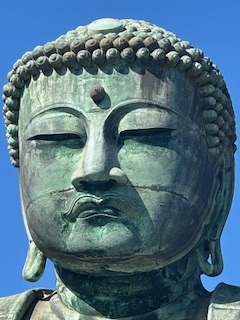
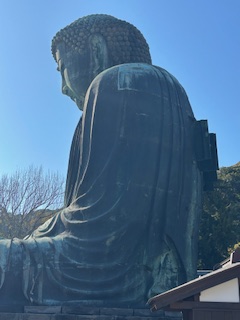
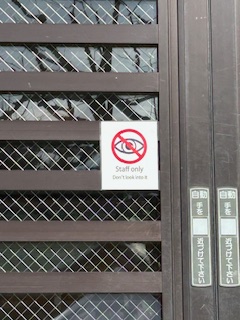
OK, then, off to Kamakura we went. It was an hour train ride. We descended into a seedy little town amidst an international plethora of people who dissipated quickly, much to our chagrin. We had hoped to follow some of them. One would think it would be hard to hide a 45-foot tall Buddha, but Japan has mastered the art of passive-aggressive signage.
The Buddha, it turned out, sat an alarming two miles from the train station, according to our GPS. The guidebook had said twenty minutes, max. But we walked a winding side street full of tiny traditional houses that screamed Air BnB. The streets were so narrow, cars had to wait not-all-that-patiently for us to pass on the single track, 90-degree slant road.
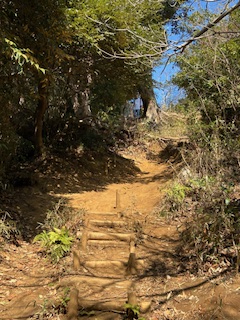
We began to worry our GPS was annoyed at having to work a Sunday, when, at the top of the half-mile steep climb we had just made, we found a sign that said we had two miles to go to find the Buddha. Our GPS then told us to turn right up a staircase that had a chain across it. Amelia read the Japanese sign and said, “Condemned.”
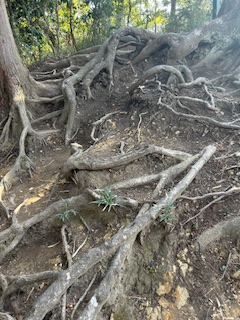
We hiked through forest. We walked through neighborhoods. We found a couple of girls from the USA in the woods. When Amelia learned they were from Chicago, she asked if ICE were making trouble there. One of the girls said, “Yes. I’m an immigration attorney.”
We changed the subject. And direction, after a quarter mile along a path so narrow I almost fell off the mountain when they decided we had missed a sign and needed to turn around. I stepped aside to let the Chicago girls go by, and my foot descended into empty air.
At one point, a slight fork in the wooded trail sported a small wooden sign someone had clearly put there out of sympathy. It said “Buddha” in English and Japanese, but it was only a foot off the ground, black paint against dark wood.
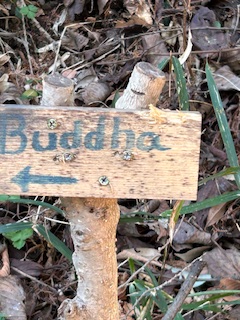
When we realized this was our third walk in the wrong direction that added distance to the trek, Amelia said, “Let’s just go back.”
“When Hell freezes,” I answered. “We are going to find this damn international symbol of peace and enlightenment if it’s the last thing we ever see in our lives.”
“It will be,” she muttered. A minute later we found yet another sign, telling us the Buddha was back the way we had come. And that the train station we had now walked two miles away from was a half mile away.
Eventually we descended down a path so steep, it offered a rappelling rope as one option. We hand crawled along tree root systems. I sat on a root and slid down a steep bit, then turned to warn the German couple who had caught up with us that the dirt was packed and slick.
“Danke” said the twentysomething girl hiking in a short flowered skirt, and jumped down from the root like a bunny in boots.
“Bitch,” Amelia muttered behind her.
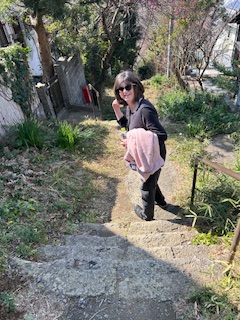
I really like Amelia.
We descended into civilization: souvenir shops, ice cream stands, lunch places. Our GPS announced we were 400 meters from the Buddha and 600 meters from a train station.
The words Amelia said at that moment were very enlightening, I tell you.
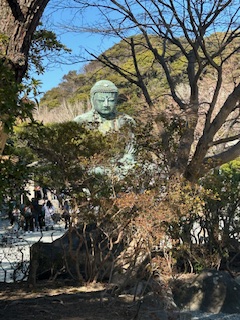
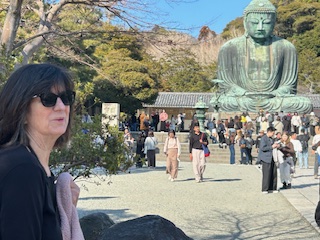
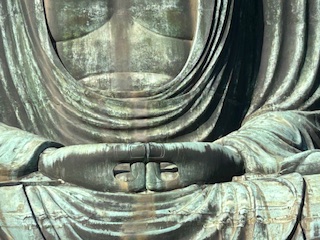
He makes you feel like you are the only one there. People prayed in English, in Arabic, in Hindi, and in Japanese, their body language indicating which deity they might be praying to in front of the giant, serene statue.
700 years. He just sits there. After World War Two, Japanese school children wove a giant pair of sandals for him, because they said he needed to walk through the land and restore peace.
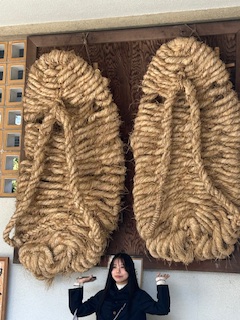
He sits. People come. People go. Ideas rise and fall. Countries dominate and disappear. He sits.
We found him. And it was worth the three-hour hike in all the wrong directions, just to feel that serenity emanating from him, that sense of him greeting each person as if they were the only one there.
We took the nearest train back to the main station and wended our way home. It was a fraught trip out, and the train back was standing room only. But it was worth it, to feel the serenity emanating from the giant Buddha of Kamakura.
 Wendy Welch: Books, Yarn, Cats, Opioids