1000 words

Next week I’ll tell you more about the ship and the people on our Alaskan adventure, and we still have the amazing story of the Aleuts in Juneau and the Russian Orthodox church there, but for this week, please enjoy vicariously the photos we snapped. If a picture is worth a thousand words, this is value for time. :]

Every time I woke up, I’d sneak out onto the balcony, and the views were always amazing. This is the first night, when the supermoon had just started waning.

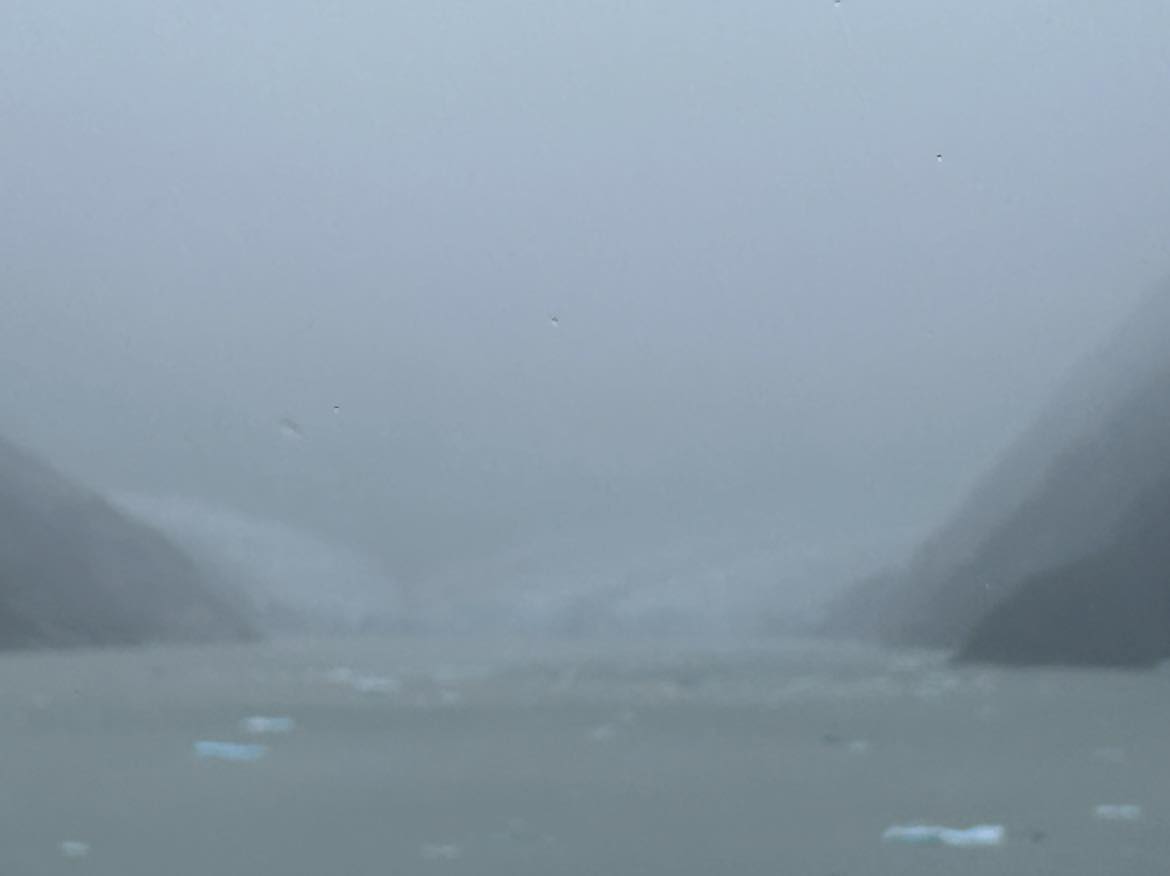
Dawes Glacier was a huge chunk of ice, with pieces breaking off and refreezing over time. It is named for Henry Dawes, a laywer and politician from Massachusetts who apparently knew the right paperwork to file, because it had been named in 1890 by John Muir as Young Glacier after his companion The Rev. Hall Young, but Dawes renamed it in 1891 and the name stuck. The fog started coming in just as we were leaving the glacier; the whiter parts are the ice.
There were so many waterfalls, the disembodied voice that came on the ship’s com and began telling us things said, because there had been significant rainfall the week before. Normally the mountains don’t have so many waterfalls.

Pack ice was all over the place as we went north, always close to shore though. Sometimes they looked like dragons or other mythical creatures and you began to understand why mariners thought they’d seen monsters.

I

The day the entire boat sat silent, taking in the grandeur of the glacier and fjords, we were also freezing on our balconies. Beth and Brandon waved from next door just before securing us all the day’s cocktail: Mallibu hot chocolate (rum added). We never found out how cold it was, but it reminded me of my days in grad school in Newfoundland, when the pack ice would come in and breathing near the ocean felt like ice razors were sliding down your throat.

More next week, including some of the fun fun people and silly things we did. But here’s one final shot of Jack enjoying the views. He said later that the balcony room had paid for itself – and that cruising was his ideal vacation: You sit with a drink in your hand watching the scenery walk past you.

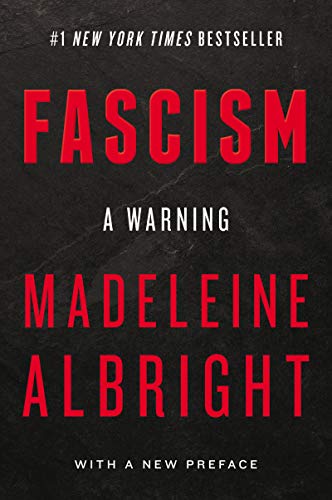
The Monday Book: FASCISM A WARNING by Madeleine Albright

Published in 2018, this book is both a history of how democracies turn into dictatorships while still holding elections, and a warning of how often elections stop or become meaningless in democracies that dance with fascism. Albright (along with ghostwriting co-author Bill Woodward) starts by describing her Jewish family fleeing Czechoslovakia –twice. First they fled Hitler, then they fled the pendulum swing of the corrective regime that quickly turned her home country Soviet. Without ever using the term, Albright talks quite a bit about the horror of pendulum swings as regimes move between types of governance.

One of the things that impresses me about this book, which covers a whole lot of rises and falls, is how evenhanded she is. Starting with Mussolini as the Godfather of Fascism, she analyzes multiple countries without blaming specific systems–not even in Americam where she outlines three ways Fascism could rise here (one by liberals, one by conservatives, and one by disaster) nor in any of the multi-party countries she discusses.

It’s as if a wise grandmother sat you down in front of a warm stove, gave you a bowl of soup and hunk of homebaked bread, and said, “Now listen carefully, dear. Here’s how it happens, and here’s what to do about it personally, and collectively if possible.” She has a lot to say about personal responsibility in her final chapter.

She also defines Fascism and doesn’t let name-calling rise to a fine art, as it has in so much of America today. Fascism was Number Two on definitional searches of the Merriam Webster dictionary in 2016, she points out with the casual humor that pervades this book–in surprising and useful ways, given the heaviness of the subject. The only term more searched was “surreal.” And she points out that Fascist is a word people use when they disagree with each other as a one-size-fits-most insult.

This is not helpful, Albright suggests. Fascism might best be viewed “less as a political ideology than as a means for seizing and holding power.” It builds from a sense of what people in a particular group feel, usually a smouldering resentment that they have been denied something, people upset about what they should have and what they fear they may never get unless they take back something they used to have. Which gets complicated because fairly often what they used to have isn’t what they want, and therein lies the manipulation of class, race, ethnicity, geography, ideology, and a few other identifiers. Take back what never belonged to you, is the beginning of many histories that wind up in Albright’s book.

Fascism isn’t always right wing, and not every dictatorship is fascist, but fascist leaders become dictators. And they are almost always charismatic. She ticks through the usual suspects and hits a few others: Stalin, Orban, Putin, Kaczynski, the unusual North Korean dynasty from grandfather to grandson, unusual among Fascist regimes. Also how long they last, and why. The history is fascinating.

The warning is a little less fascinating than subtle. Here is one of my favorites quotes: to a small d democrat, process matters more than ideology. The fairness of an election is more important than who wins.

With that quote, Albright indicts all politicians who manipulate process in an attempt to increase power, and she does it throughout the book. She is less concerned with outcomes than with the ways in which those sworn to uphold the Constitution, the System of Checks and Balances, the promise of Free and Fair Elections are now trying to interpret loopholes and pivotal words.

It is an apt warning, directed equally at all sides. Fascism isn’t right-wing or populist alone. A person who seeks power, even if originally for a good reason, can be corrupted into believing their way is the correct way. Or they can start with the intent to become The Only Leader. It doesn’t matter, both roads lead to violence without due process.

Albright died in early 2022. I wish she had written an epilogue to this book before she passed. It would have been quite a read.