
Jack gets to review the Monday book this week –
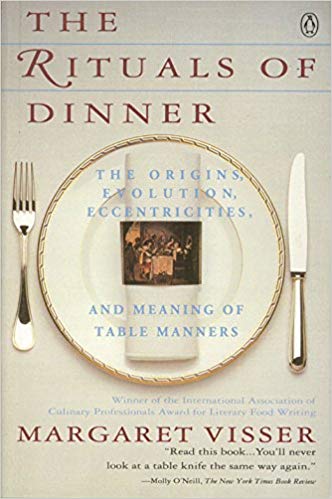
This book is both fascinating and frustrating.
Visser chose a strange way to progress her story, not chronologically as might be expected, but by topics. This results in a good deal of repetition – revisiting the Greeks, Romans, medieval Europeans etc in every chapter. Other reviewers have suggested the book could have been a good deal shorter and more readable and I’m inclined to agree.
On the other hand I found it hard to put down because of all the really interesting stuff scattered throughout. Although her specialty is literature, she is clearly a fine anthropologist as well. There are a good few references to folk motifs that I’m familiar with and was a bit surprised to find in a book about table manners. In fact, although the title suggests a fairly narrow focus, Visser ranges pretty widely around the central subject.
You could be forgiven for expecting this book to be about table manners and how to behave at the dinner table. It actually starts with cannibalism, goes through the development of tables and chairs, covers the invention of forks and spoons, deals with social attitudes in different cultures and a host of other loosely food related matters.
I think what was perhaps a bit startling for me was recognizing familiar dinner table and restaurant situations and for the first time understanding what lay behind them – everything from the placing of a knife (blade towards you and not your neighbor) to signaling the time to change courses.
The final chapter examines present day mores including the fast food culture – reflecting another book – ‘The MacDonaldization of Society’ by George Ritzer, but that’s another story – –
I have some reservations about Visser’s book, but if you don’t mind skimming here and there, it’s still fascinating stuff!
 It’s been awhile since I devoured a novel so thoroughly as this one. Hashimi writes in a simple, straightforward way. (And be warned, a couple of times the point of view shifts because the copy editor didn’t catch it.)
 Wendy Welch: Books, Yarn, Cats, Opioids