
The Monday Book – The Day the World Ended –

Jack is this Monday’s book reviewer –

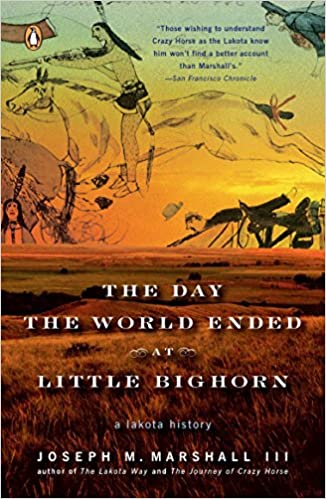
The Day the World Ended at Little Big Horn; Joseph M. Marshall
Six years ago Wendy and I set out on a road trip that wound up in North Dakota, and towards the end we visited Wounded Knee. We were surprised to see that the only sign was an obviously amateur locally made one and there was no historical marker. There were some tables down off the road with local Nakotas who were very willing to tell us what had happened there.

The following year we retraced our steps with a couple of friends and, this time, went further North to Little Big Horn. The contrast was very clear! A visitor center with books and souvenirs and a regular guided tour round the site where the message was all about the heroic ‘Custer’s last stand’.

Marshall’s book tells the history of the Nakota from the first arrival of French explorers in the 16th century right up to today. He is a professor of history, an academic and a Nakota. His book tells the story of Little Big Horn and Wounded knee from the Nakota perspective. It’s both triumphant and horrific, of course.

When we visited Little Big Horn we did the tour which was led by a local Nakota and he was following the script which was completely focused on the Custer story. So it was both refreshing and informative to read this book. It portrays the battle as a triumphant victory for the First Nations which led on, of course, to the vengeance that was wreaked at Wounded Knee.

Marshall comes right up to date in the 21st Century with the aftermath of the ‘Indian Wars’ including the removal of First Nation children to special schools, the stealing of the land and the removals to the reservations. He even mentions Sitting Bull joining Buffalo Bill’s wild west show for a tour of Europe!

I first became interested in this history when I discovered my grandad had seen Buffalo Bill’s show in my home town in Scotland in 1908. A good friend and marvelous songwriter discovered his father had also seen the same show and wrote this –

The Monday Book: BLUEPRINT FOR A BOOK: BUILD YOUR NOVEL FROM THE INSIDE OUT by Jennie Nash

This week’s Monday book comes courtesy of Paul Garrett

I once had the opportunity to observe the construction of a high-rise apartment as I drove by the site once a month. The first time I went by they had cleared the lot. The next month they had begun to dig a hole. The next month the hole got bigger, the next month bigger still. Finally, after several months a concrete column appeared. After that, the building went up rather quickly. I often use this anecdote as an analogy for my writing students to emphasize the importance of building a strong foundation for their work.

In her newly released (September, 2021)  book, Jennie Nash, the guru behind Author Accelerator, where they train people to coach aspiring authors, is also a strong proponent of laying the groundwork for one’s opus. That’s why she has produced her Blueprint for a Book: Build Your Novel from the Inside Out. With decades of coaching experience (She coached, among others, Lisa Cron on both her books.) She lays out a step-by step process to take the prospective author from the germ of an idea to a completed manuscript.

Blueprint for a Book is also the title of her Author Accelerator curriculum and could serve as a companion for her popular course, which is how I us it. (Full, disclosure I am a student of the course) or it could serve as a standalone guide. She avoids the jargon that many writing teachers use to show how smart they are; words like “premise,” “theme” “logline,” and “character arc” to make the material a little more accessible to the novice, but the experienced writer will find much to interest her as well.

Ms. Nash focuses on planning the novel and on the often overlooked but vitally important minutia of novel writing, whose neglect may be responsible for many of those unfinished and unpublished manuscripts languishing in drawers and on hard drives. Her best innovation is her “Inside Outline.” a way to marry the story and character arcs throughout the book for a more coherent narrative.

While the material seems tailor-made for the plotter, it may be confounding the pantser, who’s chomping at the bit to get it on paper. But the exercises can be helpful even after a rough draft is finished.

Whether just beginning your story, going into revision, or stuck in the middle, Blueprint for a Book can offer writers a helping hand.