The Monday Book – Seek You: A Journey Through American Loneliness by Kristen Radtke

Guest review by Janelle Bailey, retired Literature teacher.
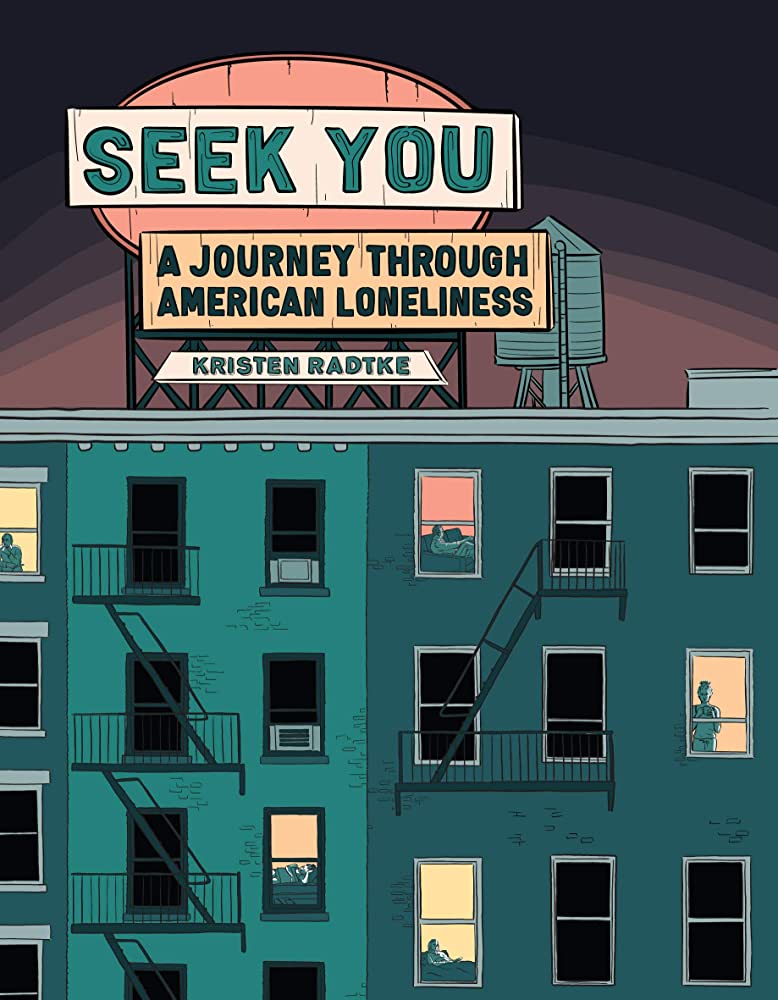
This is truly a gorgeous graphic construction of an extremely thoughtful and thought-provoking non-fiction work of literature. And the fact that it is all, coincidentally, built and written by a Bay Port High School grad/once a local, to boot, is awfully cool! Way to go, Kristen!

A lot about this book reminded me of Mira Jacob’s Good Talk, so I was only pleasantly surprised to see her acknowledged at the end of this book.

I reflected on so much while reading this, prompted by very intellectual assertions by its author, as she investigated concepts as diverse and wide-ranging as American “cowboys,” the current declining enrollment in civic organizations, railroad building and travel, and more, while also pondering her own family members, her own personal history, and the lives of these individuals matching or not those around them.

The entire book is just plain smart and thoughtful, and I may just read it again to make sure I didn’t miss anything the first time, for how densely loaded it is with good stuff. It truly sparked my interest in and thoughts about the included diverse topics. And that made me realize how much work Radtke must have done not only researching her ideas but then also determining which to include and how little or much of each, for this could have been a far longer work, given all she mentions and touches on. She does a fine job of whetting the reader’s appetite and interest for these ideas, addressing them a bit, but not dwelling or overdoing any, only initiating the thoughts and ideas at times.

This book also addresses a long-held idea I have processed myself that true loneliness is much less about being physically “alone” than it often is about “feeling” alone, even at times in an actual crowd or physically surrounded by others. It made me think about an essay I used to teach in my classroom about the value and lost art of solitude. Personally, I still feel like being in my own house all alone and able to breathe deeply and differently is a relished and rare treat, something to treasure, and not at all lonely…for me. And yet I have been in numerous situations when I have been literally surrounded by plenty of people but feel completely alone…in my thinking, my values, my understanding of things, my great wishes to be, then, anywhere else…or even alone instead. Loneliness is a mindset, I think, and has very little to do with a magic number of people in a particular place at a particular time.

I think that in this current world, isolation is of greater concern than loneliness, and hopefully others also see…and seek…the value of virtual connection and togetherness such that they do not have to feel any more alone than they wish to.

Kudos to Radtke for creating this beautiful, thoughtful book!
Peppers & Tomatoes

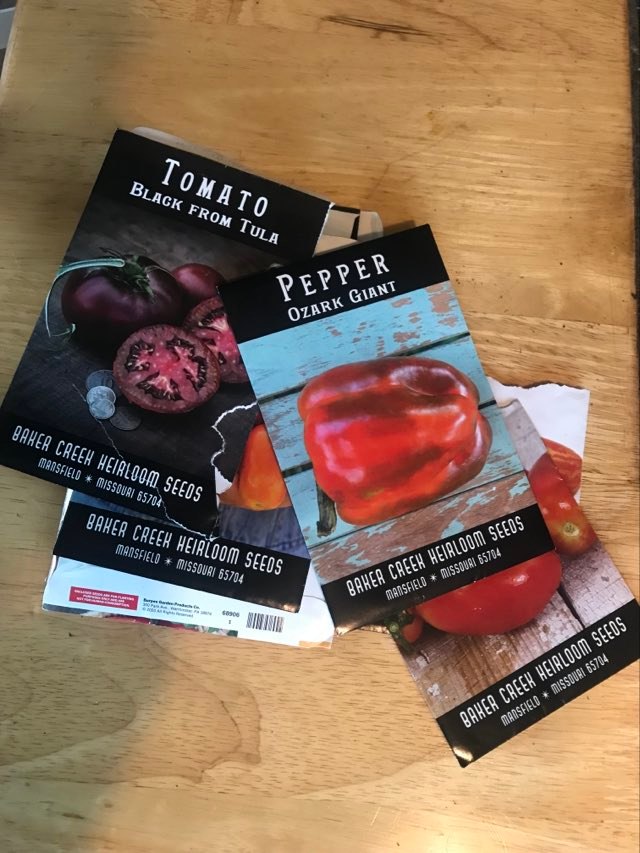
On Wednesday I seed-started our peppers and tomatoes. Every year when I do this, I listen to Ralph McTell’s song of the same name. It started back in Scotland when I was using growbags (because the Scottish climate is not friendly to tomatoes, so one must grow them indoors).

The bags say, “this soil is suitable for growing peppers and tomatoes” and Ralph McTell being the songwriting genius that he is, Kosovo being in full swing, and a very weary “same story different people” feeling pervading the general response to the violence, well, he wrote the song based on seeing those words on a growbag.

By now you know his song is not about planting peppers and tomatoes; it’s about growing hatred in carefully cultivated soil. The song spoke to me in large measure because at that time I was working with people who had entered the UK under difficult circumstances.

I ran a library group (as one does) for asylum seekers, most of whom were Middle Eastern Kurdish, African Christians, or Albanian Muslims. (Kurdish could bat for any religious team.)

During the course of an event, Mohiba, a Muslim refugee from Kosovo, and her daughter talked about their neighbors, the rising tension, the dropped comments of “you can buy gold but we are buying guns” and other hints of what was going to happen. Just because you can see something coming doesn’t mean you can get out of its way, Mohiba said. It takes money and strategy to get out of the way fast enough to not get hurt.

But Mohiba had more to say: how the Jews ruined everything, how the One True Religion had saved her, how righteous warriors were avenging the deaths by dealing out deaths of their own. This was at a time when new mass graves were being found in Iraq, where regime violence outweighed (or intermingled with) religious and ethnic violence fairly often. Saddam’s disappeared enemies were being pulled out of unmarked pits.

Naziq, an Iraqi Muslim whose husband got targeted for being an English translator, had begun talking about this, through her daughter Fatima’s translation since Naziq didn’t speak English. She had been watching the coverage non-stop on the BBC—and Mohiba interrupted.

“It is a lie, false news from the Jews who own that network,” she said. Fatima did not translate for her mother, and we tried to direct the conversation to less hate, more healing. It felt a lot like herding snakes.

After the session was over, Fatima came up to me, rigid and livid. She said her mother had been going to tell the group that Naziq’s father, missing for four years, had been identified as one of the pit bodies. He had gone up against Saddam over his policy of separating families who had married across tribal identities, literally sending people to Iran overnight without their families knowing. Grandad paid for it with a bullet.

“It is not the work of anyone else. It is not for anyone else to say such things. And for someone who has endured such violence to say more violence will solve it….” She shook her head, wise beyond her teenage years. “We cannot have these conversations, even.”

Every year, I think about the friends I made then, and how Naziq and Mohiba’s daughters must have children of her own by now. I wonder what they teach their children. And I listen to Ralph McTell’s Peppers and Tomatoes.