
Monday Book – The Rituals of Dinner – Margaret Visser

Jack gets to review the Monday book this week –
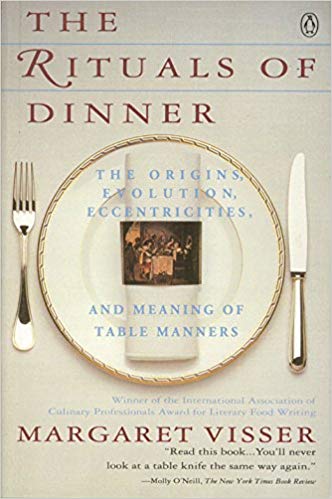
dinner

This book is both fascinating and frustrating.

Visser chose a strange way to progress her story, not chronologically as might be expected, but by topics. This results in a good deal of repetition – revisiting the Greeks, Romans, medieval Europeans etc in every chapter. Other reviewers have suggested the book could have been a good deal shorter and more readable and I’m inclined to agree.

On the other hand I found it hard to put down because of all the really interesting stuff scattered throughout. Although her specialty is literature, she is clearly a fine anthropologist as well. There are a good few references to folk motifs that I’m familiar with and was a bit surprised to find in a book about table manners. In fact, although the title suggests a fairly narrow focus, Visser ranges pretty widely around the central subject.

You could be forgiven for expecting this book to be about table manners and how to behave at the dinner table. It actually starts with cannibalism, goes through the development of tables and chairs, covers the invention of forks and spoons, deals with social attitudes in different cultures and a host of other loosely food related matters.

I think what was perhaps a bit startling for me was recognizing familiar dinner table and restaurant situations and for the first time understanding what lay behind them – everything from the placing of a knife (blade towards you and not your neighbor) to signaling the time to change courses.

The final chapter examines present day mores including the fast food culture – reflecting another book – ‘The MacDonaldization of Society’ by George Ritzer, but that’s another story – –

I have some reservations about Visser’s book, but if you don’t mind skimming here and there, it’s still fascinating stuff!


The Monday Book: The Last Days of the Sioux Nation.

Jack gets to do the book review this week –

The Last Days of the Sioux Nation – Robert M. Utley

sioux nation

My interest in this subject was sparked by a song. My old singing friend John Watt and I, both from the same small town in Scotland, knew that Buffalo Bill Cody’s Wild West Show had played there during its final European tour. He was intrigued enough to do a lot of research and wrote the song.

He discovered that among the performers was a group of Sioux who had been ‘paroled’ from a South Dakota reservation by Cody. I started singing the song a few years ago and when Wendy and I decided to plan a road trip we wanted to include the Black Hills and the Badlands. On that trip we also took in Wounded Knee and the Crazy Horse monument.

More recently we repeated the journey with a couple of Scottish friends and this time added in a visit to Little Big Horn. Along the way, on both trips, we naturally picked up a good few books that filled out our knowledge. In addition, I found an excellent book by the Scottish writer James Hunter called Glencoe and the Indians that added another layer of fascinating hidden history.

Utley’s book is probably the best I’ve come across covering this whole sad period. The period he covers is about ten years around 1890 and takes us from Little Big Horn to after Wounded Knee. His excellent research describes the tensions within the different Sioux sub-divisions as well as the rivalries between the US army and the Department of the Interior. The Sioux were reeling from the many broken promises, particularly around their sacred Black Hills and Badlands. Their final attempt to revive their lost way of life was to embrace the ‘Ghost Dance’ and this was grossly misunderstood by the Federal authorities and particularly the army.

Utley includes a collection of photographs from the period including the main actors as well as notable places such as Wounded Knee creek.

In Hunter’s book he points up the similarities between the experiences of the Sioux and those of the Highlanders who were cleared off their Scottish land. The real irony is that some of those Scots ended up in America and took a leading part in the Sioux clearances!

There’s a well known story that a few of Buffalo Bill Cody’s Sioux left his show in Glasgow and settled there. What we do know is that a popular Glasgow museum recently returned a ghost shirt to the US that they had had in their collection for over one hundred years.

I can thoroughly recommend this book to anyone with an interest in this dreadfully sorry period in US history – five stars!