
Monday Book – The Rituals of Dinner – Margaret Visser

Jack gets to review the Monday book this week –
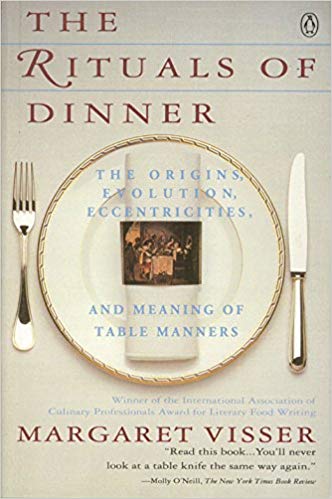
dinner

This book is both fascinating and frustrating.

Visser chose a strange way to progress her story, not chronologically as might be expected, but by topics. This results in a good deal of repetition – revisiting the Greeks, Romans, medieval Europeans etc in every chapter. Other reviewers have suggested the book could have been a good deal shorter and more readable and I’m inclined to agree.

On the other hand I found it hard to put down because of all the really interesting stuff scattered throughout. Although her specialty is literature, she is clearly a fine anthropologist as well. There are a good few references to folk motifs that I’m familiar with and was a bit surprised to find in a book about table manners. In fact, although the title suggests a fairly narrow focus, Visser ranges pretty widely around the central subject.

You could be forgiven for expecting this book to be about table manners and how to behave at the dinner table. It actually starts with cannibalism, goes through the development of tables and chairs, covers the invention of forks and spoons, deals with social attitudes in different cultures and a host of other loosely food related matters.

I think what was perhaps a bit startling for me was recognizing familiar dinner table and restaurant situations and for the first time understanding what lay behind them – everything from the placing of a knife (blade towards you and not your neighbor) to signaling the time to change courses.

The final chapter examines present day mores including the fast food culture – reflecting another book – ‘The MacDonaldization of Society’ by George Ritzer, but that’s another story – –

I have some reservations about Visser’s book, but if you don’t mind skimming here and there, it’s still fascinating stuff!


Which Side are You On

Jack scrapes over the wire with the Wednesday post – – –

I’m a week or so late in acknowledging Labor Day I know, but –

On our kitchen wall we have a tea towel with a print of a certificate by the house decorators and painters union dating from the mid 1800s.

towel

It fascinates me for two reasons. It reminds me of a famous book – The Ragged Trousered Philanthropists – that describes the working conditions of a group of house painters in England in the early 1900s. The other reason is because I served a six year apprenticeship learning all the skills depicted in that certificate.

The scenes illustrated clearly display great pride in the variety of specialisms involved –

The simple yet carefully prescribed way of painting a paneled door.

The use of color to enhance a classical Greek style cornice.

A cherub studying design and another one lettering a signboard.

A collection of regular paintbrushes and tools and another collection of tools for applying goldleaf.

In the center is a scene showing why the union was so important – a sick painter (maybe suffering from lead poisoning) is being attended by a doctor while his wife and son look on.

In The Ragged Trousered Philanthropists the main character is a young man, newly finished his apprenticeship who has a particular talent for design. He spends a lot of his own time, unpaid, making wonderful designs to be used later as part of his work. This reminds me very much of my father who served his time back in the 1920s when the system still included attendance at art college. Truly a marrying of art and craft and the legacy of people like William Morris.

My apprenticeship was served under my Dad in his painting business and I was ‘indentured’. That means that, like all his apprentices, we both signed a legal document that was then torn irregularly in half. At the end of my six years I received his half, which when matched to my half showed I was legally a time-served craftsman (indentured actually means ‘patterned like teeth’).

Everything has changed now. In Scotland there are still apprenticeships but they last just three years and don’t cover the same breadth of skills. Indenturing no longer takes place and DIY has blossomed with the introduction of easier to use materials and tools.

But I learned a lot – not just about craft skills, but also social skills. Not only that but it was the gateway to my college career, so a very good start to my working life.

Finally – I’m a big believer in unions!