
Guest review by Janelle Bailey, avid reader and always learning; sometimes substitute teaching, sometimes grandbabysitting, sometimes selling books
On the Move: A Life by Oliver Sacks
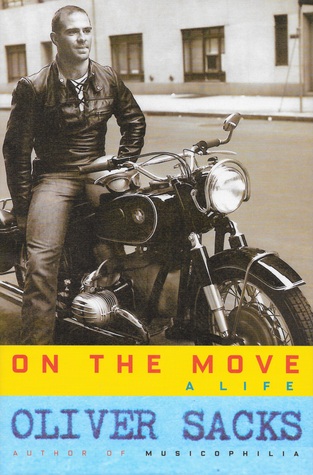
I actually listened to this one rather than reading the print version, BUT there were so many things I wanted to go back to in reference that I have since starting it purchased the printed edition as well.
Eventually I will read everything Oliver Sacks ever wrote prior to his passing, in August of 2015. By my own estimation, I am maybe 1/6 to 1/5 of the way in so far. My entry to Oliver Sacks was, like many, watching the movie Awakenings, which was based on his book by the same title. Having no idea who Oliver Sacks was and/or how he was involved with that project, I was with his very brief and relevant collection of thnext introduced to his writing via one of his short–three essays, I believe–collections called Gratitude. And ever since then I have been quite fascinated by Sacks’s stories, his brain, his storytelling–really by everything, seemingly, that makes Oliver Sacks, well…Oliver Sacks, and I wish to know and understand it all. His is a fascinating story and for so many layers of reason.
Sacks is smart and funny, thoughtful and sometimes artistically selfish, but engagedly entertaining; everything that I have read of his has given me some new perspectives on life, added interesting new layers of consideration for my own, made me think about something or some things differently from how I previously had. And if I ever do seek the attention of a psychologist, I plan to ask whether he/she/they have read Sacks. I think that’d be my standard for the smartest among them. He’s a scientist, a medical professional, a doctor–and yet he tends to people and their concerns in a patient and thoughtfully thorough way, having pondered so many situations and collected so many interesting cases over time.
In On the Move, one of his final literary projects, we read more of a memoir of Sacks’s earlier life and experiences as well as his most recent, both his initiation into romance and relationships along with fairly solid distate for it all, his coming out as a homosexual, and then as only occurred many years later, his finding true love at 77 and building a relationship with Bill Hayes. And learning about him prompted me to add his own Insomniac City to my tbr list as well.
Additionally we learn about Sacks’s relationship with his very successful and similarly smart parents, both doctors as well, and each of them passing away before him. On the Move is also about Sacks’s move from the UK to the US, and here he also explains his preference to remain an “alien” over pursuing US citizenship.
Sacks has lots to say and is a great teacher of life.
On the Move: A Life is a great read. Just like a woman who came into the bookstore recently looking for a book by Sacks and sharing why she similarly admires him, I, too, am (and already!) reading Sacks’s Musicophilia next. May I just say how much it pleased me to have someone asking for Oliver Sacks books? She explained that as a retired AP Psychology teacher, she was on a mission to read everything he had ever written. Me, too, Ms. __…me, too!

 Wendy Welch: Books, Yarn, Cats, Opioids