Sorry about not getting a blog up over the weekend. We had a massive group from Berea College visiting because of my new (academic) book Public Health in Appalachia. We had a great time with the team and will be blogging about it later this week. And we’re more or less back on schedule now, and proud of the fact that we fed 42 people in our bookstore all at the same time – a triumph of logistics over space. :]
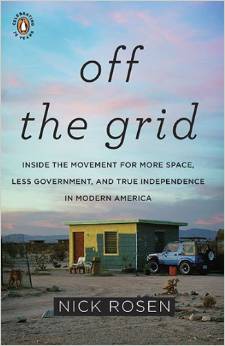 Usually I only do Monday Books that I’ve loved, and I admit that this one is kind of a “like.” Rosen’s book is interesting, but suffers from that thing that often happens to researchers who turn their work into a popular narrative style of writing: repetition and lack of a story line.
(Oh, did I just hear my agent giggling? Believe me, the words “narrative arc” come out of that wise woman’s mouth 12 times a day. And gosh darn it, she’s right. We want a beginning, middle, and end that look different from each other, strung together with smaller stories that flow toward a conclusion.)
Rosen writes about people who get off the power grid in the United States, for reasons ranging from dropping off one end after running out of money, to buying their way off the other end as rich, powerful, and/or famous citizens. (A lot of TV and film stars have off-the-grid hideouts.)
In between he covers off-gridders one might not think about, like truck drivers. And of course he includes survivalists and hippies and that controversial Mike Reynolds guy who “invented” earthships. I helped build an earthship in Scotland at a local sustainable farming community; that’s when I learned to make walls from bottles and shoes from tires. Neither of these have served me much in my present career as a bookseller, but I figure if A***on finally does us in one day, I can get great mileage out of my eclectic knowledge base and homemade sandals.
Thing is, Off the Grid, published in 2010, doesn’t so much talk about how to go off-grid as describe how it has turned out for a bunch of people who did, which gets repetitive after awhile, and also starts to skim across surfaces, hinting at conflicts and conspiracies and confusions that don’t get fully explored. (He did write, in 2008, a book that appears to be more how to.)
If you like storytelling in your stories, you may not like Off the Grid very much. I like reading about off-grid lifestyles, so I enjoyed this book. If you’re looking for how-to, try his 2008 book. If you’re looking for how-it-went-for-us, this is a good read. And if you’re into psychology-driven narrative, you’ll have a field day with what Rosen isn’t saying between the lines of what he is.
As a side note for those who have heard me talk about discovering St. Martin’s wanted to publish LITTLE BOOKSTORE on the same day that the last BORDERS bookstores announced their imminent closure, this is one of the two books I bought from BORDERS that day.
 Wendy Welch: Books, Yarn, Cats, Opioids