
Guest review by Janelle Bailey, avid reader and always learning; sometimes substitute teaching, sometimes grandbabysitting, sometimes selling books
The Covenant of Water by Abraham Verghese
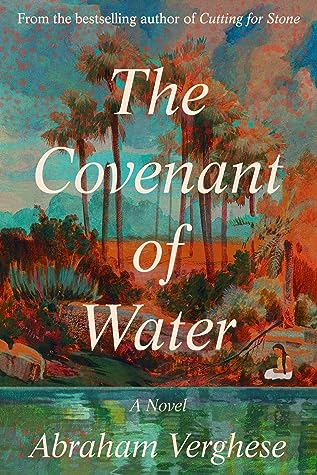
The Covenant of Water by Abraham Verghese
Whew. Wow. Whoa.
I don’t know when I last developed quite this level of relationship with a book at all, let alone a book of this 700+ page size. The past three-ish weeks, I have both wanted to complete my reading of this book and know that I had experienced it all–another amazing Verghese–but truly have not either wanted it to end. It was a complicated relationship for sure.
Somehow I often manage to “live” synchronously with whatever I am reading, in some way or ways, and for much of my reading of this book I was taking it back and forth to school each day, carrying it to the bookstore with me on weekends, selling every copy each day I was at the bookstore when we had any copies again available.
Just this morning I got to begin a discussion about it with another who recently completed her reading of it. This is my very favorite thing to get to do with any book, as that way it stays alive! I regret having read someone else’s copy of this one and not annotating at all. So many moments I thought to underline, bracket, or smiley-face or exclamation-point a margin, wanting to be able to find it again and easily, but it was a library copy in which I started reading and then my mom’s copy I read the last 3/4 or so…so no notes were taken or written inside or outside of the book.
This book kind of has it all and does it all well. There is romance for those who require that, mystery for those who thrive on it, there is travel and culture, education and medicine, parenting and much, much more; few books so have something for everyone, let alone all in a book that is so beautifully written and draws each reader in to see and find what they most need: everything from good storytelling to poetry-like philosophy, healing therapy, and souls fulfilled. The characters and the setting satisfy all of my own reading needs–feeling like I went and spent some time in this place meeting these people in person. Digby, Philipose, Joppan, Big Ammachi, Elsie, Mariamma, and more…these people–well, characters–seem very real to me, and I feel like I spent a lengthy visit in their homes getting to know them and their histories. They’re not likely to quickly leave my heart or head.
I was very much reminded, while reading The Covenant of Water, of the kinds of things I found myself doing while reading Rohinton Mistry’s A Fine Balance many, many years ago. While reading that book I got out an Indian cookbook as I was approaching the end, and I broke into my reading to cook up a storm of homemade curry sauce and dishes–even grinding my own spices and blends–so that I could eat the closest I could make to the “authentic” food of the book to savor the last many pages of my reading.
With this book I found myself, early on in my reading, purchasing half a dozen different types of coconut yogurt (a couple even yogurt literally made from coconut rather than dairy) because the book addressed a natural and available diet and its nutritional values…such that I wanted to partake, too, and that was the easiest way. And now, having finished the book entirely, I simply must make homemade bannock; I’ve already got a recipe called up on my phone and will have to make some later tonight, or tomorrow–very soon! I want to be right back in a particular scene of the book, where a simple Scottish bannock is served, shared–and this is the easiest sensory way back there to re-live and savor that scene, simply by making/eating my own. It’s maybe an odd process I’m describing, but rather than eat the actual book…lol…I’m going to get back in by eating what they were eating. Call me crazy; maybe I am!
Truth: there are so many, many beautiful passages in this deep beauty of literature, lines and paragraphs and even entire chapters that could be enjoyed again and even taught as excerpt.
One particular passage about one baby’s birth took me RIGHT back to every delivery of my five daughters and that moment when I first saw each of their eyes opened and taking in the world. And I really remember this most vividly from the delivery of the very first, nearly 30 years ago. The magic of that experience is so clearly conveyed on the page that I spent several minutes right then away from the text and thinking about just that singular aspect of my own children’s birth and how some babies are so sleepy and for so long and others, instantly aware and with eyes wide open, seem to arrive with full knowledge and insights and awareness…that if they spoke at all it would be in full sentences, them conveying all they already knew…and articulately.
I do feel bad for the couple of bookstore customers who became buyers-of-this-book early on in my reading and who did not want to enter graphic or detailed medical situations they had heard were included. At that point in my reading I had not encountered any and feel bad for steering them into this. I hope they’re okay! Yes, there are a few scenes in which very descriptive medical procedures are shared, and it could turn a stomach quite easily. Yet, one of the most surreal and out-of-body reading experiences–truly actual difficulty confronting the words on the page and what they were describing for the pain of engaging in it I’ve ever had while reading a book surrounds one of those particular passages as well. I’m personally glad that I didn’t dismiss reading the entire book, for the challenge of that passage or experience.
The Covenant of Water takes us on a journey primarily to India, and primarily from the early 1940s through the late 1970s. While we spend much of our reading time with some similar main characters and even one particular family in a particular rural landscape and area, watching them growing and changing, adding and losing, all the while, there are numerous tentacles connecting us to other characters and situations as well, in some fun Venn-diagram-ish ways of overlap and interaction.
The caste system in India is horribly intact for most of this book, just one of many themes of the book addressing how challenging it always is to be “real” and sincere within that system. Even the best of intentions of a “good” character can be prevented from occurring because of caste limitations. Layers and layers of history can make just “doing the right thing” nearly impossible. I’ll be thinking about all of this for a long time, as some things that challenge characters like this are far more universal than limited to the caste system in India. The vast majority of people grow and improve throughout their lives, and to limit and forever, the opportunities available to them or their level of pay or where they can live never really made good sense and certainly does not anymore right now.
So much about this book set within India and the caste system, the varying religions and varying faith of its citizens, can so easily be applied to other parts of the world–say the US, even–and while changing the name of the game, so much is still the same: how people are treated who were–are–natives of a land, the respect granted to “other,” the welcoming of visitors, loyalties of friendship and being neighborly, taking good care of people, the appreciation of art, culture and food. Yes, the book is set in India, but the best themes of this book are quite universal in application.
Of course there will be some who don’t care for it, but I believe they will be very few in number. I think Abraham Verghese has written yet another amazingly wonderful book.

 Wendy Welch: Books, Yarn, Cats, Opioids