Some Moments in Time —

Another musical post from Jack – –

Back around 1964 my old singing partner Barbara Dickson and I shared the stage a few times with a couple of guys called ‘Robin and Clive’ (Robin Williamson and Clive Palmer). They played regularly in a club in Edinburgh – Robin singing Irish and Scottish songs and playing guitar, while Clive played banjo and sang Appalachian songs and blues. They were at the forefront of things and very, very good!

They were so good that they were signed up to make a recording. So they decided to recruit a third person and give themselves a collective name. The third member was selected after auditions were held – unheard of then in the world of folk music! The successful applicant was Mike Heron, whose previous experience was in rock groups – he had played at the notorious ‘Snakepit’ near my hometown. The name they chose was ‘The Incredible String Band.’

Their first album was a big hit and created a stir outside of the folk world. There are reports that the Beatles and the Rolling Stones were influenced by them, and there’s another report that Bob Dylan said that Robin’s ‘October Song’ was “quite good” (maybe Robin didn’t know that that means very good in America).

But Clive wasn’t happy with the group’s direction, so he headed off on the ‘hippie trail’ to India and beyond.

Time to prepare for more prestigious gigs and more records. Robin and Mike recruited their girlfriends, Licorice McKechnie (yes, that was her name) and Rose Simpson. They quickly learned to play various instruments proficiently, and the band became a foursome.

The next thing was being booked for Woodstock, which didn’t go too well – – –

But they continued to tour and played many big concerts at famous venues.

I’m a big fan and always have been from their very earliest days – here they are, and it was hard to pick just one, but it has to be this: The Incredible String Band: “This Moment”

Next week, more from Jack

Norah Porteous — Wonderful Artist and Devoted Mother

This is Jack’s promised post about Lindsay’s mum – –

I promised a post about Norah and her life. When she was relatively young her husband died suddenly and tragically, and she was left to look after three children – Nigel, Fiona and Lindsay. She wasn’t left particularly well off financially.

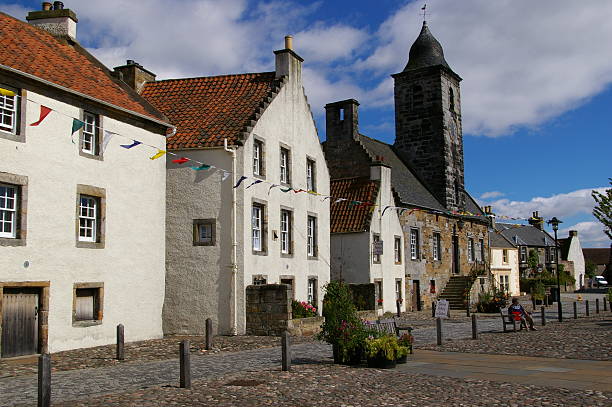
But she was resourceful and talented and made a plan. She had trained at the famed Slade School of Art in London, specializing in fiber art and water color painting. So she and the kids moved to a rented house in the small town of Culross (pronounced koorus) in Fife; the town is under protection by the Scottish Government and preserved in its original architecture and cobbled streets. Their house was called the Tron House – the most prestigious one and pretty close to the oldest; its lintel stone over the door says 1610.

Just at the top of the alley beside it was a dilapidated medieval stone wash-house which Norah bought and converted into a lovely gift shop focusing on her art work and other up-market offerings.

Nigel and Fiona moved on and made lives for themselves, but that left her and Lindsay. Knowing he would likely outlive her, she made it her work to make him self-sufficient and independent. She encouraged his involvement in folk music, believing it would give him a life of his own, which it did.

Wendy and I always enjoyed visiting them, and we were often invited for lunch or dinner, when Norah would set the table with her best china and silver. That’s when Lindsay would ‘code shift’ – speaking very posh in front of his mum, but reverting to a broad Fife accent and language when she left the room.

Her health eventually deteriorated, and their roles were reversed. Lindsay became the care-giver, and her training of him proved important in the end. He kept her from blowing money on psychics, trying to contact her dead husband, as her mind began to wander. In the end, it was Lindsay who looked after Norah.

Probably our favorite story about Norah would be easy to misconstrue: it celebrates her survival instinct and perfect manners coming to terms in a cunning move. We visited her and Lindsay around midnight on Hogmanay one year, when it’s traditional to take a bottle of whisky, a piece of food, and a lump of coal (lang may yir lum reek). This is called first-footing, and you tend to make up to a dozen such house calls on Jan. 1.

Usually you will exchange sips of Scotch from one bottle you bring with you and your host’s, and then carry on to another house with the coal sack, one piece missing from your cake, and a few drams less of the whisky. Norah took her sip from our rather expensive ¼-empty bottle, put it on the mantelpiece behind her (out of my reach), and then said “how generous; thank you.” We smiled weakly and headed for the door, planning to stop and buy another bottle to continue our first-footing.

What a woman!!