
A Little Ditty…about Jack and Wendy

Writer Wendy’s weekly blog

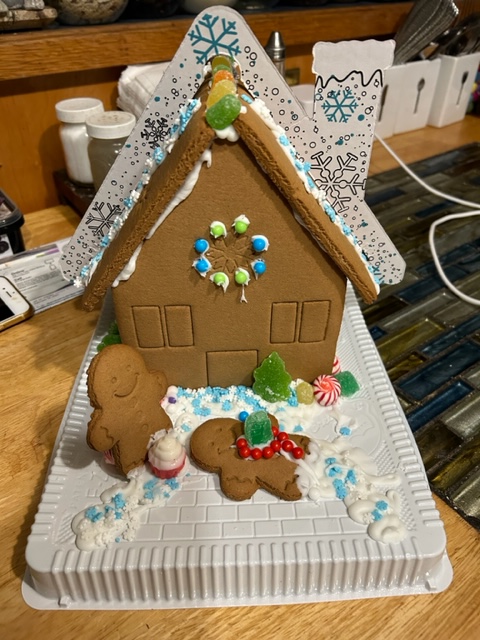
My husband doesn’t like my gingerbread house. I’m not sure why.

He got really nervous a couple of years ago, too, when I wrote a novel about a couple that ran a bookstore, and the husband died. Of natural causes, I hasten to add.

Bad Boy in the Bookstore had a plot based on real life. Jack did federal prison visits for decades, and one of the guys was an absolute charmer of a sociopath, in for murder committed during an armed robbery.

Over the months he and Jack bonded, and the guy was a tunnel master who had escaped at least three times from federal hospitality—to the point that he was taken out to classes on training officers in escape prevention.

So when Jack was trying to put a staircase into a coal chute to give us internal access to a newly-discovered basement, he started talking to the guy about it. And came home with a napkin scribbled over with diagrams and angles and a list of supplies.

I was livid. There just weren’t that many bookstores in private houses within visiting distance of the federal penitentiary. The next time this guy escaped, why wouldn’t he come straight toward us?

Jack laughed. The guy usually headed for Mexico or Alaska, where his charm would get him taken up with the wealthy set. One of his arrests was on a yacht raided because the party got too raucous.

Well, the plot about wrote itself, how this charming gentleman shows up after the male half of the bookstore owning couple dies (OF NATURAL CAUSES, so calm down, Jack!)….

It was a fun book to write, but it was, in fact, fiction. But ever since I came home with this gingerbread house, Jack keeps looking at me funny. Sorta like the time we got trapped by storms, coming back from Dublin, Ireland for Christmas. We spent two days in Chicago, and one of the films Jack watched during that time was The Shining.

If you know your horror films, you know this was about a Jack and a Wendy trapped by a snowstorm. I went for a swim while Jack watched it, but when I got back he just kept staring at me. Staring, and smiling…..

If the gingerbread house starts to show signs of possession—the heads on the little gingerbread guys start spinning, say, or we find one of the cats suffocated by gumdrops—we will take appropriate action and dissolve the house in milk.

Until then, calm down, Jack. And here, have this gumdrop…or some Wendy-made Christmas tea…

Cynicism Is Underrated

Writer Wendy’s weekly blog

When I was teaching at the local college, friends and I formed the CAB club: cynical altruist bitches. We believed that it was important to do good but that doing it wouldn’t make any difference.

Diogenes the Cynic, of Greek philosophy

Our fundraising model—although we never implemented it—was to rob gas stations and give the money to charity. But since we were all professors, getting five people together at once on that kind of schedule proved impossible. Hence our low funding.

We did get a grant once, $12 from the Provost of the College to buy red felt-tipped pens so we could correct errant apostrophes and statements of fact on public signs. None of us ever got prosecuted for the graffiti we left across town. My favorite correction was one of members who corrected “Vote Republican, Save America” to “Enslave.”

Cynics get a lot done, you have to admit. We’re grumpy and mutter things under our breath while we write policies we know will be rejected, demanding things like not promoting scholarship opportunities to students if they require a video application. Why do you need to know if the student is pretty? Or Black? Or Trans? (We did actually get one such application process changed; the problem with success among cynics is it deflates rather than fuels our contrariness-energized campaigns.)

Jokes among cynics are easy to spot, especially at Christmas. I admit, to this day one of my favorite responses when someone approaches me saying “Ho Ho Ho” is to snarl, “How dare you shame women like that?”

Cynicism walks close to bad virtue signaling. Recently some friends were grousing about how hard it can be to find the right words for a grant application to describe people who don’t have money and probably came from families who had experienced poverty before them. As the group shared how bad some of the options were—economically challenged, financially at-risk, perpetual poverty—someone asked, “Why can’t we just say ‘poor?’”

A virtue signaler huffed. “That feels like shaming people. The granting agency would and should flag it.”

A second virtue signaler tried to climb on top. “People who are poor care a lot less what we call them than whether we can bring resources to them.”

To which the CAB member in the group snapped, “We’re not bringing resources to them; we’re funding the salary for someone who will have to figure out what to call them in the next grant we write off their backs—I mean, on their behalf.”

Merry Christmas to all the cynics out there.