
Norah Porteous — Wonderful Artist and Devoted Mother

This is Jack’s promised post about Lindsay’s mum – –

I promised a post about Norah and her life. When she was relatively young her husband died suddenly and tragically, and she was left to look after three children – Nigel, Fiona and Lindsay. She wasn’t left particularly well off financially.

But she was resourceful and talented and made a plan. She had trained at the famed Slade School of Art in London, specializing in fiber art and water color painting. So she and the kids moved to a rented house in the small town of Culross (pronounced koorus) in Fife; the town is under protection by the Scottish Government and preserved in its original architecture and cobbled streets. Their house was called the Tron House – the most prestigious one and pretty close to the oldest; its lintel stone over the door says 1610.

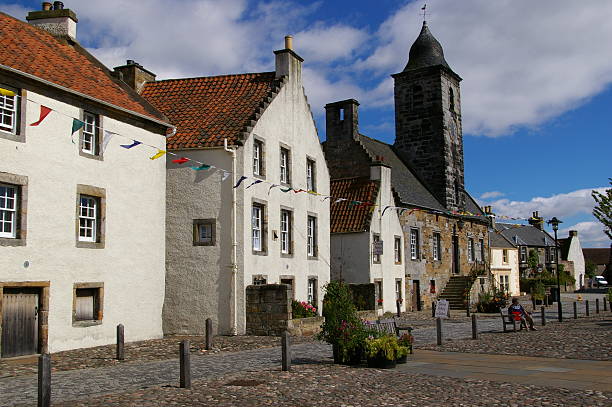
Just at the top of the alley beside it was a dilapidated medieval stone wash-house which Norah bought and converted into a lovely gift shop focusing on her art work and other up-market offerings.

Nigel and Fiona moved on and made lives for themselves, but that left her and Lindsay. Knowing he would likely outlive her, she made it her work to make him self-sufficient and independent. She encouraged his involvement in folk music, believing it would give him a life of his own, which it did.

Wendy and I always enjoyed visiting them, and we were often invited for lunch or dinner, when Norah would set the table with her best china and silver. That’s when Lindsay would ‘code shift’ – speaking very posh in front of his mum, but reverting to a broad Fife accent and language when she left the room.

Her health eventually deteriorated, and their roles were reversed. Lindsay became the care-giver, and her training of him proved important in the end. He kept her from blowing money on psychics, trying to contact her dead husband, as her mind began to wander. In the end, it was Lindsay who looked after Norah.

Probably our favorite story about Norah would be easy to misconstrue: it celebrates her survival instinct and perfect manners coming to terms in a cunning move. We visited her and Lindsay around midnight on Hogmanay one year, when it’s traditional to take a bottle of whisky, a piece of food, and a lump of coal (lang may yir lum reek). This is called first-footing, and you tend to make up to a dozen such house calls on Jan. 1.

Usually you will exchange sips of Scotch from one bottle you bring with you and your host’s, and then carry on to another house with the coal sack, one piece missing from your cake, and a few drams less of the whisky. Norah took her sip from our rather expensive ¼-empty bottle, put it on the mantelpiece behind her (out of my reach), and then said “how generous; thank you.” We smiled weakly and headed for the door, planning to stop and buy another bottle to continue our first-footing.

What a woman!!

The Monday Book – Good Night, Irene by Luis Alberto Urrea

Guest review by Janelle Bailey, avid reader and always learning; sometimes substitute teaching, sometimes grandbabysitting, sometimes selling books

Good Night, Irene by Luis Alberto Urrea

There is much about and inside of this book that I enjoyed and appreciated, from its place in chronicling this particular element in history to Urrea’s own acknowledgment and multiple times of his wife Cindy’s invested and dedicated participation in the research and development of the material. Why aren’t they co-authors, then, I’m wondering?

Urrea’s main idea, based on his own mother’s participation in the program, is that, starting during WW2, the American Red Cross (ARC) hired quantities of women to run coffee/donut/mail/music/ community support wagons, called ARC Clubmobiles, and sent them out to do this work on the frontlines, essentially. These women were casually referred to as the “Donut Dollies,” though one of Urrea’s main characters resents, over and over and over, being called that. My own quick research supports the idea that this name–“Donut Dolly”–stuck, and hard, and even stayed with these women well into the Vietnam War (the program existed until 1972, I believe), when they weren’t any longer even making donuts.

There are many things that the talented and well-evidenced storyteller, Urrea, does well, such as presenting language and lingo relevant to the time and place, the overall historical setting of the book. However, occasionally what they say in dialogue that makes sense and seems appropriate, time-wise, is juxtaposed with anachronisms in the storytelling/text in other ways, when words and terms, or tropes, more common now are used to talk about “then.”

Once engaged in Good Night, Irene and overseas with the ARC Clubmobiles, we readers spend most of our time with two Donut Dollies in particular, Irene and Dorothy. Irene has fled an abusive fiance in New York to “join up,” and Dorothy is a tall and hearty Midwesterner who quickly gains the nickname “Stretch.” How they fulfill their duties in the cause and move through a few “third girls” on their Clubmobile, being the two most steady on the Rapid City, and developing a reputation that keeps people together and remembering them, is an enjoyable, and the dominant, element of this story.

Urrea’s fine storytelling takes over and conveys the historical elements of these stories to tip the scales toward fiction, but via his rich imagery and description, the setting and situations all come very much alive, and he takes us right into the action and situations. Some concern develops for how safe–at all–it is for these gals to be driving around and navigating their way through this unknown and unsafe terrain, often with the threat of German bombers overhead, them having no idea where they are or where they are to be going.

And this also presents a hangup of confusion for this reader, as to whether those elements are true to the history of this situation, that these women were really left out there to figure this all out and take the major risks and then just provide coffee and donuts and cheer wherever they landed, or whether this is some of Urrea’s fiction. Maybe it is only this reader who becomes concerned that some of these things are less historically sound and then the story taking some deep romantic turns, too, and becoming even more about the fiction than the supporting of historical fact. And maybe that concern is deepened because said reader happens to also be listening to, at this same time when walking or traveling, another WW2 novel that has even less foundation in history and more in fiction and is also primarily a romance or few, and yet also with an abused woman who goes off to war to escape. The similarities between the two books are completely coincidental to my just happening to be reading them at the same time, but together they present a rather sexy interpretation of WW2 in unexpected ways. That’s not Urrea’s fault at all. I’m just having a hard time discerning the “truth” of things of the era.

Many readers will fully enjoy this visit to an earlier era and the stories shared in Good Night, Irene. Urrea’s own mother never really shared her own stories of these experiences with him before her passing, as I understand it, so he has given them all a “good life” here as he imagined them. And he honors her memory to have crafted them this way.

I’ll read everything Urrea writes, as I find him to be a master storyteller and a very accessible, honest, role model of an author for this day and age.

Come back next Monday for another book review!