
Jack’s guest Monday book review –
Birdmen by Lawrence Goldstone (Ballantine; 2015)
Well – my guilty secret was bound to come out eventually! I am an aviation nut, from my teenage years building flying models for competition, through a wonderfully memorable gliding vacation in Yorkshire, and on up to re-discovering the delights of model building in my retirement.
I have a particular love of planes from the early days of aviation – the glorified box-kites, with barely enough power to sustain them flown by intrepid heroes who learned through trial and (often fatal) error.
I really thought I had a good handle on the history of those times, but Goldstone reveals a story of rivalry and pig-headedness that almost defies belief!
Everyone knows, of course, that the Wright brothers, Orville and Wilbur, were the first men to design and fly successfully a heavier than air flying machine with the means of controlling its path through the air. What most folk don’t necessarily know, however, is how much they owed to other contemporary pioneers. They communicated regularly with Octave Chanute and Samuel Langley among others, incorporating many of their ideas into the design of their ‘Flyers’. Finally, they had the work of the German designer Otto Lilienthal to draw on – particularly with regard to weight distribution and the curved airfoil needed to generate lift.

A Wright Flyer in France frightening the horses.
Sadly, the Wrights came to believe that because they were the first to successfully demonstrate flight by a heavier than air machine, they were entitled to royalty payments on every other machine made by anyone after that. It didn’t matter to them if the designs were radically different from theirs – the mere fact that it could fly meant to them that the principles they pioneered were being unfairly utilized.
The pursuit of an ever growing number of law suits against other plane manufacturers quickly began to consume all their energies, and meant that they didn’t have any left to spend improving and developing their designs. The most famous dispute was with the other great American aviation pioneer Glenn Curtiss and this one probably contributed to Wilbur’s early death. Worn out by all the court appearances he succumbed to typhoid. Orville lasted longer but didn’t have the same drive as his brother, either to improve the planes or to pursue the litigation.
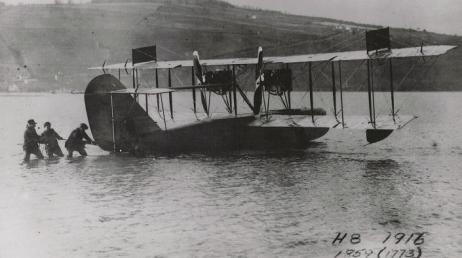
The Curtiss H8 in a 1916 demonstration.
Goldstone, in this book, argues that because of all the disputes and court cases the fledgling aircraft industry in the US fell behind those in other countries – particularly France, Britain and Germany. He maintains that it wasn’t until some years after the end of WW1 that America began to catch up with the others.
For anyone with an interest in early aviation and ‘those magnificent men in their flying machines’ this is a must read. At least five thumbs up!
 Wendy Welch: Books, Yarn, Cats, Opioids