
The Monday Book: Life without Parole – by Victor Hassine

Jack’s guest post is actually the Monday book so could be on time or not –
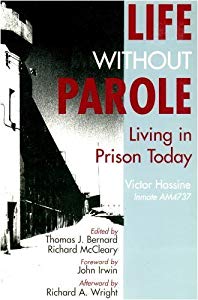
life without parole

I have been a regular monthly visitor to our local Federal Penitentiary for nearly five years. Each time I visit with two inmates for around an hour with each and we talk about all sorts of things.

But the hardest thing is to get any idea of their everyday lives before and after the visit!

I got some idea from ‘Orange is the New Black’ by Piper Kerman, but that was from a woman’s perspective. However Wendy gave me Hassine’s book and that really opened my eyes. His experiences were in a state prison but I’m sure they would have been much the same in ‘the pen’.

‘Life Without Parole’ is a series of essays or interviews by an inmate sentenced to life in 1981 who was an educated and thoughtful man. He documents his experiences over time, his conversations with fellow prisoners and his observations on the culture of prison life.

Hassine makes no attempt to excuse his crime or to suggest he doesn’t deserve his punishment. He simply relates his life behind bars.

This book spares nothing and describes a desperate and harrowing world that I have had the tiniest glimpse of. Hassine doesn’t try to excuse either himself or any of his prison community, yet draws us in and shows us a parallel world that ‘there but for the Grace of God’ any one of us could only too easily be part of!

His analysis of the various problems with the prison system is scholarly and erudite and makes for gripping reading. Each chapter features an introduction written by eminent criminologist Robert Johnson, and the book is divided into three sections: Prison Life, which introduces readers to the day-to-day aspects of Hassine’s life in prison; Interviews, which presents a series of candid interviews with Hassine’s fellow inmates; and Op Ed, in which Hassine addresses some of the most significant problems within the current prison system.

The author was an Egyptian born immigrant to the US and a law school graduate. He died in prison in 2008 under unclear circumstances although it seems likely he took his own life following an unsuccessful appeal.

I can thoroughly recommend this book, which is now in its fifth edition, to anyone interested in prison life.
 

Not ‘The Scottish Play’ – – –

Jack easily makes it for a change – – –

Easterhouse is a suburb of Glasgow, Scotland built in the 1960s to house folk from old tenements in the middle of the city. Unfortunately it quickly became a kind of ghetto because the designers didn’t include any amenities – no shops, pubs, cafes or any social gathering places. It was just a windswept series of high-rise apartment blocks that could only be accessed by scary elevators and it equally quickly became notorious for gang warfare and drug use!

This was the setting for one of the most bizarre gigs that my old folk-band ‘Heritage’ ever played. A lovely group of enthusiasts decided to recruit local folk to form a theater group that would perform ‘A Midsummer Night’s Dream’ at midnight on that very night.

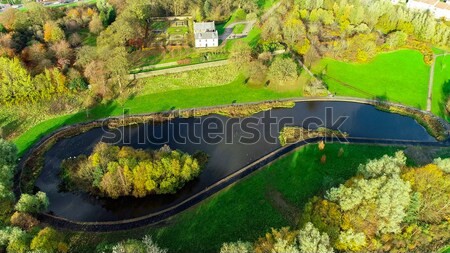
Easterhouse had a very unlikely potential venue for this event. It had a park (Auchinlea Park) set on a slope with the ruins of a medieval castle at the top and big old trees down the slope leading to a loch. The idea was to construct stages in the trees and the main one down the bottom. Somehow the organizers got funding to put it all together, but they then needed music – – –

auchinlea (2)

We were in the highest tree in front of the buildings and the play was performed on the grass beside the loch.

This was where we came in. We were contacted because a much better known group had pulled out and suggested us as an alternative (something that happened to us from time to time!). So a couple of nice women came over to Dunfermline and ‘auditioned’ us while we played lots of instrumental sets. They homed in on various tunes that involved fairies (you do know the ‘Dream’ story?). In the end they chose ‘The Fairy Reel’, ‘The King of the Fairies’, ‘The Fairies’ Hornpipe’ and a set of French polkas!

Having been hired and given our orders and a script, we discovered we would be the ‘Mechanicals’ (do you really know the story?). We would be in costume, be on the highest tree stage close to the castle ruins and be connected into a sound system. We would be required to play the fairy tunes when Titania and/or the kids dressed in fairy costumes made their appearance. Also, whenever the Mechanicals appeared in the script the lights illuminated our perch in the trees and we launched into the polkas.

We arrived to find there had been a power outage – resolved with minutes to spare. The performance began and was both well attended and entrancing. Lots of kids dressed as fairies hit their marks perfectly and danced to our various fairy tunes.

What we didn’t know was that directly under our tree was the route from the nearest pub back to the apartment blocks, and coincidentally under our tree was the favorite resting place to consume the ‘carry out’ to bolster the courage needed by the transients to face their wives (the Tam o Shanter sub-plot).

We came to a significant ‘Mechanicals’ point and launched into our Occitan polkas! We finished and from under our tree during the following silence came an insistent and repeated call – “see us anither tune on the banjo Jimmy”!

What non-Glaswegians should know is that any stringed instrument there is referred to as a banjo (just ask harper Billy Jackson), while any random male person is addressed as ‘Jimmy’.

We tried to hunker down and ignore the pleas from below and also knew that we would be required shortly to play another set of fairy tunes – – -. However, after an interval our friends finished their libations, decided they were seeing and hearing alcohol induced fantasies and headed home to face the realities.

The play was brilliant but the really funny part is that those polkas were led by that most Scottish of instruments – the banjo!