
Jack’s Wednesday guest post –
There’s a real satisfaction in taking part in a construction project being led by someone who really knows what they are doing. I had that experience last weekend and this is my report.
Wendy’s friend and colleague Beth, and her husband Jon live up in Blacksburg and last Friday Jon left home at 5:30 am to drive down here with a full load of lumber and a magnificent array of tools, ready to completely re-build the front deck of ‘Hazel’s House’ (our new cat rescue center).
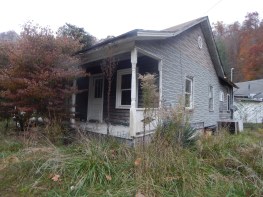
How she was before
Jon reckoned it could be done over three days, so Friday, Saturday and Sunday were set aside and he was down here and started by 9 o’clock on Friday morning. I had volunteered to help and Wendy and Beth came along later that day as well.
Just to set the scene – the house was built in 1917 (so exactly 100 years old) and is single storey, with a porch running the full width of the front. The porch has an overhanging roof with four pillars supporting it (all of them had shims underneath added at some point in the past).
The first job was to install temporary supports from the ground to the front of the roof beside each of the pillars to take the weight. Then we separated the pillars from the deck and began removing the old deck slats. Once they were removed we could see the state of the underpinning joists and foundations and that revealed some problems. The biggest one was that the front joist had rotted and split and had to be completely replaced. Jon built a 28 foot long, 12 inch wide and 4 inch thick joist by laminating six boards together and Saturday’s big job was four of us maneuvering that into place! To our utter delight it fitted perfectly, although it chose to rain just as we were committed to the task, so we all got soaked.
The center of the deck had gradually sunk by almost two inches over the years (hence the shims under the pillars), so the next job was to get that part raised back to the correct height again. Once that was done it was time to re-install the deck slats and we decided to fit new ones in the center section then use the old ones as much as possible for the outer areas. Poor Beth got the job of removing all the nails from the old boards! Finally it was time check all the levels, re-fix the pillars to the new deck and remove the temporary supports supporting the roof.
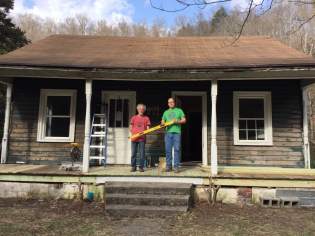
And how she is now
As I suggested at the start, what made the whole experience so satisfying was the way Jon had thought through the job very thoroughly beforehand, measured everything carefully ahead of time and brought lots of really useful tools and equipment. He had even thought to bring an additional power driver, knowing we’d both be re-fixing deck boards at the same time. We only had to make one run to Lowes over the whole weekend and that was just because we couldn’t reclaim as much of the old decking as we’d hoped.
Next month Jon will be back, when we will add partitioning to make the porch and deck ‘cat-proof’ so no kitties can make a break for it when we’re transferring newcomers into the house. I’m looking forward to once again being his laborer and apprentice!
 Wendy Welch: Books, Yarn, Cats, Opioids