
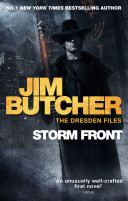
The Monday Book: STORM FRONT by Jim Butcher

storm frontFinding ourselves headed 12 hours by car up the road to Wisconsin for the Fox Cities Book Festival, Jack and I put out a plea to friends for recorded books. (We forgot our town library doesn’t open until 1 pm on Saturdays, and we were supposed to leave that morning.)

Several friends brought us books, and the first one we put in as we drove was  Butcher’s introductory mystery of The Dresden Files, an ongoing series about a wizard named Harry Dresden.

The first book came out in 2000, and proved so popular that Volume 15 of the Dresden Files is due out in May of this year.

The writing is a hoot. Think Philip Marlowe meets Charlaine Harris. “Magic noir” is what I called it as we began laughing out loud at some of the great one-liners, sardonic toss-off remarks, and zany plot twists of this book.

The wizard is tall, dark and handsome, an old-fashioned courtly gentleman, a powerful practitioner, and at the same time something of a screw-up. If the book is a bit predictable, sometimes facile, well, you don’t really mind ’cause it’s such rip-roaring fun.

The hero wears a long dark Australian cattle rancher coat. He has a nymphomaniac skull named Bob working for him. His cat doesn’t respect him. Think rescuing damsels in distress, in low-cut evening gowns, in vicious thunderstorms, but with vampires, demons, and drug dealers, oh my. It’s a send-up of every serialized adventure guy-hero genre, ever: part mystery, part swashbuckle.

Jack and I laughed out loud at several lines, but one of my personal favorites was, “I was so mad I could have chewed up nails and spit out paper clips.” It’s overblown high-jinks fun, Butcher’s stuff. And it makes the road much, much shorter. We actually had to turn it off coming through Chicago. I kept swerving from laughter.

The Monday Book: THE YEAR OF FOG by Michelle Richmond

FogPublished in 2007, this drifted into our bookstore, and I picked it up because it had a beach on the cover. It’s been a long, cold, lonely winter, and despite what your teachers told you, yes, you can judge a book that way.

From this inauspicious beginning, Fog turned into one of those books you carry with you from bathroom to bedroom, stuff into your purse in case you get a spare minute, sneak open when you should be dusting. It’s a cracking good read.

Richmond has a kind of four-part harmony going throughout her novel: it’s part mystery, has a lot of science bits about the brain and camera function in it, contains about three love stories, and is lyrically philosophical. Too intellectual to be a fast read, too compelling to be a slow one, all I can say is Richmond may well have invented a new genre: smartlit.

The story rolls around a central theme: a photographer named Abby, engaged to a man with a little girl, takes her for a walk on the beach, and the child vanishes. The whole next year is about memory, loss, memory loss, and how our brains work–not to mention Abby’s search for her missing step-daughter-to-be. Reminiscent of Kingsolver’s Animal Dreams, but more tightly woven as one story, the themes swirl around each other: protagonist Abby relives a bad love affair while trying to keep her current one alive; she researches brain activity, giving lovely insights into what the hippocampus and amygdala do and how we live that out day to day; she explores what it means to be the stepmom in a family, to love two people as part of a whole package; and then there’s the actual mystery of where the little girl went, and why.

My agent Pamela and I often discuss narrative arcs (she sometimes in despairing terms at my journalistic writing style) and this book is not only a good read, but teaches a great deal about how to create one. The themes are so tight intrinsically, yet bounce off each other so well that, if one of them doesn’t interest you all that much, you can skip it and still enjoy the story. I didn’t give two hoots for Abby’s old love affair, but skimming those parts didn’t diminish devouring the book an iota. Richmond’s writing is an odd amalgam of tight and fast, yet relaxed and unhurried. It’s as if Ernest Hemingway had allowed himself to be happy in life, and this got reflected in his writing.

As our shop cat Valkyttie would say, two paws up for Richmond’s The Year of Fog. This author has other books; I’m going to keep an eye out for them.