
HOPPY WINS THROUGH

Wendy and Jack flew to Albuquerque this week. They may be a little tired.

The weather out of Denver was windy. Very windy. Hoppy, the bunny conferred with his colleagues Cortez the sea turtle, and Peachy the red fox. All three graced the tails of Frontier aircraft, but only Hoppy’s was scheduled to go.

The raccoon wasn’t there

“It’s windy,” said Hoppy, his ears laid back.

“No shit,” said Cortez. “You still gonna fly?”

“Gotta get these passengers to Albuquerque.” Hoppy’s nose twitched in the general direction of the people shuffling onto the plane, clutching bags and hats against the breeze.

“Well,” said Peachy.

“Nice knowing you,” Cortez added.

The plane took off, almost immediately jacking sideways against the currents. Inside the cabin, a child began to wail. Hoppy folded his paws and waited.

The flight was only 56 minutes. As the craft reached cruising altitude, the turbulence eased. The child ceased screaming. Hoppy breathed a sigh of relief. So did the passengers.

With twenty minutes to go, the pilot sent the flight attendants a message: fasten in, it’s going to be a rough landing. The chief flight attendant told the passengers that if they wanted to go to the bathroom using an actual toilet, now was the time and that would be appreciated because otherwise they would have to clean the seat if they didn’t. The passengers were not amused, but several with small children got up and were promptly sent back to their seats because federal aviation regulations prevent queueing at the lavatory while in the sky.

Hoppy watched everyone buckle in. His nose sniffed the wind. And pee from a couple of children who hadn’t made it.

The plane’s nose dipped. Hoppy squatted on his haunches, a look of steely determination on his face.

“How’s it going?” Peachy’s voice came in through Hoppy’s antenna ears.

“Looking grim. I’ll see them through, Peachy.”

“You always do,” said Peachy. In the background, Cortez the turtle sang “Sooooo long, it’s been good to know ya.”

Inside, the passengers began to tighten their belts and look nervously out the window. Hoppy turned his ears toward the control tower and heard “… too much crosswind so circle around.”

The plane banked sharply left. Inside, the child began screaming again.

Hoppy hunched over the wing, gripping tightly with his paws. “I’ll see them through, no matter what,” he muttered, and began to battle the wind. Left, right, up, down, his paws flexed flaps and pulled levers, ears flat against his head, whiskers pointing due north.

The plane descended, hit an air pocket, and bounced. The screaming child was joined by several passengers.

“Fuck,” said Hoppy, and regained his footing, using his lucky rabbit feet.

A final dip, a swift correction, and the plane bounced once on the runway. Hoppy pulled hard on the brake, whiskers and ears flat against the wind. The plane stopped. The child stopped screaming. So did most of the passengers.

Hoppy wiped sweat from his furred brow and adjusted his ears.

“Everything all right over there?” Peachy’s voice came in loud and clear.

“Just peachy, Peachy. I got them safely in.”

“You always do, Hoppy,” Peachy said.

In the background, Cortez spoke. “We said a fiver, you cheater. Pay up.”
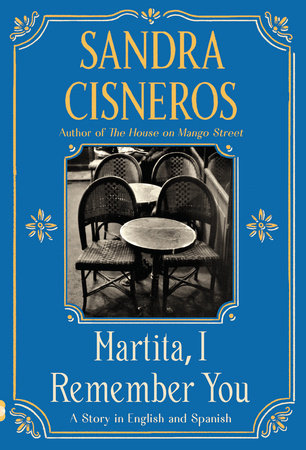
The Monday Book: MARTITA I REMEMBER YOU by Sandra Cisneros

While Wendy attends a conference in Albuquerque, guest reviewer Janelle Bailey offers some excellent reading advice. Janelle was a shopsitter for the little bookstore, and is an AP exam reviewer in Literature.

Having taught Sandra Cisneros’s writing in several American literature courses for years, and also greatly enjoying it and appreciating her voice and engaging stories, I was so excited about this brand new book coming out.

I was not disappointed at all, except possibly by the book’s actual brevity. It only reads in English halfway, and then is the very same in Spanish from the other side, and while that is a really neat feature of the book, it means that it is even shorter—by half—than it appears. And that is just too, too little Cisneros for my liking.

Part of what prompted me to like this book so much is that in addition to it containing and sharing Cisneros’s voice and writing, it is set primarily in Paris. The last trip I took abroad pre-pandemic included a very literary visit to Paris, one for which I did much reading before, during, and after about and by some of the legendary literaries who lived and wrote from there. We visited the legendary Shakespeare and Company (there was a LINE outside waiting for the bookstore to open, so amazing and warming, stimulating of my book-loving mind), and I bought and then read the book by the same name about the bookstore and written by Sylvia Beach and and all that happened there. Many of the best known literaries picked up their mail from there as well purchased English copies of books and met there to visit.

This is all to say that I became quite enthralled on that trip and in my thinking with with a very nostalgic acknowledgment of so much that had thrived, literarily, in Paris during earlier times. We visited Les Deux Magots, too—one of the oldest and a still legendary café that was frequented by a number of famous artists, Hemingway and other writers among them.

And reading this book recalled for me much of that trip and associated reading. And both the trip and this book cause me to pause in gratitude for Monsieur Feldhausen, my high school French teacher. He instilled that initial love of all things “Francaise” and all things “Paris,” which precluded my changing my major to English, studying abroad for a semester of college and traveling afterwards to Paris and other parts of France, but which have allowed me to always remember so much of what he taught me then, providing for my ability to still read and make sense of much French—enough, at least, to make sense of all that Cisneros writes tin that language here.

All to say that this wee book sparked volumes of reminiscence for me, such that I unpacked from it a whole lot of goodness far beyond the short story that is actually here: primarily it tells of a wannabe writer’s (young Cisneros’s herself?) wish and wait, while struggling in Paris, to hear that she can start her writing career; it is the sharing of her experiences meeting people, being challenged by her dependence on others at times, seeking and finding her way while so poor and so far away from home…but growing so much, too, and all the while, into a strong young woman of moral character, living this principled life while exposed to lots and learning for what it is that she truly stands. Yet this, too, is all conveyed as reminscence and reflection on that earlier time in her young life and from a great distance away in time, as the main character, Corina, is inspired one Saturday while working on refinishing a piece of furniture in her home in Chicago, to meander through some old memorabilia, including letters between herself and her friend Martita, as she finds herself thinking about her. And it all takes her back…beautifully.

Especially this book’s format—in English from one direction, in Spanish from the other–makes me wish to find another book so similarly presented, but half English and half French– –to read and make sense of from “both” directions. I think that students of the Spanish language as well as native speakers will find Cisneros’ new book especially satisfying. But so, too, will anyone willing to reminisce and engage…as I did.