
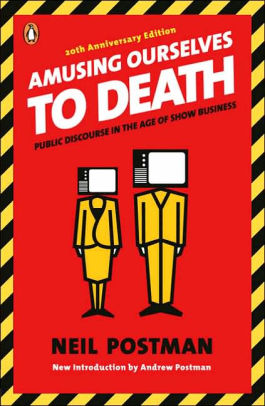
 In the 1960’s the media and culture critic Marshal McLuhan famously opined “The Medium is the message.” Neil Postman, who was a student of McLuhan’s expanded McLuhan’s thesis in “Amusing Ourselves to death.” The book is a stinging critique of the television culture and how television and other forms of media have changed society forever, and not for the better.
Postman takes us through a brief exposition of the history of language communication pointing out how each new development, from writing to the printing press to the telegraph expanded our access to information while at the same time exposing us to more and more information that we had little use for. He points out that while a man in 19th century Virginia could learn about the happenings in New York, he had little use for the information.
The advent of radio and television increased the deluge of information reaching us every day, but with the added problem that these media must keep our attention so that we are not tempted to change the channel or get up and go to the kitchen for a bag of chips. When this strategy is applied to news and information it tends to trivialize. An average evening news cast may feature news of a horrible wreck on the Interstate juxtaposed with a cute puppy story followed by an ad for a new dish detergent, with the most frivolous stories given the same weight as the most important.
Postman died before the advent of modern social media, but one can guess what he might think about a medium wherein profundity is now limited to 140 characters or less, and with a constant firehose of data spewing from one’s device it is impossible to sort through it all, and studies show that one is most apt to pay attention to information with which one is already in agreement.
Is it any wonder that college students, who, having grown up in a world where they could ignore or drown out any idea they did not want to be bothered with, are asking for “Safe Spaces” where they are sheltered from thoughts with which they disagree. Postman would see it as a logical progression of a society in which information is as cheap as air. As Michael Crichton put in in Jurassic Park, “In the information society nobody thinks. We expected to banish paper, but we actually banished thought.”
 Gnomeland: An Introduction to the Little People
 Wendy Welch: Books, Yarn, Cats, Opioids