
Clapton’s Guitar (Allen St. John)
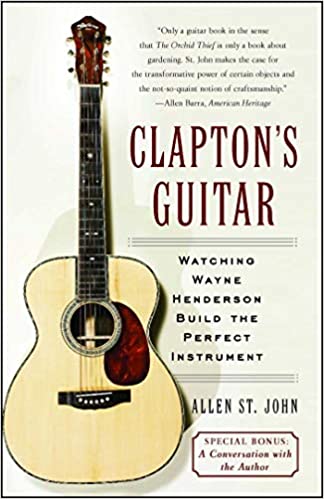
Jack presents the Monday book today
As I’m a bit of a guitar freak, I looked forward to reading this and I wasn’t disappointed. However, I do have a few caveats –
First of all, despite the title, this isn’t a book about Eric Clapton – he makes no appearance. This book follows master guitar luthier Wayne Henderson as he builds two nearly identical guitars. One is being made speculatively for Clapton while the other is to auction off and raise money for Junior Appalachian Musicians (Jam). Jam was the brainchild of Henderson’s late partner Helen White and there are branches throughout Appalachia.
This brings me to my second issue with the book. There’s hardly a mention of White or JAM in the book, which strikes me as very strange. I have seen Wayne and Helen perform a good few times together and their individual activities were very much intertwined. Perhaps she declined to be involved; I don’t know. I only know Henderson by reputation, whereas I had a friendly and mutually respecting connection with White through providing advice on tutor training for JAM. There’s no report in the book of how much went to JAM or whether any did.
I’m also not impressed with the way the author describes the various characters who hang out regularly at Henderson’s workshop. There was more than a hint of Appalachian stereotyping and condescension. For example, eating cold fast-food and the famous tail out of the box trick.
Aside from these issues, the book does describe wonderfully how Henderson puts these guitars together, where he gets his wood, the tools he uses and the sheer craftsmanship involved. This I found truly fascinating. I won’t give you a spoiler on whether Clapton bought the guitar.
The author is also a guitar freak, and he references many other excellent and well known luthiers, such as T. J. Thompson (I’m surprised he didn’t include Dana Bourgoise in Maine or Chris Bozung in Nashville.)
If your interest is in how a top notch luthier puts together a hand crafted guitar, then I can thoroughly recommend this book. Just ignore the ‘local color’ and wait for another volume that should be written about the life achievements of Helen White.

 Wendy Welch: Books, Yarn, Cats, Opioids