Jack’s Wednesday guest post is a day early – or more likely a week late – – –
Wendy reminds me often about our marriage vows. She has a much better memory than me so can remember them in much more detail. I can only remember that I’m supposed to keep her happy and comfortable.
Last week she reminded me of one that involves checking on our chickens and making sure that they have food and water. I hadn’t remembered that one.
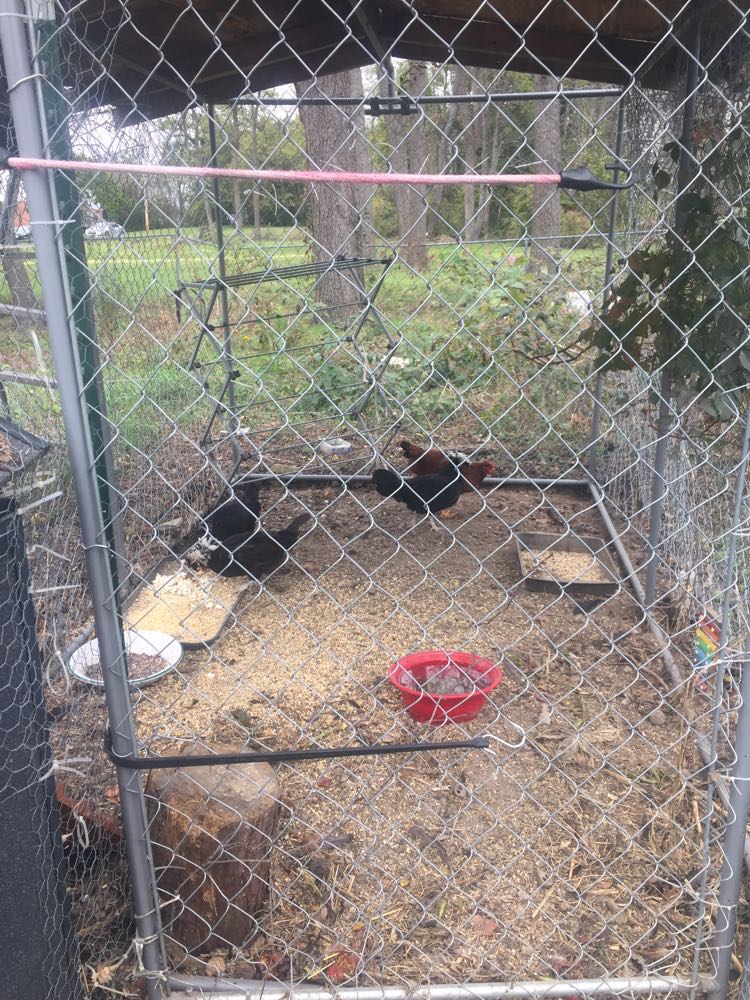
I should explain that we currently have four chickens in a wire mesh pen at the far end of our backyard. To get to it you navigate a narrow flagstone path between two vegetable gardens and then across a grass area littered with fallen black walnuts strewn around. You know, the ones the size of baseballs.
So it’s a long walk across a bit of an obstacle course anyway, made more difficult when carrying a pan of water and a tub of mixed grains for the feathered darlings.
I set off gingerly and successfully arrived at the gate to the pen. It is wire mesh and held in place by two elastic cords with metal hooks on each end. I opened the gate and delivered the water and food, then exited and closed the gate, I fastened the bottom cord in place and then started to the top one. The hook slipped out of place, the cord sprung back and the metal hook hit me full in the face!
Having explained to the chickens that this was all normal and intentional (they were immediately concerned about the supply chain effects, you see) I retraced my steps down the narrow path and towards the end tripped over a raspberry cane lying across the flagstones in wait for me. Reaching out my hand to keep my balance I fell on my back but not before stubbing all my fingers on a concrete slab!
I wish now I had kept at least one copy of those marriage vows just for future reference and to be sure Wendy didn’t make the chicken feeding part up. See, I don’t think we had chickens when we first got married. I understand her insistence that taking care of the litter boxes is in the vows; we did have a pre-marriage cat. But the chickens? That would have been very prescient of her….
Oh – and another one seems to have been to get her large diet cokes with light ice – – –
Sometimes the best parts of a holiday are the little things, and this was a day full of the small happinesses that make up a big happiness.
First thing: the hotel had a pool. I got up early and enjoyed it, but as the minutes ticked by, it began to fill with Germans who all knew each other, and who had no intention of circle swimming. The water came to look plowed as people continued to pile in, and since I wasn’t with them, and I was doing a 20-minute water tread instead of swimming back and forth, dirty looks came my way.
Not so the lady swimming back and forth next to me. I scooted over, and she smiled and said in a very Scottish accent, “I can go around ya easy enough.” We began chatting as she half-protected me from the encroaching snarling women who wanted my corner for their own. She swam at the pool mornings before going to her nursing job in town.
“Is it always this crowded?” I asked as two more bodies tumbled in next to us.
“Nah. Sometimes it’s much worse.” She grinned.
After the swim and a fun breakfast full of international foods again, off we went to Dunfermline.
Now you need to remember that Jack and I used to live here, and in the East Neuk, so for me this was old home week. Everyone else was oohing and aahing over the sites and I was looking to see if the tea shop was still on the corner. I was also very aware that Dunfermline’s High Street, not far from its historic abbey, has seven-count ’em, seven-thrift stores. The abbey is next to the library and I ran a storytelling club there for about a decade.
So Cassidy and I went to the Abbot’s House just in front of the Abbey, because it is beautiful and historic. It was owned by a lady who basically kept Scotland’s second-most famous poet safe during the Reformation. She was rich, and she was a royal backer, so when she took him into her house as a guest, Robert Henryson was safe, even though some of his poems had not been looked on kindly as religions and allegiances swung back and forth in the ponderous pendulum of who was trying to get more power. After the reformation, it was owned by an herbalist named Anne Halkitt who almost got burned for a witch; ironically the great Dunfermline fire saved her.
Back when the Historic Trust for Scotland was trying to get more kids to visit historic properties, I led mouse hunts through the Abbot’s House, telling kids the sanitized version of various historic events, and letting them look for the mice that decorated the walls because Henryson had done Scots versions of the Aesop fables, and there was the infamous story of all the mice leaving town before the great fire that destroyed the house’s second floor in the 1600s, etc. It was fun. And I still know where every mouse is, and what she represents.
But my favorite part of the Abbot’s House is out front, in the saying over the door, which I will translate here: Since word enslaves but thoughts are free keep well thy tongue I counsel thee.
Good advice then, good advice now.
After the Abbot House Cassidy and I peeled off as the rest of the group followed Jack into PIttencrieff Park. The biggest thing to know about the park is, Andrew Carnegie (yeah, the guy who got rich) was born in Dunfermline and not allowed to play in the park as a child. When he made the big time, he bought the park and opened it to all the children of Dunfermline. Sometimes, just sometimes, the best therapy is revenge. But only if the revenge is kind to other people, shall we say?
The second thing to know about the park is, by skipping it, Cassidy and I found two sweaters, two rare recordings, a pair of shoes that looked like cats, a purse, and some yarn.
It was a good morning.
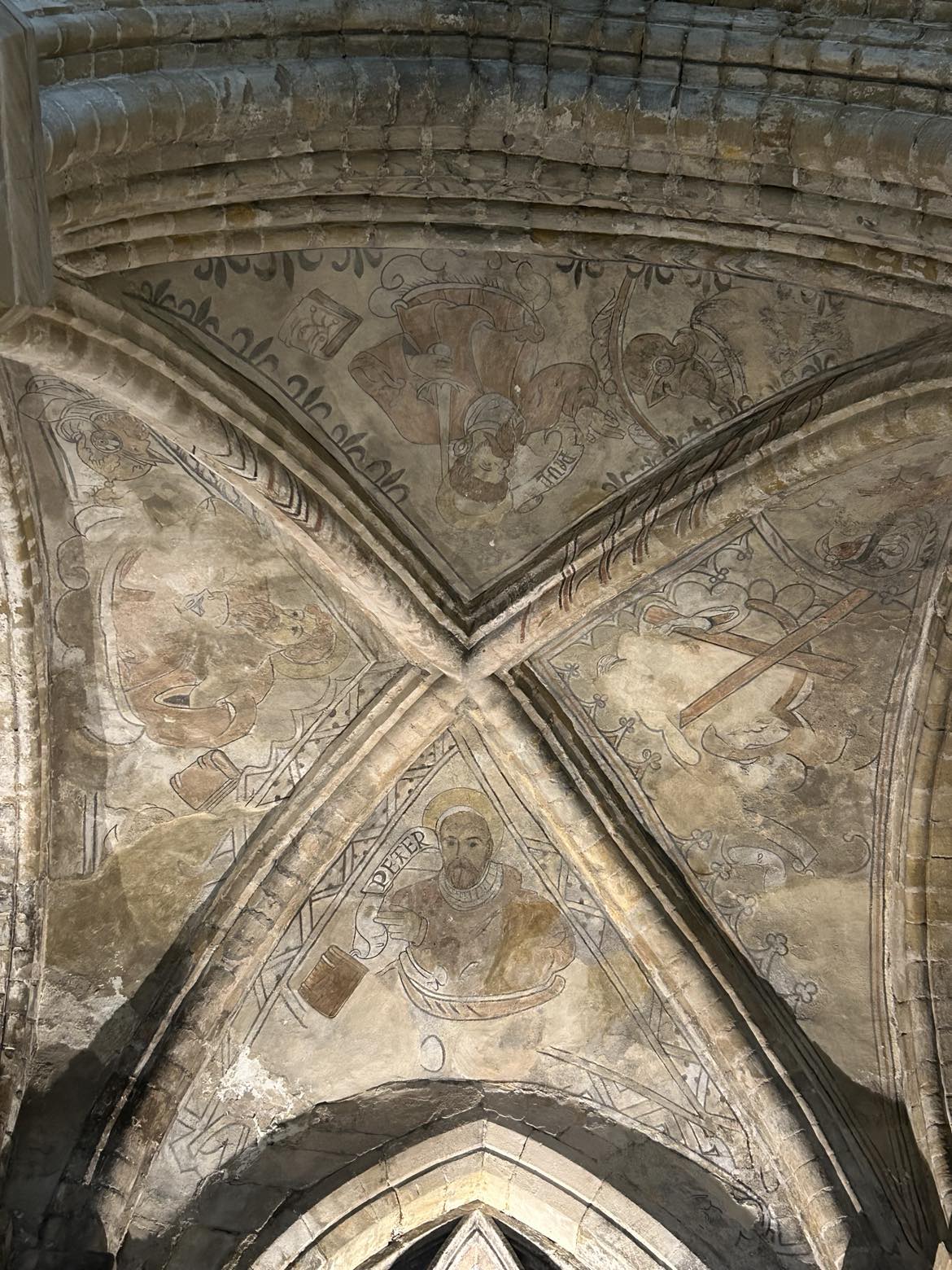
Dunfermline Abbey is gorgeous and one of those places my friend Donald Leech (a medievalist at UVA Wise) likes to hold up as what people get wrong about those times. Color was EVERYWHERE in this abbey. All the colors they knew how to make (three, but hey it’s a start) were spiraling around pillars, decorating the sides of the stained glass windows, across the coats of arms of wealthy families who went to church there.
The palace next to the abbey was originally a priory, and then King David I (1124-1153) made it into a palace. Charles I was the last king to be born there in 1600 (he’s the king who got beheaded after a trial for treason in 1649. It’s unusual for a king to be beheaded, but that Declaration of Arbroath changed a lot of the responsibilities royals were expected to uphold for their people.)
One more thing about the palace: David was the son of Margaret and Malcolm, and if you want to read about an amazing piece of Scottish history, look up Malcolm Canmore and Margaret of Hungary. There isn’t enough space to go into their lives here, but they might be the most fascinating royal couple ever. The only thing I can’t resist saying here is, Shakespeare missed the better story. MacBeth reigned shortly before Malcolm (whose reign ended in 1097, and whose father was Duncan; yes, THAT Duncan). Shakespeare really should have written about the double Ms. They were formidable.
But he didn’t. And Cassidy and I still beat everyone else to the abbey, despite our shopping streak. We had a wonderful look around, imagining the colors on a sunny day and the monks walking on the now-derelict walkway above, and the gold stars put into the ceiling. It would have been heady.
Then we walked out to the palace, and Cassidy went to the tower while I went to the queen’s chamber. We met later, and compared notes. What the guides don’t tell you is that taking the turning stairs to the second floor of the ruined palace is, in a word, terrifying. Hands and knees, I crawled, telling myself it was okay, I knew Jesus, if today was my day He would receive me, although He and all the angels would be laughing at how I died. And thinking that my tombstone would say “she was an eejit for trying” and also thinking that once I got up, I would have to come back down….
Cassidy later sent a video of herself, hyperventilating as she inched down, hugging the wall. Highly not recommended. Andrea took one look and said, “Nope.” Harry just turned around with her.
I think Mr. Fox might have tried it, but Lulu wouldn’t let him.
Altogether once again, we visited the gift shop. Because that’s what you do after seeing almost a thousand years of history and surviving a near-death experience.
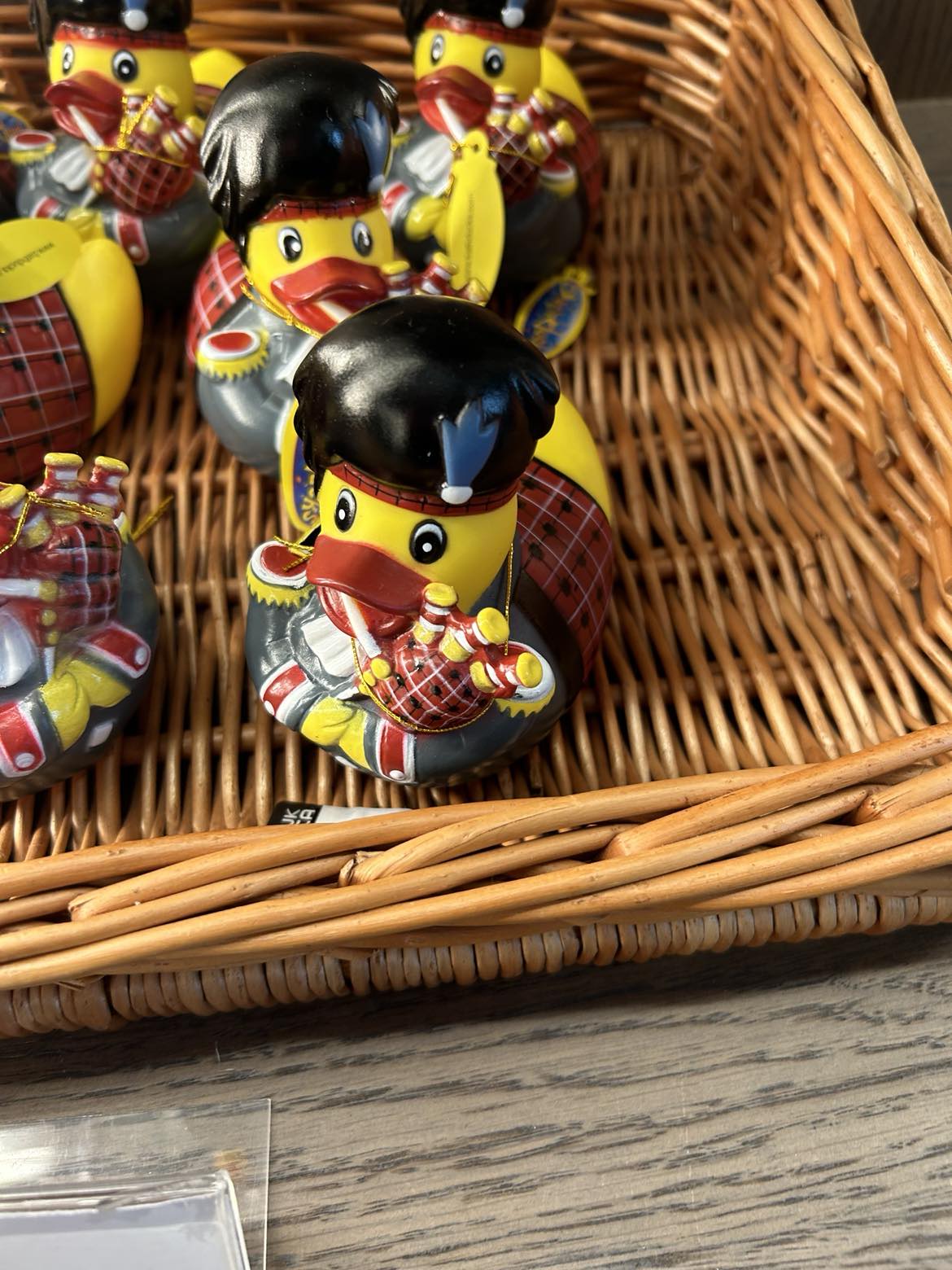
Awed by the majesty and the intense history of the place, I bought a rubber duck in full regalia playing the bagpipes. Made in China sticker on its bum.
In my defense, it was for a good friend who collects them and loves Scotland.
Off to Falkland we drove, everyone comparing notes on the palace stairs. Fiona hadn’t tried, Gareth raced up and down them, and Lulu didn’t want to talk about it.
Falkland is famous for its marriage stones. On either side of the top the doorway in a newly built house (back in the 1500s and 1600s) people would put stones with the initials of the two newlyweds, and the date of their marriage in a stone in the center. What’s really sweet is some people in the side streets of Falkland paint pieces of slate with their initials and date of marriage and set them beside their doorways.
The Falkland palace was the royal hunting lodge (read: weekend getaway) for the Royal Stuarts. Mary Queen of Scots would have hunted there, along with her traitor son who agreed to her execution so he could be both King of England and of Scotland. (This is the one who was terrified of witches and nothing went well for herbalists and other strong women for awhile there in either country.)
Falkland holds 500 years of amazing Scottish history. It’s also where they filmed the opening scene of Outlander, so the buses just kept pulling up to the market cross and teashop, one after the other. People filed out, took photos, filed back on, and the next bus came.
I can’t really talk. I bought a duck playing the bagpipes in one of the oldest preserved abbeys in the country.
And then it was off to the East Neuk. Of course we had to go to Anstruther for their famous fish suppers (for lunch, you understand). Even Gareth couldn’t finish all the leftovers. I used to joke about the self-loathing that follows a good fish supper given that everything is fried and battered and bad for you and tastes so good.
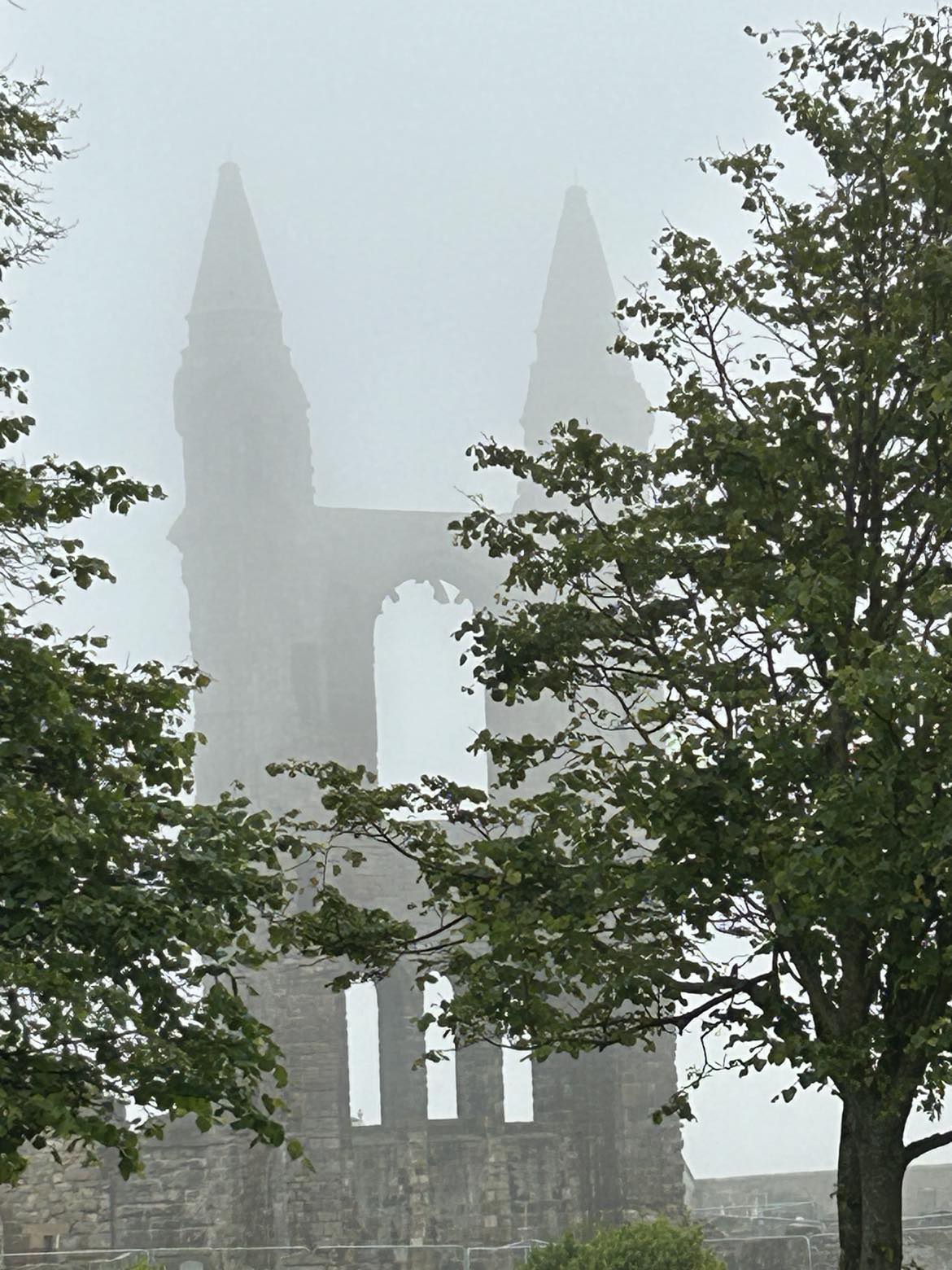
And then it was St. Andrews. I feel a bit sad visiting St. Andrews these days. When we lived in the area it was my go-to for the grocery store, or a day out thrifting, meeting a friend for tea, and walking the cathedral grounds. It kept me grounded when I was writing my dissertation, as a newly wed while Jack was working during the day.
But the cathedral ruins were declared unsafe after some stones and mortar fell from a tower. They embedded in the ground and everyone knew it was time to fence the ruins off. So now they’re behind chain link.
St Andrews is also the place where, as you walk past the ruined palace on one of the side roads to the shops, you can look down and see the brass X where Wycliffe was burned to death. The Bible translator. Just walking around, and that’s where died. It’s a wee bit melancholic.
I showed Cassidy how to find the 12 charity shops of St Andrews, and then Jack and I went on an errand.
Several years ago, on another trip to Scotland leading a tour, Jack had bought me some Sheila Fleet earrings. These are high end Scottish-themed products. And on a recent trip to Richmond, one fell off. We were going to replace them.
But when I told the lady in the shop the story, she went behind the counter and produced a catalog. “The Fleets will replace a lost earring. And since these are sentimental from your husband, she would be happy to do that.” She gave me contact details, and wrote down the model number and information. “I’d be happy to sell you a new pair, but what you really want is your old pair intact. And that’s a design she doesn’t do anymore, but she never throws away the molds. So write her.”
We took the card away, and this is on my to-do list once I finish all the adventure blogs.
From St. Andrews it was back across Fife to the hotel, where the sunny solarium was heaving with the Germans from the swimming pool. Some of them recognized me. I tried to keep a low profile. And there was sticky toffee pudding and cranachan for dessert, and everyone went to bed happy but feeling a little sad, too.






 Wendy Welch: Books, Yarn, Cats, Opioids