
Sorry about yesterday. My presence was required at multiple events in town, usually hefting luggage and smiling. Let’s pick up with our heroes’ adventures today, shall we?
After a hearty breakfast at Liz’s place we meandered down through the Irish back roads to the Ulster Folk and Transport Museum. (Think Williamsburg, but Irish.) Andrea loved the gardens, Maria loved the church, Cassidy loved the sweet shop, and Mr. Fox loved the farm.
Mr. Fox, I should say, picked up his very own fox puppet at the ginormous Giant’s Causeway gift shop the day before. The little guy fit perfectly on his paw, and when I passed them on the Folk Museum grounds, Mr. Fox and Zahnke party of three were enjoying the sights tremendously, with Mr Fox-the-puppet’s wee fox puppet making erudite comments.

Maria and I also passed a man walking alone in a blue sweatshirt emblazoned with a school logo. Schools in Scotland require uniforms (public or private). He asked if we had seen “the blue uniform school children” and we pointed him in the right direction. He thanked us and walked the other way. Don’t judge; teaching is a difficult profession.
Andrea and I spent a great deal of time sorting through linen dishtowels at the Folk Museum shop, trying to parse statements like “conceptually designed in Scotland manufactured in Indonesia.” After spending the morning learning how people harvest and weave flax, we were looking for something a little more… local? Although I understand the age-old dilemma between local quality goods and prices tourists will pay: you can’t sell authentic stuff at bulk prices. It’s an omnipresent problem in cultural heritage.
I bought my dad a plastic Rubik’s Cube with multicolored sheep on it, made in China. C’est la vie.
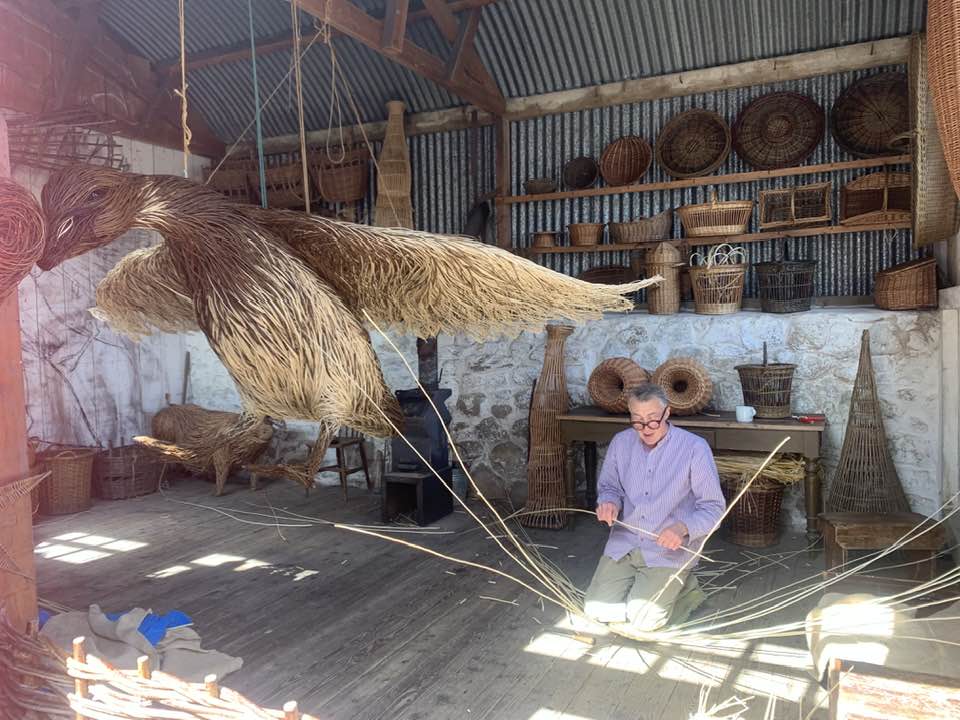
As a chair caner, I had to check out the basket weaver’s place, where we found a sweet story waiting. The big goose in the center of the caning area was made by the basket weaver in honor of one of the Folk Museum’s volunteers, a guy whose nickname and life symbol was a goose. The volunteer had spent more than twenty years working with the museum.
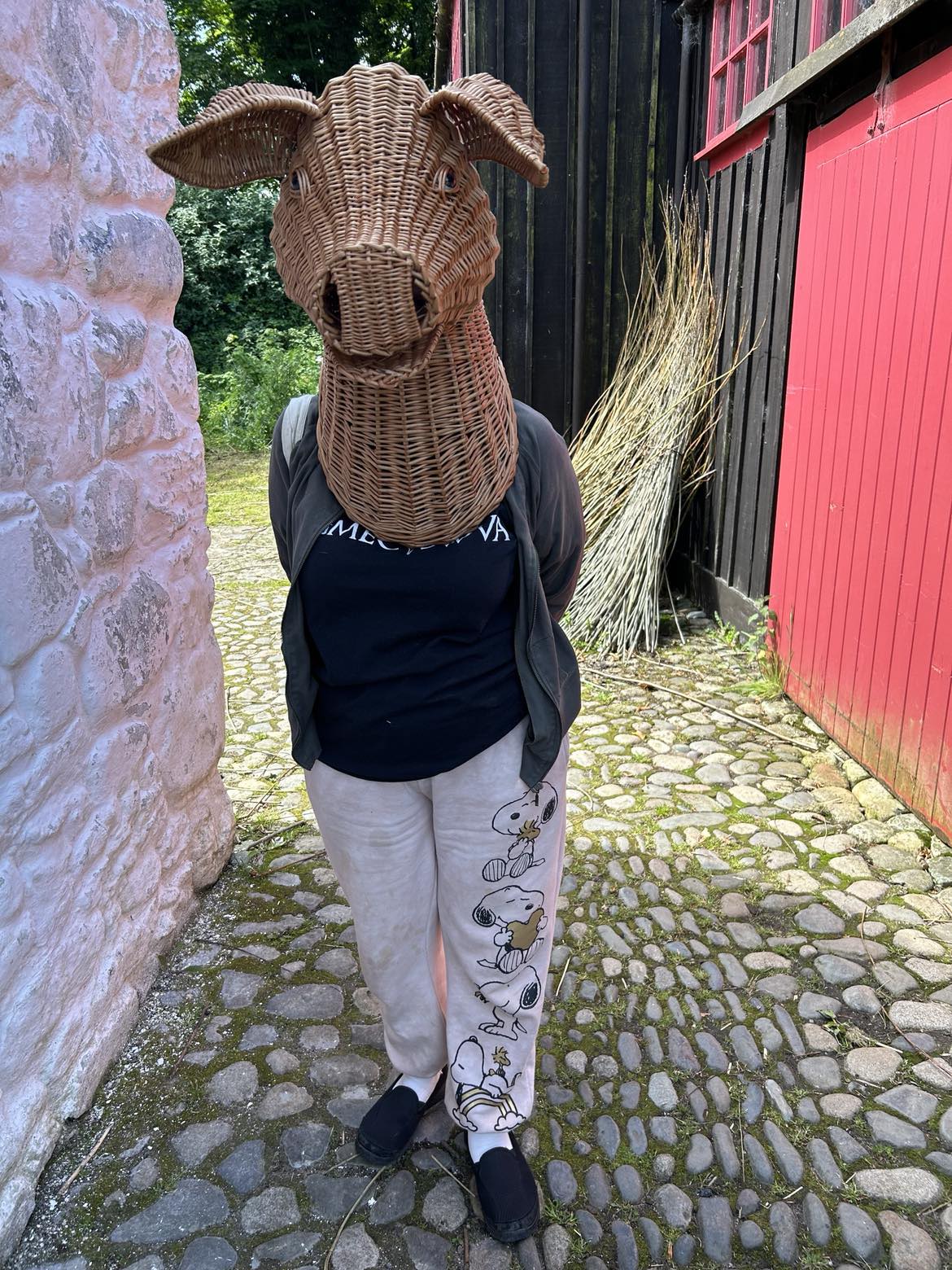
And of course, who can resist trying on a mummer’s mask shaped like a pig? When I was doing my PhD in Newfoundland, people would show up with masks while doing the traditional holiday mummering (when you go house to house dressed up in disguise and play music and dance; think Christmas caroling with a Halloween twist). But none were as cool as this pig.
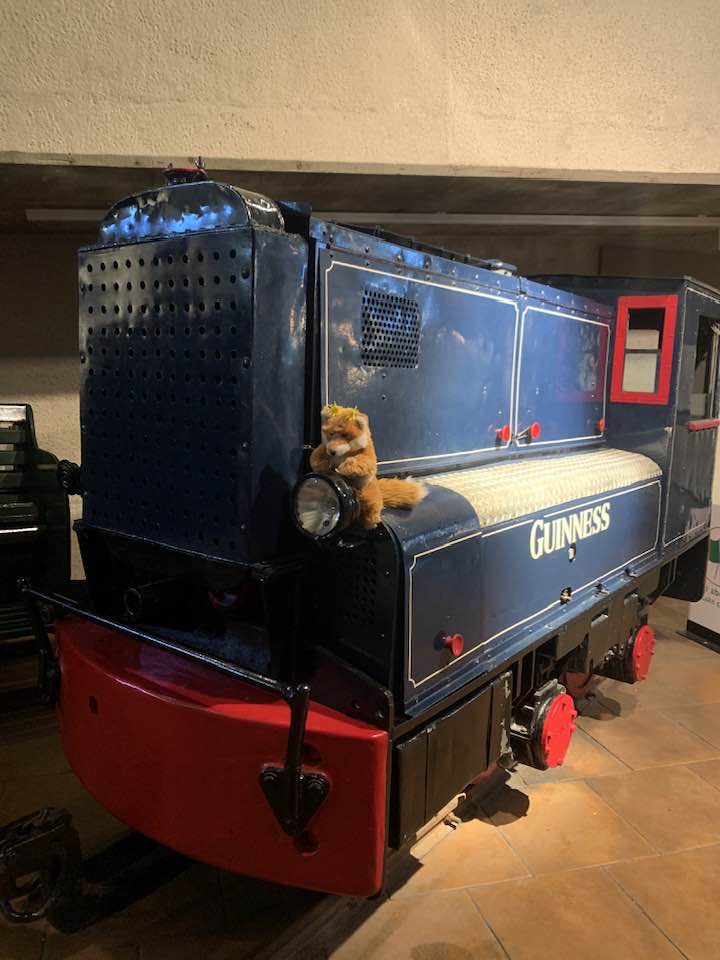
The Transport Museum is a separate building, built in a huge spiral, and just as we pulled in so did about six busloads of school children. After about an hour even Mr. Fox–who was thoroughly enjoying the day out–had seen enough of trains, planes, and automobiles–not to mention small children in school uniforms. But where were Lulu and Fiona? We had a ferry to catch.
The mystery was made more perplexing because Mr. Fox and his fox puppet were safely in the van. Gareth tried texting his aunt and grandmother, but no answer.
I went in search of them, and found them trying to hurry up a path blocked by six busloads of schoolchildren being paired up by their minders after having been told to use the toilets before the buses drove them home.
Since Fiona and Lulu had also wanted to use the toilet, and the occupancy rate at the museum gift shop was one child per square inch, they had been directed to the toilets at the bottom of the spiral ramp, three stories down, where the classic cars were kept. Fifteen minutes down, fifteen minutes up.
We made the ferry with a few minutes to spare, and ate dinner back at the Stranraer hotel of the Victorian elevator. Actually, I forgot one of the funny stories about this elevator from our first day in Stranraer, before we went over to Liz’s ceilidh barn. When we arrived, the staff handed out keys and pointed us to the wee lift. What we didn’t grasp, or they failed to tell us, was that the room numbers starting with 4 were not on the fourth floor. There was no fourth floor. The 400s rooms were evenly divided across a recently renovated wing of the hotel, 401-409 on the second floor, 410-419 on the third floor.
Complicating these numbers is that Scotland numbers its floors differently: when you get into an elevator, you will see G, 1, 2, etc. This translates in American to G=1, 1=2, 2=3. So if you ask if something is on the first floor, the staff will respond, “No, Madam, on the ground floor.” Which is always good for a couple of “who’s on first” kind of routines, Scots style.
But because the elevator at this hotel was tiny, we shoved Fiona, Lulu, and Gareth into it with their luggage and sent them unaccompanied to look for rooms 409 and 412. As the hotel had an influx of other guests arriving, I was lining the luggage up for our next team of the Meadors and Maria to get into the elevator, when the doors opened and I saw Lulu, Fiona, and Gareth still in it, arguing. Fiona was saying “But there isn’t a fourth floor, they must have given us the wrong keys” and Lulu was saying “if I get out and ask at the desk we’ll lose the elevator” and Gareth was staring straight out the elevator door with a glassy expression and then the doors closed again.
A minute later they opened, revealing the Zahnke women engaged in a lively discussion of what the hell was going on here. Gareth had removed his hat and was resting one elbow on the stack of luggage.
All’s well as ends well. We had supper, and fell into our respective beds in rooms on the third and fourth floor of the hotel, labeled second and third floors, bearing numbers in the 400s. And there was sleep by 9 pm. Americans abroad: we know how to party.

 Wendy Welch: Books, Yarn, Cats, Opioids