
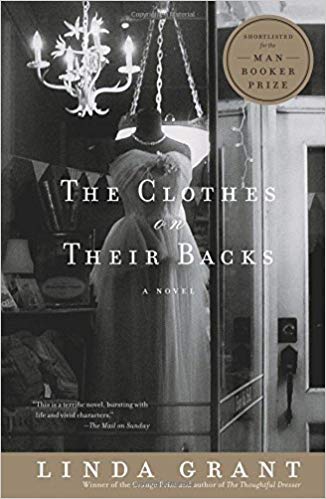
The Monday Book: THE CLOTHES ON THEIR BACKS by Linda Grant

grant bookThis book was interesting to me less because of its characters than the conundrum it presented, a morality tale of “who’s the good guy and who do you as reader get to judge?”

Remember when Breaking Bad set everyone to talking about when people go bad versus when they’re just trying to survive? Grant’s novel supposes two brothers from Hungary, one who left before things got bad for Jewish people, one who got caught–in Hungary, and again in England. But caught for what – being Jewish, or being a criminal? It all starts going sideways once one asks that question. So Vivien (the daughter of the older brother) sets out to learn what secrets her parents have hidden under platitudes, and what truths her uncle has hidden under crimes.

Clothing becomes almost its own character in this story, as people struggle between what they were, what they are, and what they want to become, showing their riches and their hopes by what they wear. I’ve never seen such use of fabrics and design, even in some of the trendy movies lately. Fascinating.

And Grant has this interesting writing style – plodding along, telling the story, then flaming into poetry, and back to prosaic, practical writing. Here’s one example, when the uncle is in Harrod’s department store:

Sometimes he would spend a whole day just looking at all the beautiful things he had once owned before he went to prison, and had treated far too lightly, feeling that they were like water that fell through his fingers.

This is a slow, savoring read. Make yourself some tea and settle in.


The Monday Book: The Story of the Tweed

Jack gets to do the book review this week –

The Story Of the Tweed by Herbert Maxwell

I’m not usually all that keen on travel books, but this one intrigued me as it’s about a part of Scotland with which I’m familiar. In fact I was there in June this year with my tour group, as I have been every other year for the last fourteen.

This is a facsimile reprint of a book first published in 1909, but it holds up well and could easily have been written more recently.

Maxwell traces the journey of the river Tweed from its source near Moffat to the North Sea at Berwick. But he takes a good few side turnings to explore the countryside, adjacent towns and other smaller rivers that feed into the Tweed.

river_tweed

The Tweed with the Eildon Hills in the background

Of course this is ‘ballad country’, and Maxwell was clearly well acquainted with many of them – many are quoted, including ‘The Dowie Dens o Yarrow’, ‘True Thomas’, ‘Johnnie Armstrong’ and more. Walter Scott’s famous ‘Minstrelsy of the Scottish Border’ is the definitive collection and it would seem Maxwell had his own copy!

The writing is excellent, descriptive and humorous. Much of Scotland’s history was played out in this ‘debatable land’ covering the much disputed border with England. Again the author proves himself well up to the task of dissecting and explaining the history as he leads us along. Like most of my generation my schooling included very little Scottish history so it’s through books like this that I’ve had to re-educate myself.

Maxwell is clearly a big fan of Walter Scott, who lived the last part of his life in his mansion beside the Tweed. It’s clear also that he, like Scott was a big supporter of the union of Scotland and England. However I think the reason was more to do with the ending of cross border raids and the establishment of peace than for the economic reasons Scott espoused.

If you can find a copy then I highly recommend this to anyone with connections to the area or with an interest in Scottish history and balladry. Fans of Outlander will also recognize some familiar themes!