
The Monday Book: EDUCATED by Tara Westover

This week’s Monday book comes courtesy of Paul Garrett. Thanks Paul!
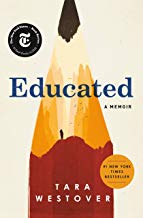
educated             Tara Westover’s memoir about growing into adulthood as the daughter of a Mormon fundamentalist is at times remarkable, at times horrifying, and in the end, bittersweet.

Growing up in Idaho one of seven children, her father was a prepper. Along with God, and Joseph Smith, his other hero was Randy Weaver whom he believed (wrongly) was murdered by federal agents at Ruby Ridge. Suspicious of the government and the Illuminati, whom he believes controls the world, he refused to allow his children to have any interaction with the outside. This meant no school, no birth certificates, no immunizations and no doctors, even when his wife and children suffered life threatening injuries working in and around the family scrap yard.

As his paranoia grew, he became more isolated and created vast stockpiles of food, weapons and gasoline in readiness for the apocalypse which he believed was always just around the corner. Of the seven children three, including Tara gathered the courage to seek a college education.

When Tara entered Brigham Young University with little knowledge of the world outside her cloistered circle, it was like landing on another planet. She recounts the time in one of her freshman classes when she raised her hand and innocently asked what the word “holocaust“ meant. She had never heard of it. The other students seemed like aliens. They drank diet soda, wore makeup and tight-fitting clothes, things her father warned were of the devil. They even insisted she wash her hands after going to the bathroom.

The decade she spent pursuing her undergraduate degree at Brigham Young and her graduate studies  (at Harvard and Cambridge) kept her suspended between two worlds; the world of civilization and that of her sadomasochistic tribe of a family that tried incessantly to pull her back into their orbit, where she was gaslit and frequently brutalized by her siblings, and where life threatening injuries, whether severe head trauma or near fatal immolation were welcomed as a gift from God. The cognitive dissonance between her new reality and her old one nearly drove her insane.

The billionaire H.L. Hunt once said of being successful; “Decide what you want, decide what you’ll give up to get it, then get to work.” Tara Westover knew what she wanted and set out to get it. By the end of the book, the cost of what she gave up was still being calculated.

Educated: A memoir by Tara Westover, Random House, NY, 2018


The Monday Book-turned-TV-series: THE HANDMAID’S TALE by Margaret Atwood

HT MAI resisted watching this for three seasons, under the same reasoning I avoided watching NARCOS for quite some time: too close to reality. Please, divert me while I crochet, until I’m ready to re-enter Reality.

After Anne with an E built my saccharine to sufficient levels, I was ready. And so began what was not so much a binge-watch as an eyes-averted analysis.

The book has been interfered with, that much is clear. But not necessarily in a bad way. The end of Season 1 ended with Atwood’s famous quote as June Osborn is ushered into a police van,

“And so I step up, into the darkness within; or else the light.”

Most people deem the book to end there, and readers had to choose whether June was getting out or not. It actually ends with a public address by a future scholar analyzing the fall of Gilead, and that speech is amazing in its chilling sarcasm, suggesting not a lot has been learned from the bad times.

The TV series continues from June (Offred) entering the van, going with the assumption that June is indeed rescued, sorta, for awhile. While waiting to escape, she makes some very human choices, creating a shrine for those killed in secret places, saying real prayers instead of the warped quotations of the Commanders and Wives.

The series is interesting because it lets in the thoughts and motivations of other characters; in Atwood’s book there was a moment when one of the aunts broke down and told the girls she was trying to help them, they all had to make the best of what was left available to them. Atwood also made clear in her book that the Marthas and Aunts feared being deemed no longer useful; in the TV series, it’s a little more complicated. The aunts are enjoying their power. Also, Serena Joy in the series is not a former televangelist as she was in the book, but the author of A Woman’s Place, one of the manifestos that later ousts her from being a thinking part of the Glorious Revolution into the meek helpmate Gilead requires women to be. She is more complicated than in the book. I like this.

There are also more clear examples of the regular working folk outside the extremes of Handmaids and Wives, and definite hints at the blurred lines between collusion, collaboration, and just trying to survive. In all honesty, in this series, none of them look that different from each other. Which is kinda terrifying.

What does look different is the venom poured out toward religion overall in both book and TV series being very carefully differentiated from True Religion, the kind Jesus talked about, taking care of widows and orphans and showing compassion. Quakers come out well in the series as they did in the book, I am pleased to note. But there are also points where characters are shown praying with sincerity versus being rote repeaters of things they are supposed to say. Churches are torn down, nuns and priests hunted, because they weren’t doing religion Right.

When June lights a candle at the wall of memory she’s created from an execution site, she prays with humble sincerity. Which is kinda brilliant contrasting against the constant Gilead reminder to her that God loves the Meek, which means she should keep her eyes down. Subtle, and thus so effective, this juxtaposition. When June gets to choose how she acts toward God, she IS meek, and loving. When it’s forced on her, not so much. Hello Christian Right movement, are you listening? Don’t alienate us from REAL relationships to God through your rhetoric. That’s in the Bible, actually; Jesus says it’s a very bad idea.

Back to Handmaid: its beyond-the-book parts are so clearly reflecting the cultural lexicon found in today’s divided America. While the book is usually better than the movie, I’m highly recommending this series for MATURE audiences only; it is violent and sexual, usually to make a point, but sometimes gratuitous.

And that’s my final thought on the series. Do you remember The Stanford Prison Experiment, which had to be stopped early because those chosen to be guards with near-absolute power over the “prisoners” became so brutal, injuries occurred? I wonder how many of the men wearing all-black and acting as low-pay extras playing The Guard cried during or after the filming, how it made them feel or act at home. There is one scene in which a large group of handmaids believe they are going to be executed for an act of defiance. Herded in restraints into an execution site, the scene involves guards roughly handling the women and such.

If you look closely -he is only there for a fleeting second -one of the men who reappears often as a non-speaking Guard throughout the series is an older, balding man. He is in the midst of the terrified group of women, shoving them around, and when you catch his face, he is distraught. Not angry, not trying to get the job done.

Not acting.

He looks something between remorseful and despairing and terrified, and I swear he’s crying.

Holding us all in the Light, that’s my review.

You can read about the Stanford Prison Experiment here.