
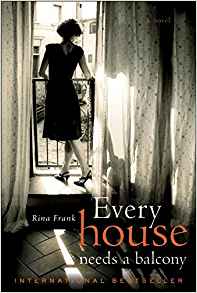
The Monday Book: EVERY HOUSE NEEDS A BALCONY by Rita Frank

This book came into the shop, and I’d seen somewhere online that it had been nicknamed “The Israeli Kite Runner.” So I took it downstairs to our flat and made it my bedside book.

Hmm….. on the one hand, it’s very atmospheric, makes you feel the Haifa poverty and inner city activity of the time period (post-WWII). On the other, translated books have that one-step-removed feel, and this novel has that in spades. It feels like reading from behind a curtain.

The story centers around a woman who decides to marry a guy from Barcelona, both Jewish, different classes, dealing with a lot of the ethnic and economic and political effects of the day. Marriage strains, sick babies, family members who aren’t cooperating, etc. If it weren’t for being set in Haifa, it would be an Aga Saga. But instead, it’s kind of an atmospheric time piece. Maybe even a peek behind the curtain.

I love character-driven books best of all, and this one isn’t. It’s setting-driven, and I have to admit that works really well. I didn’t care about the people, but it was like watching a television instead of reading in terms of the filled-in living details and little tossed-on-top nuggets of unexplained culture. It’s written from the inside, and those of us on the outside can learn a lot just from watching the casualness of the unexplained as it appears.

It’s not a book in which a lot happens action-wise, at least not most of the time, but it’s a great depiction of how time, place, and money can rock a marriage. Any marriage, any time, any place.

Four stars, shall we say?

The Monday Book: DANCING AT THE SHAME PROM (Ferris and Dexter, eds)

So this isn’t really a book you LIKE. It’s a book I personally read to see how writers handled the subject (a point in your life about which you are ashamed). I wanted to study them, from style to emotion to word choice.

Some of them handled it very well, and others left me feeling like the story they had to tell wasn’t the one they were telling.

This book is a collection of short stories/essays by women who have felt shame for something, ranging from divorce to making fun of people to being bad in school. The stories tend to focus on women who have influence and affluence (discovering her husband was having an affair, one writer lobbied his Emmy at his head, if that gives you an idea).  They’re not “on the ground” stories of not being able to provide, etc.

They’re also not as no-holds-barred as I was expecting as a whole, although in some cases they’re so intense that much is demanded of the reader. I read this book because Seal Press, who published it, have a great reputation for women authors with meat on their wordy skeletons. These women have things to say, and because I was dealing with a point in my own writing where shame came up, I wanted to see how they could do it graciously, conversationally, without justification or haranguing.

Well, some did and some didn’t, but when one reads for instruction and edification, one gets those things. I’m glad I read it, but it’s not a sit-down and feel-good book. In fact, at the risk of sounding demeaning or facile, this is the kind of book one keeps in the smallest room in the house, and ponders piece by piece. To do otherwise might be overwhelming. I found that reading a chapter a night dragged me down, whereas a bit here, a bit there, with time to ponder and piece together ideas and smell the flowers between, was better for my mental health.

So this is less half-hearted endorsement than an upfront admission that I read this for personal reasons, to gain insight into good writers talking about bad stuff, and I got what I came for. If you’re not interested in how shame holds us, or you’re more interested in the inspirational side a la Brene Brown, you may not like this book. But it certainly got interesting.