
Lang Syne isnae sae Lang

Jack gets over the line in time with his Wednesday guest post –

There is such a thing as time travel – and part of the journey involves sound waves captured on coated fragile plastic tape.
Every time I’ve moved house within Scotland, then to England and finally to the US, a treasured box of open reel tapes has gone with me. Only rarely over the years have I had a compatible tape recorder to play them or the time to sit and listen to them. But a good friend recently provided the means and Covid 19 provided the time.

Most of the tapes are big nine inch reels but there are some smaller ones and a good few cassettes as well. The biggest problem is that some have lost their labels or ended up in the wrong box. Just to make things even more complicated the tapes were recorded in mono on either the right or left channel in both directions, so each tape has two full mono tracks in one direction and another two in the other direction!

That’s why this has been a voyage of discovery and a discovery of forgotten delights.

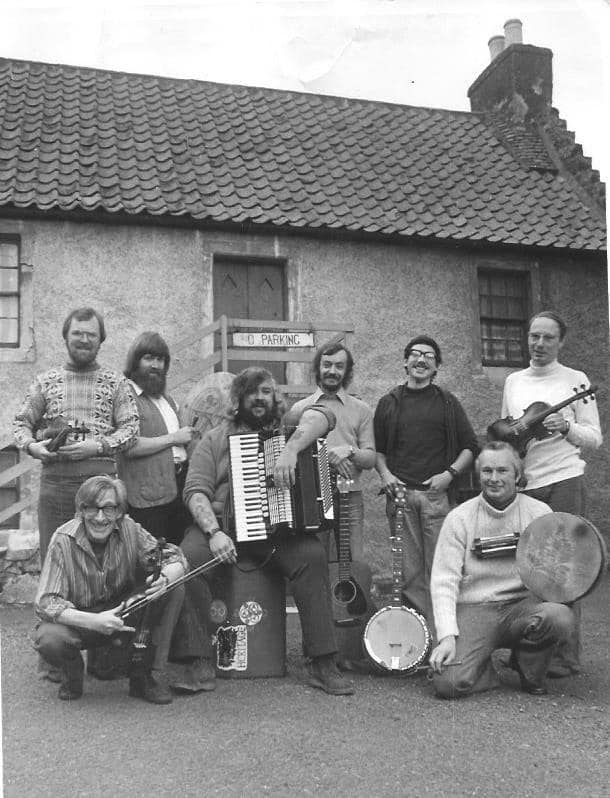
Many of the recordings are of live performances either by me and Barbara Dickson from the 1960s or my band ‘Heritage’ in the 1970s and the quality is very variable. Sometimes the problems are to do with the circumstances of the original recording and sometimes with deterioration of the tape over time.

It’s the ability to actually picture the place and the people around me that is most amazing. One of the surprises was a recording of the very first public performance of ‘Heritage’ in a small village hall. Another was a recording I made of the great Irish band ‘Planxty’ at Inverness folk festival when for only that tour Paul Brady replaced Christy Moore. They never made a commercial recording with that line-up!

Of course this all makes extra work for my good friend and excellent audio engineer Dirk who turns my radio shows into easier listening. I use a Roxio suite to capture the tapes as digital files to my computer, then upload them to Dropbox and copy in Dirk. That’s when he gets to work and we then agree what is of potential radio quality. The historical importance of the recordings is usually uppermost in my mind and some of the earliest ones have already gone to the Library of Congress and the Scottish National Library.

So, although this is an enjoyable journey back in time for me I’m also aware that I’m preserving history and that may be the most important thing in the end – – –

Wha Daur Meddle wi ma Lingo – –

Jack’s Wednesday post makes it over the line in time – –

As Wendy continues to deliver masks, hand sanitizer and gloves around this corner of the world as well as trying to hit three publisher deadlines, I’m still holding the fort here on her blog. She is hoping to be back next week!!

I may have posted about this before, but language is something that fascinates me, and particularly my own Scots language. From an early age I have spoken a mixture of standard English and Scots. More recently, my singing of songs and ballads in Scots has probably made me even more aware and more knowledgeable. It didn’t hurt to have a grandfather living with us from my birth until I was fourteen who was a very natural Scots speaker.

Because of the ‘Scotch-Irish’ who were the main settlers here in Appalachia I’m often asked about my language and vocabulary whenever I sing at concerts or festivals. This is what I usually say – Scots and English are two different but related languages. Think of Spanish and Portuguese, or Danish and Norwegian. The same kind of relationship. Scots differs from English in many ways – sentence structure, vocabulary and pronunciation etc. It’s not simply a dialect of English.

The problem is that when the King James Bible was published English became the predominant written language throughout Britain, while Scots continued until very recently as only a spoken one. Over time and following the establishment of The United Kingdom Scots began to be regarded as a ‘sub-language’ and for anyone to succeed in life they had to master English.

So let’s take a look at some examples of Scots language alongside the English translation –

It’s a braw bricht moonlicht nicht the nicht (it’s a lovely bright moonlit night tonight).

Mony a mickle maks a muckle (lots of small things makes a big thing).

Ah kent his faither an clappit his dug (I knew his father and even patted his dog).

Through the historical connections over many centuries with other European countries, Scots has often borrowed words from Germany, France and Scandinavia. Kirk for Church (German), bigging for building (Scandinavian), ashet for large plate (French). There are also some imports from Gaelic such as whisky and loch.

Because Scots became a mainly spoken rather than written tongue various local versions developed over the years, So Aberdonian is quite different from Glaswegian or Fife.

Happily, following the re-convening of the Scottish Parliament there has been a greater effort to encourage a proper appreciation of my language in schools and colleges.

But something that still depresses me is when I see written passages with apostrophes to indicate supposed missing letters – continuing to suggest that Scots is just poorly pronounced English. No, it isnae ava.

If you’d like to find out more this is a great resource – https://www.scotslanguage.com/articles/node/id/575