
A Lad o’ Pairts – –

Jack’s Wednesday post is on time for a change –

I suppose everyone, when they reach my advanced age, looks back and is surprised (even amazed) at where their life has taken them.

Here I am in southern Appalachia, in the midst of a glorious and so important region in the history of American traditional music.

When I first got interested in folk music when I was in my late teens and early twenties back in Scotland, I was singing mostly American songs and it wasn’t until a few years later that I discovered my Scottish musical roots.

But I never imagined in my wildest dreams that I would end up living here, where many of the songs I was singing back then originated.

Yesterday was pretty crazy in many ways. It was election day here and I was standing for county supervisor (regional councillor in Scotland) and then it finished with Wendy and I performing at the Birthplace of Country Music Museum in Bristol Tennessee. Of course, I was roundly defeated in the election, but that gig – – –

BCM-Museum-Full-Screen_Malcom-Wilson

I actually thought that appearing on a CD along with Pete Seeger, Doc Watson and Dolly Parton might be the highlight of my musical journey, but perhaps last night might just equal that.

The concert was well attended by a very enthusiastic crowd and I got to sing The Carter Family’s song ‘The Storms are on the Ocean’ which was recorded close by in 1927 and has fascinated me for years, not least because it contains two verses straight from an ancient Scottish ballad and another that has a strong similarity to one by Robert Burns in ‘Red, Red Rose’.

But, really – the idea of a guy from Dunfermline playing that venue – whodathunkit!!

Wendy and I were very worried beforehand how the audience would react to a program of Scottish songs and ballads, particularly as the promoters were a local arts organization more usually concerned with chamber music, opera and the like. But, we needn’t have been concerned – they were engaged and enthusiastic from start to finish and (not surprisingly) the sound system was really excellent.
King’s Mountain?

Jack’s Wednesday guest post is, OF COURSE, late again –

A Dance called America – James Hunter

This isn’t really a book review, but I thought I’d better head this post that way, as much of what will come next is from my reading of this excellent and informative book.

The Battle of King’s Mountain is seen in this area and taught in US schools as a pivotal event in the American War of Independence. While that is certainly true, there is another way of seeing it that has a lot to do with centuries of Scottish history.

Everyone is familiar with the story of the ‘Scotch Irish’ and their settling in Southern Appalachia. These were the children of lowland Scots who themselves had moved to the north of Ireland and established plantations there. These children grew up to find they were unpopular in Ireland and with little economic prospects. So they moved to the ‘New World’ and specifically to Appalachia.

However Gaelic speaking highlanders from Scotland had already emigrated to the coastal regions of the Carolinas and Georgia earlier. These were relatively wealthy ‘tack men’ very high in the clan pecking order and just below the level of clan chief. Once in the Americas they established cotton and tobacco plantations (which is why Glasgow and Paisley became the tobacco and cotton ‘capitals’ of Europe).

The forces that met at King’s Mountain in 1780 comprised a loyalist army led by a professional British soldier – Major Patrick Ferguson, who was a Scots highlander, and a contingent of patriots who were mostly drawn from the Scotch-Irish immigrant population. On the British side, apart from Ferguson, the army was all volunteer, and they were mainly Gaelic speaking highlanders from the coast. The patriots were all volunteers and their leaders included many with Scots names.

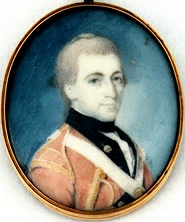
Patrick_Ferguson

Patrick Ferguson

It should be noted here that back in Scotland there had been centuries of clashes between the northern clans and the southern folk – a fault line between two distinctly different cultures!

I could never understand, however, why two lots of Scots that had been, effectively, forced out of Scotland would end up on opposing sides in what was at that time pretty much an English colony. It seemed odd to me.

But, as Hunter points out, the highlanders considered themselves ‘upper class’ and aristocratic before all else and saw the patriots as lower-class peasants who needed to be put in their place. So they aligned themselves with their ‘peers’ in London rather than their fellow countrymen. In doing so they inadvertently simply continued a long tradition of Scottish history – albeit in a foreign land.

Footnotes –

When the war ended with victory for the patriots, a great many of the highlanders who had been captured didn’t return to the Carolinas and Georgia. Instead they made new lives in Canada. At the present time there are more native Gaelic speakers in Canada than in Scotland.

The last native Gaelic speaker in North Carolina died in the late 1800s. He was a Presbyterian Pastor and an African-American!

Shortly after these events the highlands of Scotland suffered ‘The Clearances’, and this resulted in a much stronger feeling of solidarity between the Gaelic and Scots cultures, which has continued to strengthen down to the present.