
Compliments to the Chef

Jack has been busy with some construction, so of course his guest post is late –

One of the things we’ve been brushing up on during the last year is our culinary skills. I’ve been expanding my range of meals while Wendy taught herself to pressure can. We purchased a new toaster oven that doubles as an air fryer so with that plus our trusty slow cooker crock pot and the pressure canner we set out on our taste adventures.

Air frying is a fast, clean and healthier alternative to deep frying, which is what I’ve usually done in the past. It’s really a small convection oven with a fan to distribute the hot air and very little oil is needed.
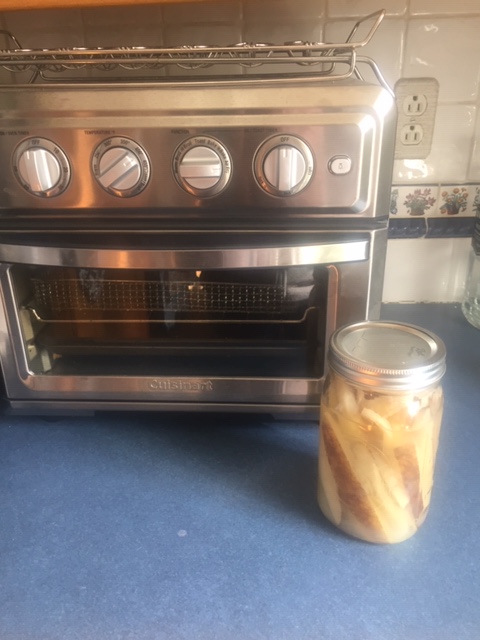
Wendy became an expert at sourcing vegetables in bulk from local farms, and after distributing them to local foodbanks, non-profits and the ‘pay it forward’ café we had loads of stuff left to be canned for ourselves. The only problem we’ve had is where to safely store the jars where they would be cool and safe from our cats. We have lots of potatoes, mushrooms, tomato sauce, curry sauce, beans and onions stashed away in every nook and cranny!

During the pandemic and before we were vaccinated we avoided going to grocery stores as a great many people there were either un-masked or wearing them round their chin. So we concentrated on using our stocks of veggies and meat or fish from the freezer.

Another safe source of protein is thanks to our four chickens and their egg laying proficiency. They give us so many that we’ve been able supply friends and neighbors as well.

So, with a limited range of ingredients I’ve been scouring the internet for interesting and different recipes – 101 things to make with potatoes or what to make with potatoes, mushrooms and onions. It’s been an enjoyable journey and I suspect that when things get back to ‘normal’ our approach to cooking will have changed permanently. My main specialty before was curry, but now I can add many more, just so long as it includes potatoes, mushrooms, onions and beans!

Bon Appetit – – –

The Monday Book: THE LONG WINTER by Laura Ingalls Wilder

I found THE LONG WINTER at a thrift store, one of my first fun outings in a year involving non-socially-distant hiking. The title looks different when you’ve emerged from your chrysalis, post-vaxx and post-winter weather, to go do something with a friend.

Most American school children read this book before they graduate middle school. As a child I had the boxed set and devoured them over and over. It’s a little odd to read them as an adult and realize how much sweetness hides some truly terrible things.

Last night I read LONG WINTER in one sitting. How did I miss that sense of threat that pervades every chapter, as the family ticks down from the last of the butter to the last of the milk to the last of the flour to the last of the potatoes, to the last of the burnable fuel? The dawning realization of the townspeople that the train was not coming, the train that was their literal supply line, anchoring them out on the prairie with the safety of coal and already-ground wheat and other “new-fangled” things like kerosene. Ma’s ingenuity at producing a button lamp from axle grease. Pa buying the last two cans of oysters in town for Christmas dinner. The hay sticks that they burned as fast as they made them; twist hay to have the warmth to twist more hay.

And the darkness. The robbery that Pa participated in to get the supplies he came home with.The dying of the lamp on Christmas Night. The inability to buy flour or lumber at any price because “Banker Ruth bought it all.” What happened to Banker Ruth when winter was over, one wonders?

The heroism of Almanzo and Cap, going to buy wheat from a man in the middle of nowhere, is offset by the fact that Almanzo walled up 150 bushels of wheat before they left. So no one could ask him to buy it.

It is a different book as an adult than as a child. I’ve observed there are several rewrites and washouts of these American classics over time, based on racist overtones and the charming overwrites of things like being illegally in Indian territory, or quite possibly murdering a railroad employee, etc. You know, these are still American classics. Just, now that I can see what wasn’t meant to be visible to children, I appreciate Wilder’s two-layer genius in writing all the more. She told the whole story, twice at the same time, for two different audiences. Gonna go back and read the rest of these now.

Yep, American classics: fear, prejudices, frontier justice, snowball fights, family spirit, and all.