When the Saints go – – –

Jack gets in over the wire for a change with the Wednesday guest post –

There are often events that are described as marking the end of an era, and the death yesterday of Chris Barber certainly seems like that for me. The path that led me to a love of Scottish traditional songs and music started, as it did for many others of my generation, with the New Orleans style jazz popular all over Britain in the 1950s and 60s.

Popular bands including those led by Acker Bilk and Kenny Ball regularly topped the hit parade with numbers like ‘Stranger on the Shore’ and ‘Midnight in Moscow’. But the Chris Barber Band was by leaps and bounds ahead of all the others.
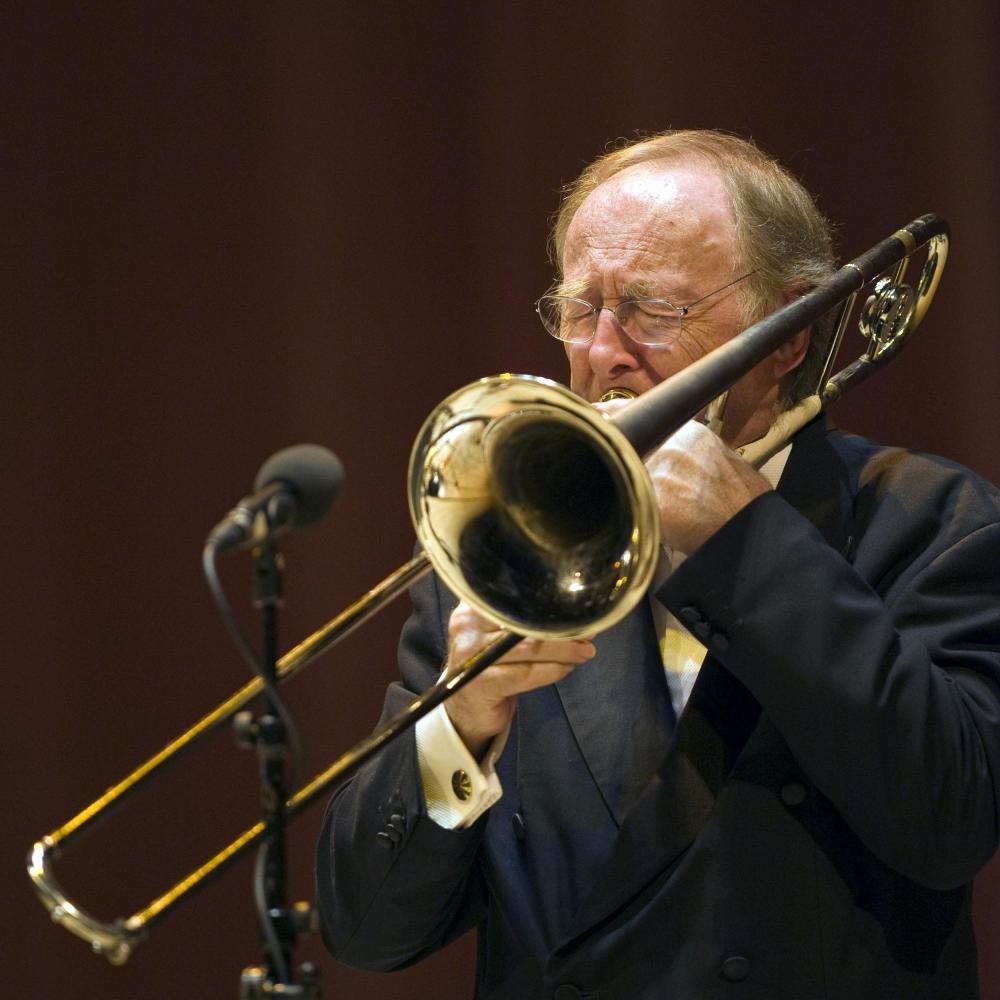
The original line-up was really just the Ken Colyer Band minus Colyer, with Barber becoming the leader and Pat Halcox replacing Colyer. The story is that the members of the band wanted to experiment with music from outside the strict confines of New Orleans and that led to the split. The first big hit for the Barber band was ‘Petite Fleur’ featuring clarinetist Monty Sunshine and that brought the band to a much wider audience. Then the guitar/banjo player with the band, Lonnie Donegan, began interspersing blues and old-time American songs between the band’s instrumentals. One of these – ‘Rock Island Line’ even topped the US charts!

However Barber himself was very much in charge and stamped his personality on the band from start to finish although that seems to have been necessary with personnel changes over the years. Despite these changes the sound remained recognizable. They had always had a broader repertoire than other bands of the period, including pieces by Count Basie and Duke Ellington and this became more evident as additional players were added. There was a period in the 60s when he ran a London club called The Marquee where modern jazz would often feature with folk like Tubby Hayes and Johnny Dankworth, and this, I’m sure was how the Barber band got the inspiration for their broader approach. At that same time he was bringing blues artists from the US and touring with them as well as putting them on in the Marquee. That was how he and Donegan became the ‘firelighters’ for the likes of the Rolling Stones, Eric Clapton and even the Beatles.

The last time I saw the band was around 2007 at the Burnley Mechanics Theater in Lancashire and by that time they had become ‘The Big Chris Barber Band’ but Pat Halcox was still there on trumpet and Chris Barber on trombone. They were both in their late seventies but you wouldn’t have known it! What I loved about that concert is that they had a section in the middle where everyone except the basic seven piece New Orleans outfit left the stage and we were transported back to the 1950s for half an hour.

I think my lasting impression of the man is the curious mixture of uninhibited playing and very English laid back humor, always delivered in an immaculate suit and tie!

RIP Chris and thanks for everything!

PS – here’s a track from an early album I still have that I bought when it came out in 1959 –

How Will we Know?

It was a rough year, and the time isn’t up yet. How will we know when the pandemic is over? Good question, one that will see many answers, but hopefully not too many false finishes resulting in further irresponsible deaths from maskless wonders and “it wasn’t real” hard cases. (A girl can dream.)

Perhaps the biggest question is not “when will we get back to normal” but “how can I help now that so many people have gotten hurt?” Those harms will linger, be they financial or family loss.

Friends in mixed circles of right-wing-first Christianity worried about The Great Reset, an idea pushed by a billionaire with a big mouth but not a lot of influence. He said now was the time to rearrange society along more equitable and sensible lines, do away with cash, globalize in governance as well as markets, and other things that set the heads of apocalyptic-prone thinkers spinning.

The Great Reset isn’t gonna happen, because politicians understand: why fix society when you can make a LOT of money prolonging its problems? But can we have a whole lot of small resets? My priorities changed this year, some for the better. I’m praying for guidance on how to re-enter, and the wisdom to know what to keep, what to alter in the new habits I’ve learned from this year. We are reopening a world that won’t so much be even a new normal as a rag-tag amalgam of people who just want it all to go back to the way things were–many of whom were forced into new ways of living–and people who used this time for a small reset. Oh brave new world, to have such diversity in it. Help me learn to value, honor, and uphold the rights and needs of everyone in it, Jesus. I’m listening. Of all the things You have ever redeemed, let pandemic time be one of them, so the lessons learned aren’t wasted within those who learned them.

This year taught the difference between privilege and guilt. I had money and a continuing job working odd hours, which gave me options for taking up new leisure crafts like decoupage (which has become my new thing). I didn’t have child responsibilities and I own land, so became a whiz bang grow-your-own and then preserve it by canning. I discovered how much I enjoyed these activities. Guilt over privilege at these options, no; responsibility for having them, yes. Giving away food and (decoupaged) furniture. Writing the book about Conspiracy Theory came from a sense of accountability: I knew people who knew a lot about the subject, and we had access to publishing. Time to offer back. Which can sound conceited, but it’s also what you’re supposed to do. If you know what’s going wrong, say so. If no one listens, you did the right thing. If a lot of people listen, you did the right thing.

I remember watching a reporter and a photographer who covered the ongoing wars in Iraq and Afghanistan, showing photos to a small group of New York City attendees at a posh bookstore. The reporter said something about going out to the valley after the battle for the photos and on the way back to the hotel getting stuck in traffic and sweating so bad she couldn’t keep her headscarf on, etc. Joking with the assembled listeners. A woman wrapped in a beautiful shawl in the air conditioned room stood to ask, after all this horror how can you joke, how can it be just a job to you?

The reporter had clearly been asked this before. She said, in essence, I have to have a life. I share what I know as a surrogate for others who will never walk into these situations, and when that is done my job is done. I don’t live my life in guilt that I’m not one of those bodies; I do make sure people understand any one of us could have been one of those bodies.

This affected me. Guilt is tiring for the person who carries it and of no comfort to those who need things. It is a useful fake virtue signal among people who want to push agendas. As the slow reopening unfolds around us I am asking Jesus to guide me in life, responsibility, and ignoring fake signals in favor of the true, small reset opportunity before me. That is all.