
How Green is my Garden – – –

Jack feels doubly competent today – the blog post on time and – – –

One of the things I really like about living in this part of the USA is the weather. The winters are similar to Scotland, but a good bit shorter, and the summer is much sunnier and warmer. Combine that with lots of short sharp rain showers and you have perfect conditions for growing things.

So Wendy and I have been learning how to (or not to) grow vegetables and herbs. It’s been a steep learning curve but we’re getting there. We inherited a large back yard that already had a veggie plot laid out so, nothing daunted, we set to. The first problem was that the yard had six mature walnut trees on two sides and we learned from Wendy’s former student Erin Dotson, a genius in gardening (yes you can hire her) that these are death to many plants in the nightshade family. They send out a maze of tendrils from their roots that exude something called juglone that is poisonous to many vegetables.

But we didn’t know that when we started preparing the long neglected plot and found a layer of garden cloth below the soil, so we pulled it all and threw it in parts of the yard where we wanted to kill things. Big mistake! It was there because of the juglone – – –

Luckily there were some raised beds that still had the barrier in place. So we were able to grow peas and asparagus in them and choose other stuff for the areas we had denuded of cloth. We also planted tomatoes as far away from the walnuts as we could or in plastic bags with earth from elsewhere, and these did well.

I’m happy to report that we were successful with peas, tomatoes, kale, onions, and lots of herbs. Much less with potatoes, peppers, Brussel sprouts and cauliflower. We also inherited raspberry canes which also have done well (too well in places) and volunteer cucumbers appeared without warning in our wooded areas.

We’re watching our second crop of peas developing right now and have high hopes for them before the frosts arrive, and we’re experimenting with planting seeds and seedlings in pots inside the house to have them ready for either an early start next year or even some winter produce. These include cumin, coriander, red current and marigold cherry tomatoes, basil, thyme, and blue potatoes. All are thriving. We even have a winter squash wending its way from the back garden toward the house, developing fruit along the way. We’re feeling almost competent!
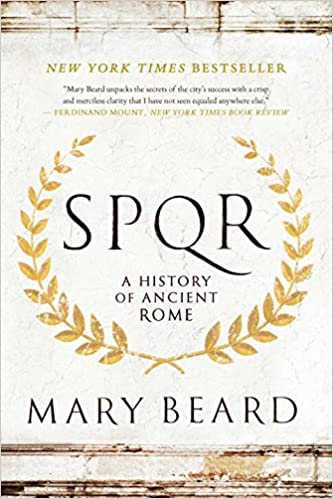
The Monday Book: SPQR by MARY BEARD

This review of SPQR comes to us courtesy of Paul Garrett, guest reviewer and resident curmudgeon.

There is a hilarious scene in the Monty Python movie The Life of Brian where some Hebrews are planning to overthrow Pilate by kidnapping his wife and demanding he dismantle the entire Roman empire in two days. John Cleese attempts to rile up the crowd by asking, “What have the Romans ever done for us?” There follows a litany of a dozen or so Roman contributions to Palestinian society, from roads and aqueducts to sanitation and good cheap wine. Though not entirely accurate, the scene highlights the influence the Roman Empire had on its world.

Though the empire officially ended with the Ottoman invasion in the late 1400s, its actual demise occurred around 900 years earlier with the rejection of the political reforms put in place by Caesar Augustus in the first century CE.

At least that is the theory put forth by Mary Beard in her tome SPQR. Beard is proud to call herself an Oxford Don and even has a blog by that name. She also produced a series called “Meet the Romans for the BBC (now available on YouTube) where she tromps around roman ruins in her long gray windblown tresses and sneakers looking like somebody’s hipster grandma. She has spent the last fifty years studying the ancient Roman empire, of which a mountain of material remains, in the form of letters, contemporary histories, marble and bronze artifacts, and even an actual mountain, made solely of millions of discarded amphorae for transporting olive oil. The oil-soaked into the clay and turned rancid, which prevented the 60-liter (about 15 gallon) jars from being repurposed, an early version of single-use containers.

SPQR is the abbreviation for “The Senate and the People of Rome” (Senatus Populus Que Romanus). Youcan still find the letters stamped into things like manhole covers all over the city of Rome today, the same way we use “Made in America” or little decals of the American flag in the US.

Beard spares nothing in her description of ancient Roman society. It was a society rife with treachery and violence.  Civil wars, assassinations, backstabbing, and political intrigue were more the norm than the exception. The city had no active police force, and many politicians took advantage of this by using mobs and riots to achieve their political objectives. (Sound familiar?)

Babies were “exposed;” a euphemism for infanticide, where unwanted newborns were thrown into rubbish heaps to die. The lucky ones were rescued by families that could not produce children of their own, as having babies was Job One for married women. 

Perhaps we should expect this level of violence in a society whose founding myth included fratricide and rape. According to the story, two orphan brothers, Romulus and Remus, founded the city after being nursed by a wolf. Not long after the founding, Romulus killed his brother in a property dispute. Later, to increase the town’s population, Romulus invited the people from a nearby town, the Sabines, to a party during which the Romans kidnapped all the eligible daughters and subjected them to forced marriage.

Whether Roman civilization ended 500 or 1500 years ago, it still interests us. From the movies like Ben Hur and Gladiator to the various miniseries such as A.D., Britannia, and I, Claudius to books like Rosemary Sutcliff’s The Eagle of the Ninth, and Colleen McCullough’s Grass Crown series, there seems to be no end to our fascination with the life and times of the men and women of Ancient Rome, and SPQR deserves a respected place in the modern Roman historical pantheon.