
My day job took me to DC. I’m on the 12th floor of a hotel, looking out over the city, which had a snowstorm. Overnight, it looked like the little pellets inside a snow globe, and in the lamplight as I watched the snow fly, it was beautiful.
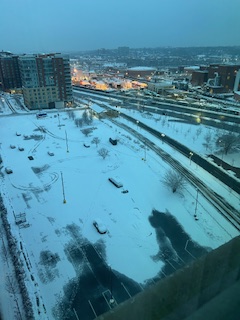
I stood looking out my hotel room window, and thought, “There are two men out there who have done the same, only with acquisition on their minds. They don’t see a strange mix of buildings and beauty; they see something they feel they own.”
Tuesday, the meetings I attended talked about how to talk to the legislators regarding rural health policy (think the sexy topics of Medicare and Medicaid) which we will do today. I am at the National Rural Health Association’s annual Policy Institute, since you ask.
Tuesday, several men in suits told us which words to avoid, which words to focus on. What no one discussed much was, how do you talk to people who work for someone who considers us serfs? Who looks out over the city and doesn’t think, “how can I make this place better,” but “how much can I enrich myself from this place?”
Maybe we didn’t discuss it because there is no way to get into that mindset and come out whole.
There was one interesting group discussion. Someone pointed out that “rural health” can be framed as a national security issue. If we can’t make them feel compassion for the loss of places where women can go to have babies, perhaps we can shock them with the potential loss of their own safety and security? We supply the food, the raw materials that become power (as in electricity, don’t stretch that into a metaphor, k thanks?). We supply the soldiers that fight wars and “keep” peace. Rural is vital to the proper functioning of the United States.
Mmhmm. Today is the day we go talk to the elected men (and some women) in suits, who work for the men in suits looking out their windows at what they believe they own. Those elected ones, they must be in some confusion at the moment. One hopes. It depends on why decided to occupy an office in the capital in first place. Did they believe they could make the world a better place, or that they could better their worlds? That they could do both with integrity and good results?
Moral high ground is slippery, and sometimes it walks through dark valleys. Good luck, elected officials. You’re going to need it.
But so are we, the grass roots non-profits and other care providers who find ourselves suddenly framing arguments without using certain words, and shining bright lights on how lucrative we are to their agenda. We’re being drawn into their kind of fight, and it would be naïve to believe that we can refuse to do that with any good results for the people counting on us to get them care.
I am praying to hold onto some integrity, intelligence, and a sense of humor today. Humility may come in handy, too. When people speak different dialects, you need to speak theirs to get things done. It’s called code switching, changing your accent and vocabulary to make communication more clear. It doesn’t usually have a moral component.
Except this time. Here we go.
 Every year I go to DC to advocate on behalf of rural Virginia inside rural America. We converge from all 50 states and a couple of charted territories, spending a day catching up on the annual stats in health and economics, then charging The Hill to talk to the reps and senators for our individual states.
 Wendy Welch: Books, Yarn, Cats, Opioids