
Everyone was looking forward to Iona. For those who don’t know the history of it, Iona is where St. Colomba came and established Christianity, including a monastery, in the early 600s. People have been drawing and photographing Iona since the prehistoric era, so explore their website later for more photos.
Besides the abbey and the ruined church, there are about 100 houses on the island, and about 3 times as many sheep as people. Since the island has a lot of hills on it, and since the rooves of the houses are often thatch, it is common to see sheep and goats atop the houses, munching or playing. I would estimate the number of touristic pictures of sheep atop houses at 1 per minute throughout the summer.
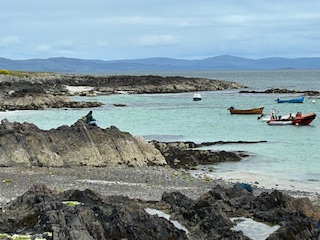
Iona is one of those places that makes me wish I could paint. The colors are amazing: yellow sand, white foam, turquoise breakers, green-blue sea, green mountains, blue sky, pink-white clouds. It’s layer on layer of color in its coves. It also has one of my favorite caution signs ever:
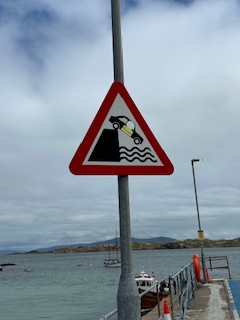
Alan and I found each other walking to the same cove we remembered, about a mile from the ferry drop-off point. Neither of us cared to tour the abbey, me because I’d taken many people to it when we lived in Scotland, and Alan because…. Well, there’s a story.
Back on the bus, I got Alan to tell everyone what he’d told me as we walked. Remember, Alan is a successful musician who founded and lead Battlefield Band, one of Scotland’s best-know bands. But back in his school-leaving days, as he kicked about for a job, maybe even a career, Alan went off to Glasgow (aka The Big City) and took a job dishwashing in a fast-paced high-end restaurant. At the end of his first week, the owner paid him off and said, “Son, the hospitality industry is not for you. Try something else.”
Reluctant to head home with his remaining pay, Alan instead hitchhiked over to Mull and talked his way aboard the ferry to Iona, where he asked at the abbey could he bed down in the sanctuary until he found a job.
The guard for the abbey said, “No, son, we don’t want to encourage hippies coming to Iona. We get a lot of that already.” (In his defense, this was the sixties.)
Alan found a farmer who offered barn-for-baling accommodation and within a week or two decided farming was also not his calling. But for the rest of the tour we called Alan “the hippie.” Behind his back, of course, being polite Southerners well brought up by our mothers.
In addition to rejecting Alan, Iona had one other thing to dis-recommend it. Well, two. First, as we walked past the ancient church (not to be confused with the abbey; the church is a ruin housing a very old graveyard) a girl was busking outside with a karaoke machine and one of those ipad music stands that shows you the lyrics. It was…. Incongruous. About 200 feet on, when the shops that sell summer goods made mostly on the island (but check your tags) line up in a row, another person was busking—with electronic bagpipes.
Call me old-fashioned, but if you’re gonna busk on an island that dates back to prehistoric civilization and bans cars unless you live there, get into the folk scene and don’t sing covers of Pink. Oh, and get off the lawn.
The other thing was—and this is deeply personal—they charged 9 pounds 99 pence for a gin miniature made on the island. And it isn’t made on the island. Iona gin is made on Mull, because where ya gonna put a distillery on an island that’s 1.5 miles wide by 3 miles long without the neighbors complaining? Most gin miniatures in Scotland are between 4.50 and 7.99, so I left without an Iona gin—and bought one back on Mull for 6.99. Well, the islanders have to make a living somehow, I guess.
But that was not the last extortion we would see that day. Off to Oban we went to stay the night in an inn right down by the harbor. We arrived in time to explore the shops – sadly just one small charity shop hardly worth mentioning. But you could buy every weird and tacky thing known to humanity representing Scotland – the hat, the plush nessie, the gin miniatures…. We had fun.

And supper was delicious. So casually replete with a good day, Jack and I retired to our room. I opened the curtains to get the harbor view, and a charming little sea gull was tucked in the gutter between the window and the gable of the hotel roof below our window.
I gave it a piece of stale oatcake that had fallen out into my bag that day.
A minute later there were three gulls. Jack split a second oatcake between them.
A minute later there were six seagulls.
Jack looked at me, shrugged, and poured the rest of the open package on the roof. Instantly the air was full of wings and battle cries as gulls dove from everywhere. They battled for what pieces fell, but I saw one snatch an oatcake piece from the air.
A gull started through the window, falling backwards as it aimed for a piece in the gutter. Jack slammed the glass shut, pressing bird butt in inglorious relief against the glass. The gull threw an annoyed look over its shoulder and said something in squawk that would definitely have translated as rudeness. We watched in amazement as birds covered every corner of the gable and gutter. Then we drew the curtains because the birds were watching us, eyes demanding, beaks open.
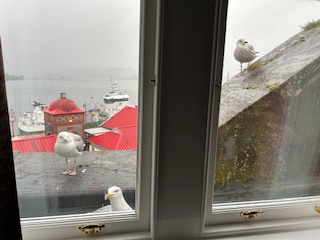
“Will the glass hold?” I asked, trying not to think of Tippi Hedren covered in blood.
Jack shrugged and poured himself a double whiskey. We listened as the insistent cries slowly died down over the next hour. I expected the concierge to call any minute.
When I looked again, just before we went to bed, the original small gull was back in place. He fixed me with a beady yellow eye.
“No,” I said. Before I pulled the curtain shut again, I swear the bird flipped me off with one wing.
And that was day 7, from the sublime to the ridiculous.
 Wendy Welch: Books, Yarn, Cats, Opioids