The Monday Book – March: Books One, Two, and Three by John Lewis et al

Guest review by Janelle Bailey, avid reader and always learning; sometimes substitute teaching, sometimes grandbabysitting, sometimes selling books

March: Books One, Two, and Three by John Lewis et al

March (Books One, Two, and Three) by John Lewis et al

In honor of Martin Luther King’s birthday today and this national holiday, returning to this trilogy of graphic novels for today’s book review(s), seems wisely appropriate.

What an important trilogy for everyone to read. I picked up all three of these books after visiting very shortly after John Lewis passed away in July of 2020.

Graphic works are not my jam as a rule, but this format certainly made Lewis’s critically important story, history, and message accessible and digestible by many (and maybe more than otherwise) who need to read it. Steadily, when I do read well-written graphic novels, I am compelled by the form and its avenues into our heads that differs from the single dimension of a non-graphic text. These three books are very well done.

Overall, this is the story of John Lewis preparing for Barack Obama’s Inauguration on January 20, 2009, while also going back in time to educate two young boys visiting his Washington, D.C., office that morning.

In March: Book One, he reflects on and shares with these young boys memories of his own childhood and growing into the activist that he was by this first book’s end in the spring of 1960. It moves between the pending 2020 event and his own life’s chronology from raising chickens on his parents’ farm to going to college and then participating in non-violent protests for African American rights and into 1960.

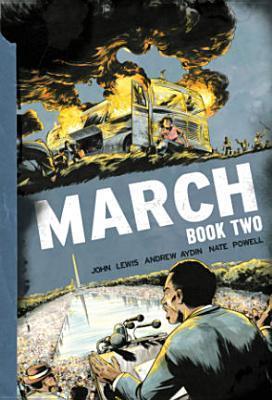
The second book in Lewis’s trilogy, March: Book Two again moves between Barack Obama’s Inauguration on January 20, 2009, and picking up where the first book left off, with Lewis continuing the story of his own past and participation in non-violent activism. These parts go back to November of 1960 and move right through the major and historic event of August 28, 1963, when the famous March on Washington took place. This is when Martin Luther King, Jr., gave his famous “I Have a Dream” speech…and when John Lewis also gave a speech. Lewis gave that speech in his role as one of the “Big Six,” six leaders of the Civil Rights Movement…and John Lewis the only one still alive when this second graphic work was published in 2015.

The third book, March: Book Three, is actually the thickest of the three volumes while also covering the shortest duration of time. This book picks up where March: Book Two left off and finishes with Lewis’s Civil Rights work through the signing into law and by President Lyndon Johnson, of the 1965 Voting Rights Act, and then ends, also, with Inauguration Day 2009, when Barack Obama was first inaugurated as President of the United States. March: Book Three was published in 2016. John Lewis died in 2020, weeks before I first read all three of these books.

Everyone gains understanding and the experience of walking through these historical events through the eyes of one very important leader, John Lewis. May he, Martin Luther King, Jr., and all who have worked toward these critically important causes but lost their earthly lives rest in peace and know that others will carry on the work. Reading these books is certainly inspiration to take up a little more of the work, even in sharing the books with others, as we are right now.

May it also please you to know–as it did me to see in person in December of 2021–that Ben & Jerry’s dedicates a wall of their Vermont experience to John Lewis and his March as well as enlists all of us who wish to, to join the general march toward justice and racial equality that this country’s willing still pursue. The John Lewis Voting Rights Advancement Act, in fact, continues the work only begun by the 1965 Voting Rights Act, and is, itself, still a work in progress. You can read more, if you like, here: https://www.hrc.org/resources/voting-rights-advancement-act

Come back next Monday for another book review!

The Monday Book – Yellowface by R. F. Kuang

Guest review by Janelle Bailey, avid reader and always learning; sometimes substitute teaching, sometimes grandbabysitting, sometimes selling books

Yellowface by R. F. Kuang

Yellowface by R. F. Kuang

(My final read of 2023…my 111th read of the year…hit my 100-book goal for the first time, ever, and surpassed it.)

This book made for a fantastic finish, for all of the boxes it checked for me.

First, its sub-plot conveys all kinds of interesting information about the publishing industry, the work writers face to get books into print and then ears/hands/eyes, etc. I enjoyed reading this perspective, albeit all of it shared in fictional form. I suspect that there are grains–and possibly several–of truth in this story that are somewhat generally applicable to that “real life,” the writerly life in this day and age.

R.F. Kuang, herself, has produced not just one but two big–successful by many marks–books within a year’s time: Babel in August of 2022, and this novel, Yellowface in May of 2023. That’s impressive, by many measures. So I’m curious, for sure, about the possibility that, like Ayad Akhtar’s Homeland Elegies, Jason Mott’s Hell of a Book, Louise Erdrich’s The Sentence, this novel, too, may potentially be a bit of “auto-fiction,” where the line between autobiography and fiction is blurred…but even a good reader never knowing exactly where the clearly black and white, the gray, let alone where the boundaries are.

And what I learned before and from those other books is that it doesn’t matter. It places an interesting responsibility on the reader to confront themselves and their own fact/fiction…autofiction…person. If they were telling their own story, for instance, how much fact, how much fiction, would they convey? And do we even know the “facts” of our own lives? Or is our own “truth” the closest we can get for our skewed perspectives of our own stories, even?

However, in those other examples (Akhtar, Mott, Erdrich), there are more pointed similarities, such as a character with the same name as the author, or a “character” which is a book with the same title as the book itself, or the main character not only having the same name as but doing the exact work and living that the author, herself, does. Things are a little more clearly conveyed as auto-fiction in those books. But I do suspect that at least some of Yellowface addresses realities Kuang has faced. I don’t need to Google that; if it all helped me empathize with an author and her cause, purpose, plight, then I gained insight, and Kuang provided it, whether it’s “fact” or not.

Second, it is interesting to see this, let’s call it a “competition,” between these two characters, June Hayward and Athena Liu, Ivy Leaguers who learned early on in their coursework that they possibly both wanted to be writers but went about it slightly–to lots– differently and/or experienced different levels of success due not only to their writing but also the lengths to which they would go. Whether they are truly “friends,” given all of that, is debatable.

Additionally, the controversy of who (of any–any authors thinking about or pursuing a lead and then writing the story or book) gets to tell which story–to which the answer seems: truly, none, without criticism, unless it is your very own–is brought to light for consideration. And all of this interesting because perhaps even if it is your own story but someone else has a different angle on it or a different idea for how you not just could but “should” tell it–or sell it– they may just take you to task for that. And here we are not even–an iota–delving into the mess that is or could become the AI writing monster.

Ultimately, gosh: this is just good, solid, compellingly enjoyable writing and well-done storytelling, and thus extremely engaging reading. The characters are believable, the plot thickening all the while without feeling hokey or like it’s spinning out of control to just be a longer read. Everything about Kuang’s writing is stellar, solid, pleasing to this English major who still cares about so much of the language and…following its lost art of rules. Are there errors? Yep, a couple. Bummer, as it always is. Thankfully they are very few in number; I’m forgiving.

Writing these days is, it seems, not a super glamorous career. Talk to writers, and many are working their tails off–err, working off their tails. And it’s probably–like teaching, like being a police officer or medical professional, or working in customer service, etc., etc.–yet another career where so many critics are louder with their complaints than any affected are with their praise. Unfortunate, really.

But it didn’t convince me to quit aiming for that particular carrot, myself. And R. F. Kuang has me hooked on her writing, so there you go. I leave Yellowface inspired by all of the good stuff, not really deterred or disappointed or anything of the kind. I still share some big dreams with the main characters, dreams of making it–even just a little bit–in that writing business.

As is so often the case when I’ve finished a good book, I’m eager to discuss this one with anyone else who has read it. If that’s you, let me know when we can go for a walk, meet for a beverage, and/or schedule a virtual visit if that’s as near as we are to one another. There’s plenty of material, for sure.

Come back next Monday for another book review!