
The Monday Book – Option B: Facing Adversity, Building Resilience, and Finding Joy by Sheryl Sandberg and Adam Grant

Guest review by Janelle Bailey, avid reader and always learning; sometimes substitute teaching, sometimes grandbabysitting, sometimes selling books

Option B: Facing Adversity, Building Resilience, and Finding Joy by Sheryl Sandberg and Adam Grant
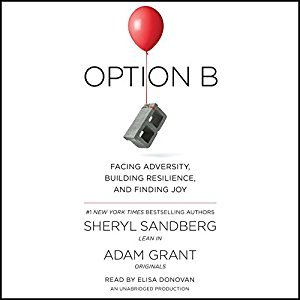
Option B: Facing Adversity, Building Resilience, and Finding Joy by Sheryl Sandberg and Adam Grant

I know of not one single person who could possibly gain nothing from reading or listening to this book to help themselves and/or to help them help someone else but really just to learn from two people who are sharing the wisdom of their joined experience and understanding of how to survive…the very toughest of things.

Adam Grant you may recognize from his other wisdom-filled books, Think Again, Originals, Give and Take, and more.

The most amusing reality is that I really did not know how much I needed to be reading–listening to–this book right now and exactly when I did. I grabbed the audiobook from Libby days ago and primarily because it was available right then. I like to listen to a book when I am walking alone, and I found myself with a couple of days of walking opportunity. And my filters (audiobook, non-fiction, available now) in Libby typically yield very few results, and then when I scan those few available to prefer one read by the author him/her/themself, often nothing remains. In this case I took the “other than author” reader for knowing a little bit about the authors previously and wanting to see what this one is all about.

Sheryl Sandberg’s husband, David Goldberg, died while they were on a vacation in Mexico with friends in 2015. He was formerly of Yahoo’s employ and then a lead at SurveyMonkey. Sandberg was previously with Google and then employed at Meta. Whether you know of them does not really matter. This book is about the most isolating and humanizing reality of suffering: grief. No matter the money or power or privilege one has, losing your husband and the father of your children and then having to face the future and with young children in a way that gives all of you, ever again, any kind of wholeness and hope does not take money. It takes time and thought and smarts and the development of strength.

This book is also not solely about “that” kind of grief: losing a spouse instantly. It is about facing any and all kinds of grief (and I’ve experienced quite enough lately and long-time and of a few varieties, myself) in a fresh way and with more objectivity and logic of, as well as wise counsel through, the process of recovery from it to then also be able to move toward building resilience and accepting joy when the future brings it.

It’s also about helping others…doing better by others and becoming better at knowing what to say and how to say it to be helpful in others’ journeys rather than isolating them even more, and instead by seeing them and meeting them where they are and “leaning in” (Sandberg’s earlier title and work is Lean In) rather than staying away to let them figure it out themselves…and appear to be entirely not helpful, even though you may think you’re doing the right thing in giving them space and time.

The most lasting and relevant-to-right-now idea conveyed, and one that only confirms that I had, in this most recent situation, done the right thing, is truly listening and hearing when young people ask for help, making it clear that you are trustworthy if/when they come to you. I smiled a teary smile while listening to that section–and then listened again–and then held that highlight button to return later–as without having read the book first for “how to” instruction, that is EXACTLY what I had just done. I had answered a students summons to ask for help. And I have no regrets about giving my all–and this substitute job, I guess–by absolutely and instantly agreeing to help someone who asked and who was being harassed and bullied.

I seriously gained so much valuable and extremely practical information from reading this well-written and accessible book. And in reading it I grew in my skills of seeing and assisting others going through tough things as well as helping myself through a few soul-frying varieties of grief. Everyone gains something–even if they are resistant to learning, to change, or don’t, themselves, have an innate growth mindset–from reading this one. It is very, very good!

Come back next Monday for another book review!

The Monday Book – Yellowface by R. F. Kuang

Guest review by Janelle Bailey, avid reader and always learning; sometimes substitute teaching, sometimes grandbabysitting, sometimes selling books

Yellowface by R. F. Kuang

Yellowface by R. F. Kuang

(My final read of 2023…my 111th read of the year…hit my 100-book goal for the first time, ever, and surpassed it.)

This book made for a fantastic finish, for all of the boxes it checked for me.

First, its sub-plot conveys all kinds of interesting information about the publishing industry, the work writers face to get books into print and then ears/hands/eyes, etc. I enjoyed reading this perspective, albeit all of it shared in fictional form. I suspect that there are grains–and possibly several–of truth in this story that are somewhat generally applicable to that “real life,” the writerly life in this day and age.

R.F. Kuang, herself, has produced not just one but two big–successful by many marks–books within a year’s time: Babel in August of 2022, and this novel, Yellowface in May of 2023. That’s impressive, by many measures. So I’m curious, for sure, about the possibility that, like Ayad Akhtar’s Homeland Elegies, Jason Mott’s Hell of a Book, Louise Erdrich’s The Sentence, this novel, too, may potentially be a bit of “auto-fiction,” where the line between autobiography and fiction is blurred…but even a good reader never knowing exactly where the clearly black and white, the gray, let alone where the boundaries are.

And what I learned before and from those other books is that it doesn’t matter. It places an interesting responsibility on the reader to confront themselves and their own fact/fiction…autofiction…person. If they were telling their own story, for instance, how much fact, how much fiction, would they convey? And do we even know the “facts” of our own lives? Or is our own “truth” the closest we can get for our skewed perspectives of our own stories, even?

However, in those other examples (Akhtar, Mott, Erdrich), there are more pointed similarities, such as a character with the same name as the author, or a “character” which is a book with the same title as the book itself, or the main character not only having the same name as but doing the exact work and living that the author, herself, does. Things are a little more clearly conveyed as auto-fiction in those books. But I do suspect that at least some of Yellowface addresses realities Kuang has faced. I don’t need to Google that; if it all helped me empathize with an author and her cause, purpose, plight, then I gained insight, and Kuang provided it, whether it’s “fact” or not.

Second, it is interesting to see this, let’s call it a “competition,” between these two characters, June Hayward and Athena Liu, Ivy Leaguers who learned early on in their coursework that they possibly both wanted to be writers but went about it slightly–to lots– differently and/or experienced different levels of success due not only to their writing but also the lengths to which they would go. Whether they are truly “friends,” given all of that, is debatable.

Additionally, the controversy of who (of any–any authors thinking about or pursuing a lead and then writing the story or book) gets to tell which story–to which the answer seems: truly, none, without criticism, unless it is your very own–is brought to light for consideration. And all of this interesting because perhaps even if it is your own story but someone else has a different angle on it or a different idea for how you not just could but “should” tell it–or sell it– they may just take you to task for that. And here we are not even–an iota–delving into the mess that is or could become the AI writing monster.

Ultimately, gosh: this is just good, solid, compellingly enjoyable writing and well-done storytelling, and thus extremely engaging reading. The characters are believable, the plot thickening all the while without feeling hokey or like it’s spinning out of control to just be a longer read. Everything about Kuang’s writing is stellar, solid, pleasing to this English major who still cares about so much of the language and…following its lost art of rules. Are there errors? Yep, a couple. Bummer, as it always is. Thankfully they are very few in number; I’m forgiving.

Writing these days is, it seems, not a super glamorous career. Talk to writers, and many are working their tails off–err, working off their tails. And it’s probably–like teaching, like being a police officer or medical professional, or working in customer service, etc., etc.–yet another career where so many critics are louder with their complaints than any affected are with their praise. Unfortunate, really.

But it didn’t convince me to quit aiming for that particular carrot, myself. And R. F. Kuang has me hooked on her writing, so there you go. I leave Yellowface inspired by all of the good stuff, not really deterred or disappointed or anything of the kind. I still share some big dreams with the main characters, dreams of making it–even just a little bit–in that writing business.

As is so often the case when I’ve finished a good book, I’m eager to discuss this one with anyone else who has read it. If that’s you, let me know when we can go for a walk, meet for a beverage, and/or schedule a virtual visit if that’s as near as we are to one another. There’s plenty of material, for sure.

Come back next Monday for another book review!