
OK, now that the Facebook questions are covered (see previous blog post) let’s talk about how much fun it was to travel with the Wayfaring Writers to Oaxaca, Mexico.
Lots of fun. A few weirdnesses, and lots fun.
Oaxaca is the “mildly undiscovered” part of Mexico way down south, and about 2.5 hours by car inland from the beach. In other words, it has US citizens and Canadians living in it, but not like some of the other parts. Oaxaca is a city of more than a million people, and it’s vibrant with multiple cultures, including the indigenous Zapotecs.
Rather than do a trip chronology, let’s just hit some of the fun points, like YARN!!!!
The Wayfaring Writers is structured so you have perhaps three short classes/discussions on topics like characterization, scene depiction, or writing dialogue, and over the course of the 10 days of the trip, you alternate writing days with outing days. One of our outings was to a traditional weaving family’s business.
I had been waiting for this one. It is easy to buy acrylic yarn in Mexico that’s made in Mexico, but the good stuff, well that’s more tucked away. Not least because the country has got to be hard on sheep; in the non-rainy season the place has that grey-green cooked look we get in the mountains when it’s too dry, and what are wooly little sheep going to do in a pasture where 45 degrees is dead cold winter, with the shepherd bundled into a North Face jacket?
But they do have sheep, mostly in the colder regions of the mountains. I never met any sheep personally, but the family at the weaving firm told us about them. The family spoke Zapotec, but they were used to tour groups and could switch to Spanish so our guide, Alberto, could translate for us.
First they showed us how to card and spin the wool.This used the same things people in traditional wool work use in the United States, including what we would call a “great” wheel or a traditional American spinning wheel.
Her yarn was amazingly even for handspun, and when I said as much she grinned and said she had been spinning since she was five.
Then the color glories began, and as a dabbling herbalist and an avid yarnist, this was the best part:
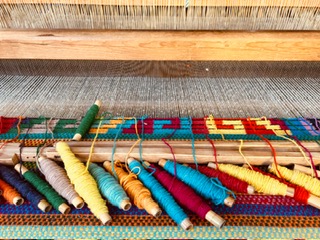
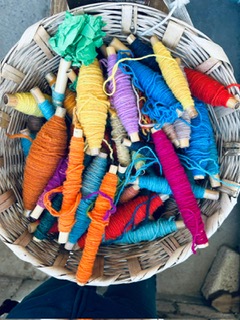
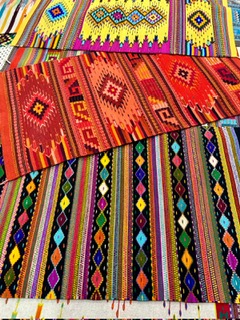

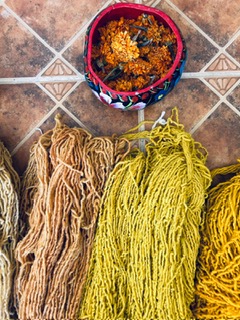
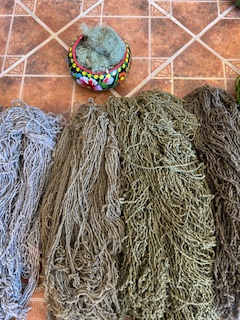
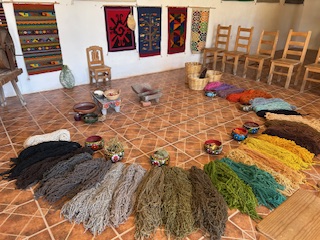
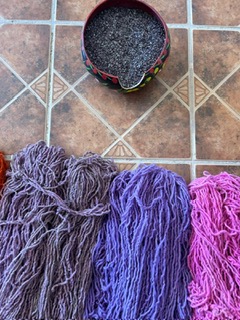
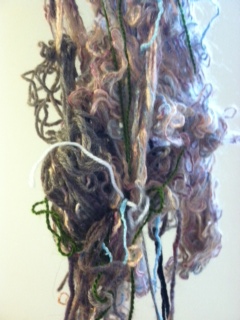
In one of the pictures above, with the green yarn, you can see they used usnea to dye it. (That’s what’s in the bowl.) Other dyes were made from cactus bugs, cacti mold, flowers, nut shells, a few indigenous plants, and sometimes indigo. Red and turquoise yarns cost more because of the dying process. And the natural colors of the sheep, pale and dark brown, were cheaper. You can see what I wound up clutching.

The rugs were amazing, and basically on a good day of 8-10 hours of work on a fairly complex pattern, a weaver would get between 6 and 8 inches done. The colors sang in the room where they were stacked, and we all went a little bit nuts deciding which things to take home. Some budgets were broken that day, but nobody cared.
The family gave us lunch, and the requisite Mezcal. (We will talk more about this later, but Mezcal is to Oaxacan hospitality what coffee is to the States. You’re really not leaving without being offered a sip at least six times.) Guacamole in Oaxaca is made with grasshopppers in it, and once you reconcile to this fact, you’re going to like it. That stuff is delicious.
The day we visited the weaving family was referred to by the rest of the Wayfaring Writers as “Wendy’s Happy Day.” And it was. More adventures later, gotta go crochet a rug now. :]


 Wendy Welch: Books, Yarn, Cats, Opioids