The Toilets of Japan

Japan is famed for its toilets. Shop windows that sell these proofs of superior culture even have little signs up in English: Sorry, we don’t ship internationally.

Because when you visit Japan, you will begin to think about installing one of these bowels and whistles machines when you get back home, trust me.
Welcome to Japan

It starts in a cold airport arrival, jetlagged and confused. You stop at a toilet on the way to customs, and –what’s this? The seat is HEATED?!

Lust begins there and will build through the rest of your trip. As you sit doing what is necessary, woozy from plane sleep and international travel, music begins. Or the sounds of a soft flowing waterfall.

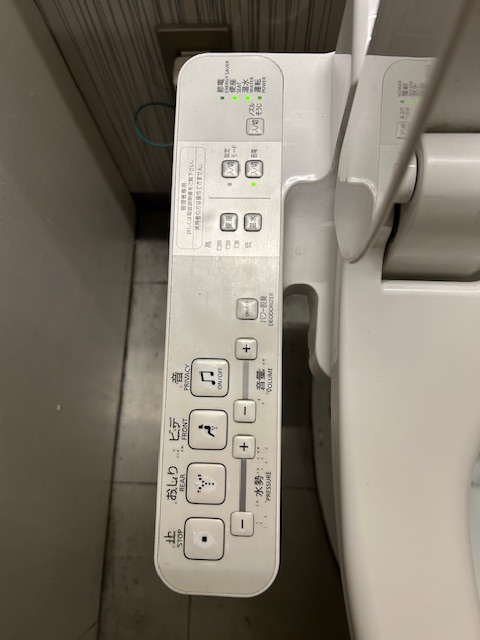
Japanese toilets have sensors. If you, ehm, drop a load, they start covering the activity with pleasant noises. There’s a button on the toilet marked “privacy” should you choose to work manually knowing you will deliver a physical payload.

Amidst the same row of buttons you will find something that looks like a woman sitting on a geyser. That’s for cleaning up after the payload. Another button is marked “shower” and that’s for general cleanliness. The geyser button is targeted to crevice clean. And baby, it leaves no corner unexamined.
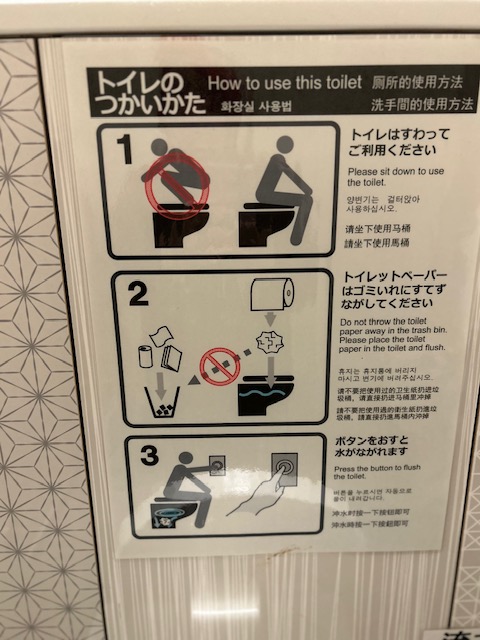
Instruction manual

Which is essential, because Japanese toilet paper is thinner than the alibis of a cheating spouse. That stuff won’t take crap from anyone. You need to learn to use the geyser; the faster you accept this and move on, the faster the person pounding on your stall door can get in. Because you’ve probably fallen asleep in this comfy stall, equipped with its own sink for hand sanitizing, the aforementioned heated seat, and those soothing sounds–plus a baby seat for moms. Plunk your kid down, then plunk yourself down.

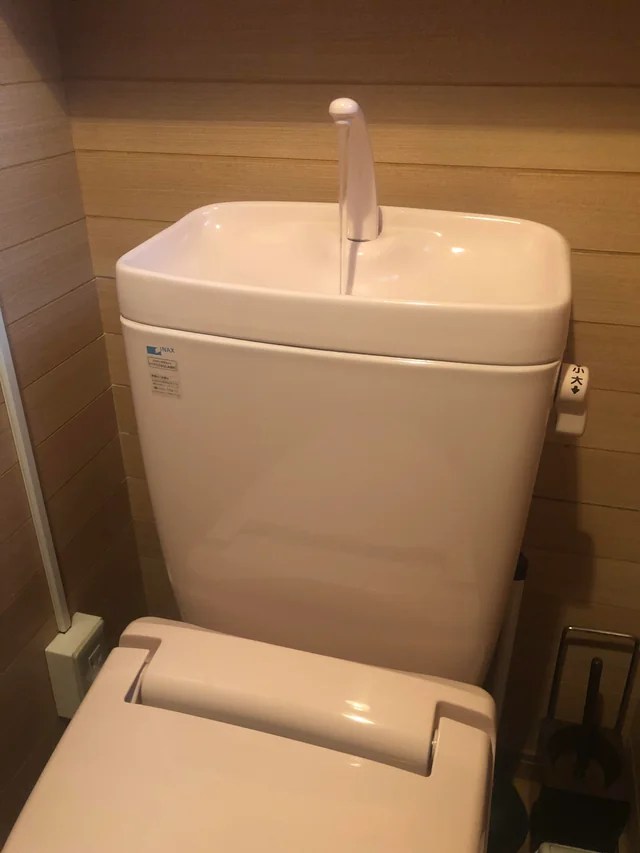
Those sinks are amazing things. Sometimes the spigot is atop the tank of the toilet, because the water refilling the toilet tanks pumps clean. This freaks visitors out at first: it feels so unsanitary! Which is what the Japanese people are thinking about the foreigners: why won’t they use the provided sinks; what have they got against handwashing?!
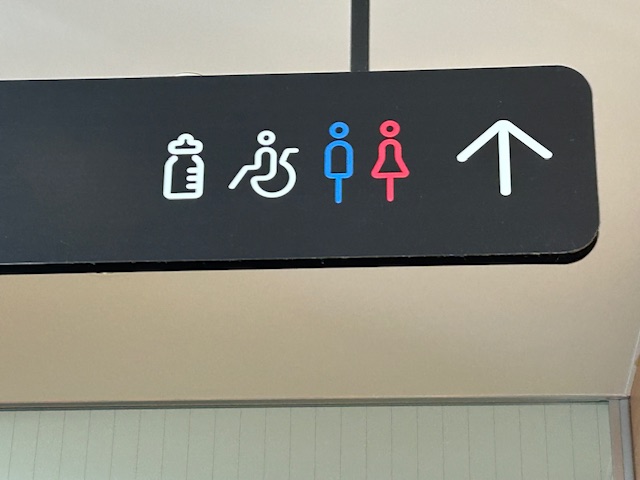
Simple enough: gender neutral toilets use all the symbols
I beg your pardon?!

Amidst these high tech rows of buttons and lights and sink choices, one will find squatter toilets. India has a high population presence in Japan, and when you walk into a public restroom, at least one “stoop and sluice” squatter toilet offers no bells, no whistles, just a handle to put water into the hole instead of a bucket. The hole is toilet shaped and porcelain lined, but squatters is squatters and you can tell who drew the losing straw in the toilet line by the faces of the women waiting, who realize they are going into the squatter. Sometimes women offer the next person in line their spot at these. If an Indian woman is in line, she’s going to be offered a pass to the head.

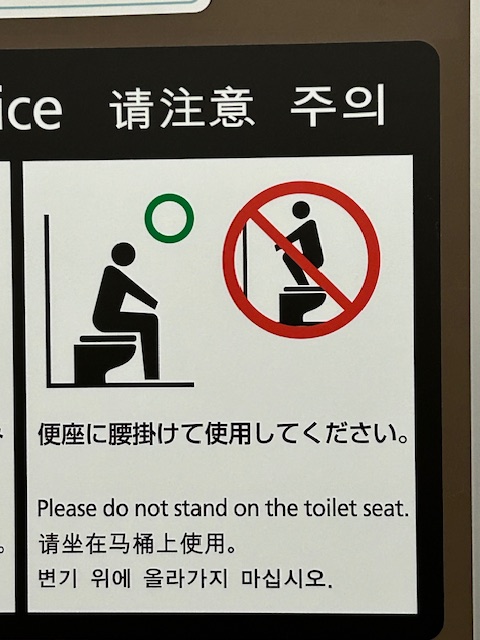
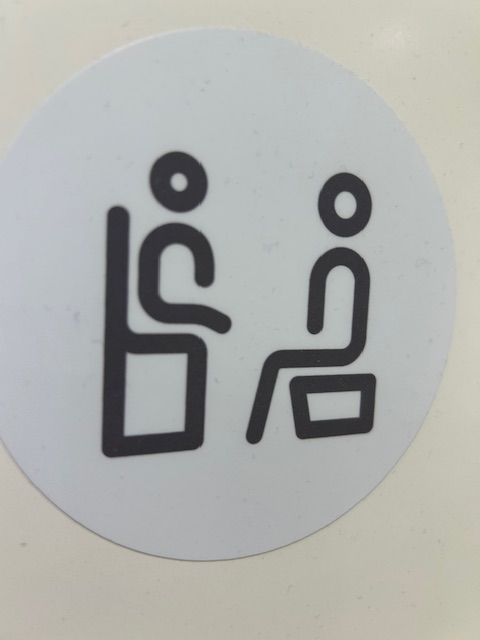
Then there are the signs. One says please don’t stand on the toilet seats in English, Gujarat, and Japanese. Most are pictographs, and can be open to interpretation. I never did figure out what two people facing each other meant. “This toilet available for meetings?”

Overall though, it’s not hard to be a proper toilet visitor, once you master a few simple rules:
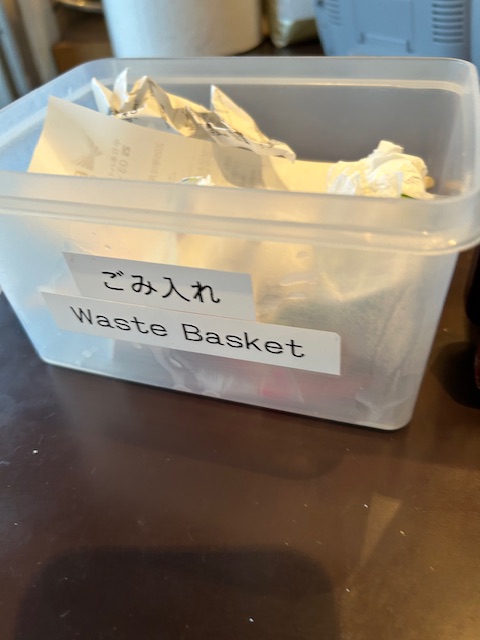
Yes, that is a small Tupperware box
  1. Use the water features to clean and the toilet paper to dry, or you’re going to regret it. Wash your hands in whatever sink the stall provides.
  2. Do not throw trash away in the sanitary pad disposal. Trash is a whole thing in Japan; no public trash cans, and signs everywhere saying “If you didn’t buy it here, don’t throw it away here.” Pack a trash bag with you.
  3. Carry a drying towel. Per this reduce trash rule, Japan does not provide paper towels in for drying hands, and often doesn’t have air blowers either. Pack a small washcloth with you, or buy one as souvenir. These are sold everywhere with every possible character and design on them, because the locals are carrying them as part of their daily lives.
  4. Put the toilet seat down after flushing. (I once had an attendant stop me as I was leaving, check the stall, then beam at me. She hadn’t expected me to know to put the seat down. This elderly woman literally patted my hand as she indicated I could go–and with her blessing.)
  5. And whatever you do, don’t make a scatological noise without the noisemaker on. Do yourself a favor and start it when you sit down. As the waterfall and birdsong floats into your ears, and the heat of the seat works its way into what is often the fleshiest part of female anatomy, relax and enjoy it. They’re not called rest rooms without good reason.
Japan: The Day we got Mugged

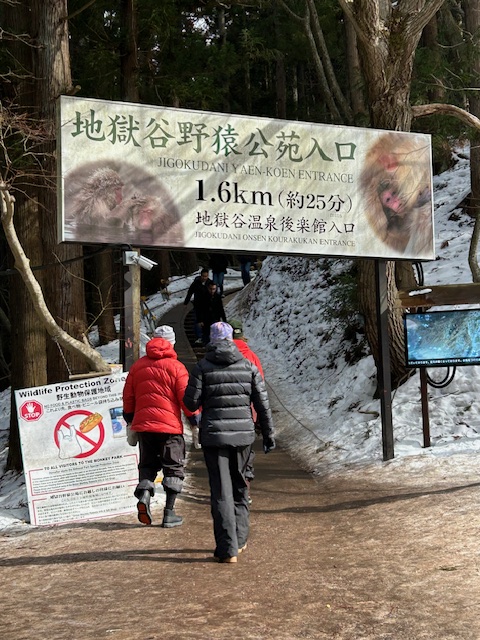
Tokyo is the safest city in the world. The Jigokudani monkey park, not so much. International tourists come from all over the world, and once they realize that from Nagaro station you have to get a specific and highly-sought-after bus, and once you get off that bus it’s a 2 mile walk straight up an incline, they get pissy. You’re going to hear a lot of swear words in a multiplicity of languages and people stop moving aside on the path.

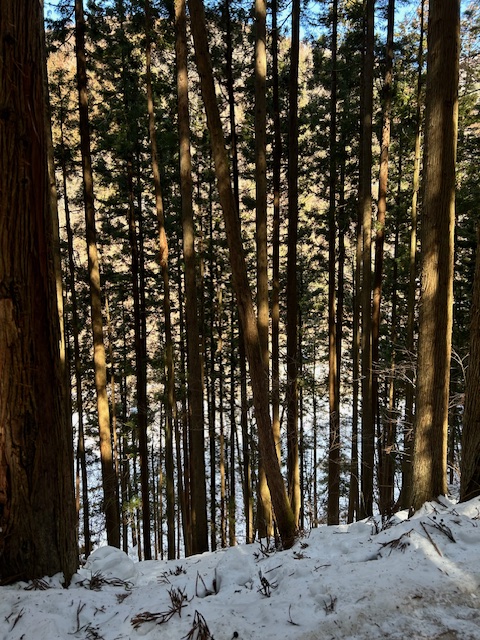
Especially in winter, because that path is covered in snow and ice. Sweetest thing we saw on the path was a tall elderly man and his short wife, looking and speaking Nordic. The tiny handrail on the turning slope didn’t reach this guy’s knees, but he was trying to use it because they were both clearly terrified.

Below them a group of Middle-Eastern-looking men spoke to each other, turned, and two of them went back up that treacherous slope and said one English word: Sir. And each held out a hand to him.

They got him down. We got up, although we had a bad moment when we thought we were going to have to carry our entire luggage up the whole way. Turns out you can pay to leave luggage at the information booth, but the little girl working there was not forthcoming with this info. It is hard to tell ages on face types one doesn’t see everyday, but I put her below 15 for sure. And bored out of her mind. But she saved our lives when she agreed to watch our bags for 500 yen.

Up we went, and as we ascended I looked at the faces of those descending. They looked happy.

“We’re gonna see monkeys,” I said to Amelia.

She half-grunted, half-gasped. We were on a steep part.

Like the giant Buddha, the monkeys were on Amelia’s bucket list, and halfway up the vertical two miles, I believe she may have been regretting some life choices. But there we were.

In the snow and ice I kept seeing tiny yellow circles. I am one of those weirdos who picks things up, but not until I’m sure what they are. At the bottom of the hill, a bunch of Romanians were selling crampons, plastic tie-ins to cover tennis shoes and let you dig into the snow. The little yellow circles were the tops of the embedded studs from those high-quality products we had decided not to buy.

We saw our first monkey even before we got to the park. We saw our second monkey 12 seconds later.

“No matter what, Amelia, we did it! We saw monkeys!” I shouted in jubilation.

“Ufffmopht,” Amelia said, gripping the hand rail. We were at the top.

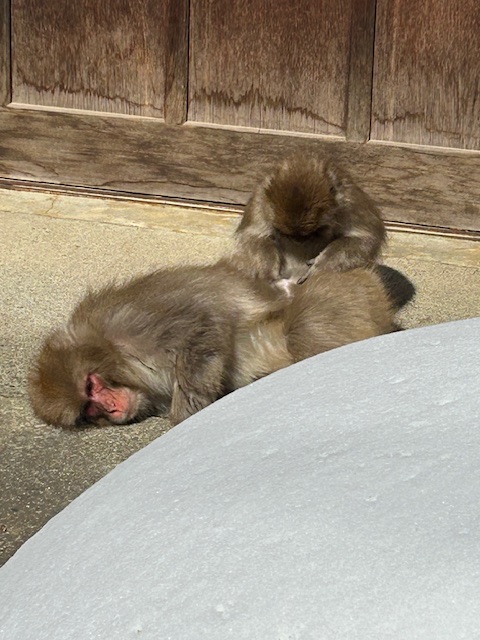
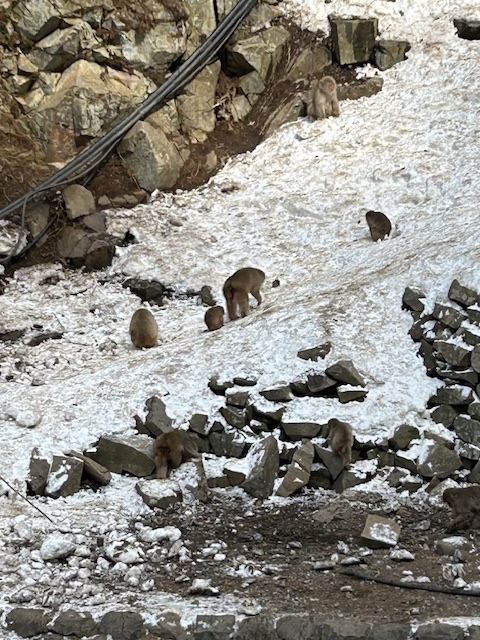
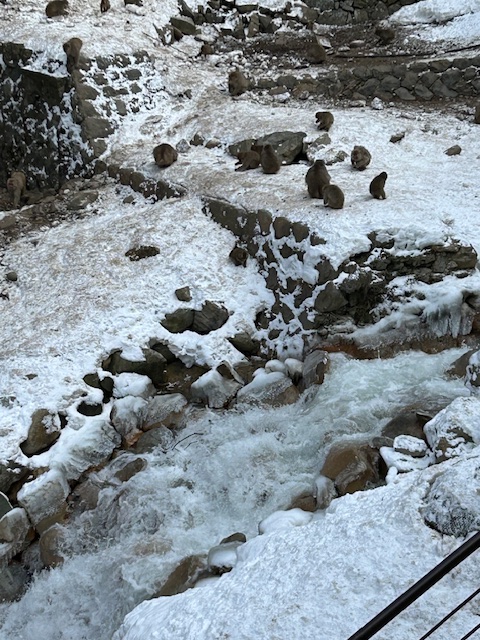
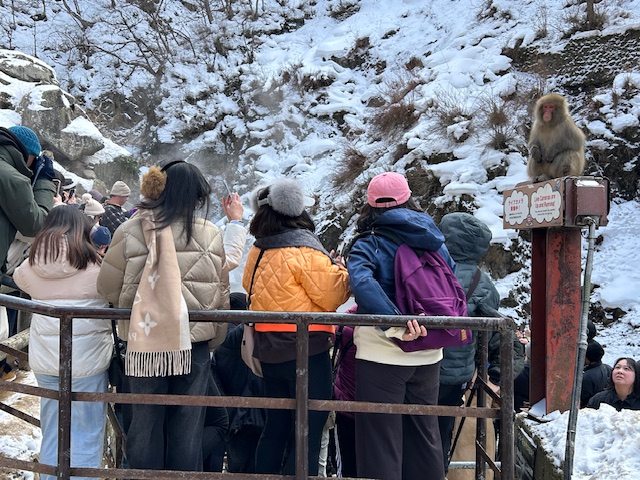
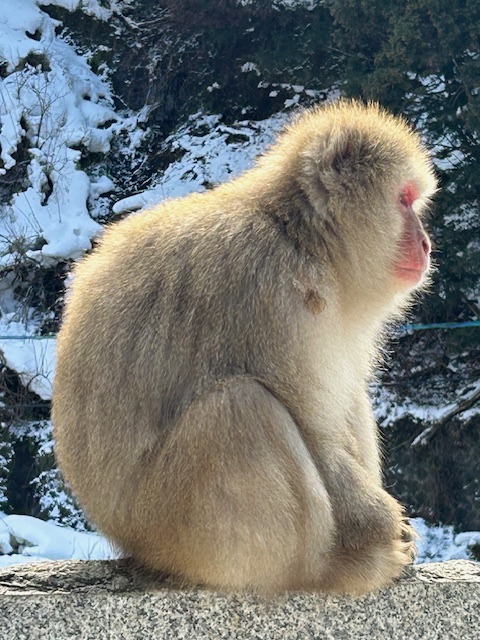
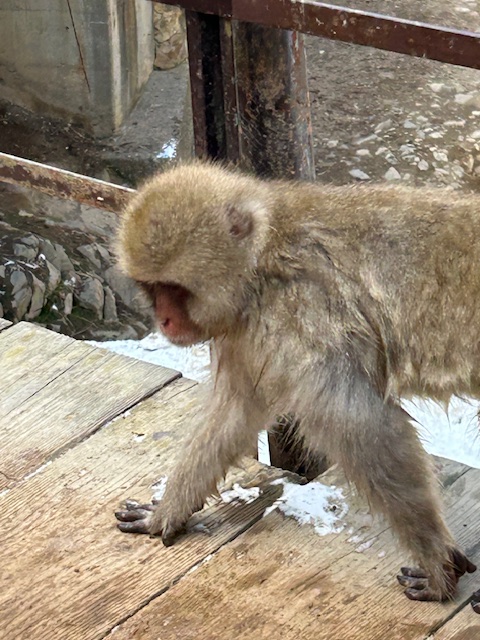
We saw monkeys. Big grandfather monkeys, teenage monkeys, baby monkeys, mama monkeys with babies on their backs. There were roughly three people for every monkey, and some of them had massive camera lenses. I got tired of taking photos of monkeys sitting under these lenses while people trained them on far off slopes. I laughed at one guy who was photographing a monkey sitting coquettishly on a stone in the hot steam of the spring, while next to him another monkey touched the pompom on his hat. Turning from this scene, I nearly tripped on a monkey crossing the bridge behind me.

“Sorry,” I muttered, but that little guy only spoke Japanese.

We had our fill over an hour and a half. Monkeys are cool. Monkeys are cute. They came running when a staff member went out with a bucket of treats and attracted them to the hot spring where 400 photographers waited. It was like watching the cows come in.

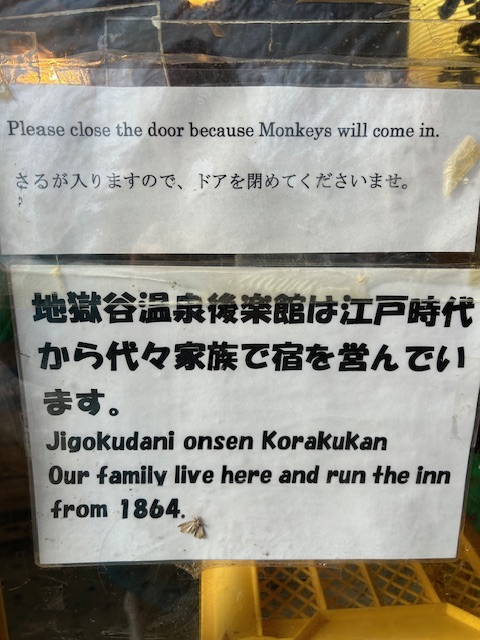
Amelia and I decided not to go to the human onsen there. Sharing human water is one thing, but with monkeys is another. We stopped at an inn where a kindly elderly man would make us hot cocoa for 500 yen. The sign said his family had been running the place for 9 generations.

We stepped across the breezeway, took off our shoes, and sat down in the scenic dining room hanging off the back of the mountain. I got out the apples, cheese, and crackers we had brought for lunch, and Amelia said, “I think we have to go back across to get the cocoa.”
Popping on my shoes, I crossed the breezeway and the kindly man said “No no I bring.”

At the entryway, I took off my shoes, slid the door open and closed–and it flew out of my hand.

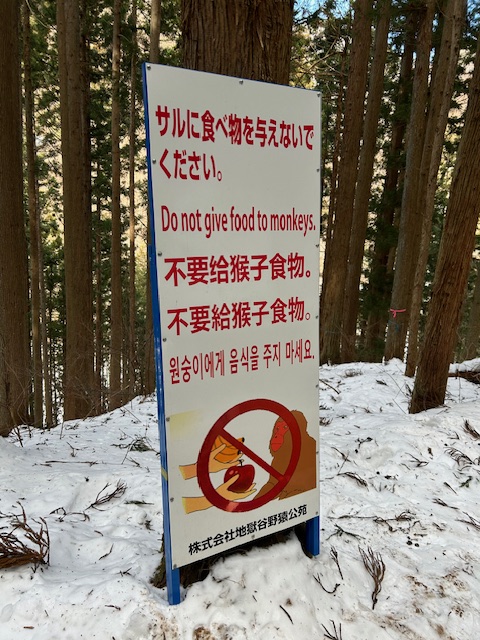
A rather portly monkey entered. Astonished I turned and blocked her way toward our table. We made eye contact, something all the signs tell you not to do. I said, in my most reasonable storyteller talking to kindergartners voice, “You need to leave now.” The monkey looked me in the eye. I stomped my foot, and the monkey cocked her head at me. The thought bubble above her head said, “Nuisance, not threat.”

The thought bubble above my head was just forming, in the shape of a headline: first stupid tourist death reported at monkey park in showdown over table space at local diner.

The monkey sidestepped me with casual disdain and headed for Amelia, who had been filming me coming in but dropped her phone when she saw the monkey. I have a picture seared in my mind of Amelia, recoiling backwards against the dining room windows, as the monkey reached our table in two mighty bounds, sat down atop it, and picked up a package of crackers.

I reached the table in three steps. “Those are plastic! You’ll hurt yourself!” I said to the monkey, reaching for the crackers.

She smacked me. Like a mother might do a fractious toddler. Not harm, not intent to be mean, just “stop that.” Then she picked up one of our apples and bit into it, picked the other one up in her hand, and with this bounty exited the room in three leaps.

I felt a pang of loss. They had been very good apples and I only got one bite. From the only other family in the room, a woman in pink hijab said, in a tone I didn’t consider entirely friendly, “That’s why they tell you to close the door.”

I glared at her. She had a toddler smaller than the monkey, so likely she was in full tiger mama mode, but I swallowed my retort: They don’t tell you the part where monkeys rip them out of your hands, madam. Those little bastards are strong.

Amelia and I made do with cheese and the remaining crackers, plus the delicious cocoa the man brought a moment later. When we exited the inn, that same monkey was sitting outside, looking as if butter wouldn’t melt in her mouth. Just waiting.

I like to picture her entering her home with the apples: Get out the fruit knives, Bert! Lunch is ready!

Alternatively, she went straight round the back to the kitchen of the inn, where the kindly old man gave her 200 yen for the apples and put dumplings on the menu.

We inched our way downhill. The only thing worse than uphill ice is downhill ice. We slid on one slope but never fell. At the bottom that same bored child was watching the shop full of monkey trinkets and the tourists with equal disdain.

That’s her, officer. What do you mean, she has immunity?
You don’t say…

On impulse, I typed into google translate: Thank you. We had a lovely day and would not have made it if we had to carry our luggage. You probably have souvenir money from America, but if not, would you like some?

She stared at the phone, then her eyes lit up as she looked at me. Honestly, I don’t think it was the offer of an American dollar. It was that someone saw her.

She brought my bags, I gave her the dollar, explained it was roughly 100 yen (more like 150 but I can’t say 150 in Japanese) and she literally squealed as she beamed. As people looked around–maybe seeing her for the first time–she tucked it into her pocket. We bowed to each other, Amelia got her son a t-shirt, and off we went, replete with adventure.

I hadn’t seen the thieving monkey lurking by the door, but I had seen the bored teen who just needed a boost. And if you are robbed, remember: give something away afterward and you will feel better.

Never forget the journey can be as beautiful as the destination. Even on a scary slope.